Choosing between a permissioned and a permissionless network is the most consequential architectural decision a blockchain team makes. It dictates who can verify transactions, how quickly data settles, what regulatory frameworks apply, and whether the system survives a coordinated attack.
While public cryptocurrencies popularized open networks where anyone can participate, banks, supply chain operators, and healthcare systems often require strict access gates. Understanding how these two models operate—and where each breaks down—prevents costly rebuilds down the line.
Core Mechanics of Open and Restricted Ledgers
At a technical level, both network types rely on cryptographic hashing and distributed ledgers to record data sequentially. The divergence lies in governance and participation rights.
How Permissionless Networks Operate
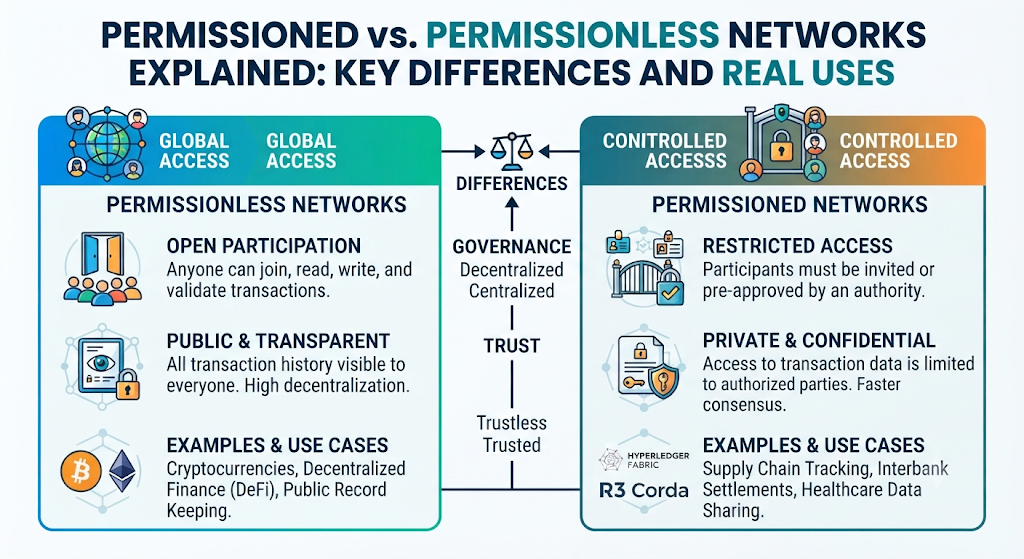
A permissionless network is an open-access system. Anyone with an internet connection and compatible hardware can download the software, run a node, submit transactions, or participate in block validation without asking for approval. Bitcoin and Ethereum are the primary examples.
Because participants are anonymous or pseudonymous and cannot be inherently trusted, permissionless networks rely on cryptoeconomic incentives and heavy consensus mechanisms like Proof of Work (PoW) or Proof of Stake (PoS). Validators lock up capital or expend computational energy to earn block rewards, making malicious behavior financially self-destructive.
How Permissioned Networks Operate
A permissioned network restricts participation to vetted, known entities. A central authority, consortium, or governance board manages an access control layer—often using public-key infrastructure (PKI) certificates—to determine who can read the ledger, submit transactions, or validate blocks. Hyperledger Fabric, R3 Corda, and Quorum follow this architecture.
Because every node operator has a verified real-world identity and legal accountability, the network does not need energy-intensive mining or massive token staking to prevent Sybil attacks. Instead, these systems use faster, deterministic consensus algorithms such as Raft or Practical Byzantine Fault Tolerance (PBFT).
Side-by-Side Architectural Comparison
| Feature | Permissionless Networks | Permissioned Networks |
| Access & Onboarding | Open to anyone globally without approval | Restricted to pre-approved, verified participants |
| Participant Identity | Anonymous or pseudonymous | Known identities tied to legal entities |
| Consensus Mechanisms | Proof of Work (PoW), Proof of Stake (PoS) | PBFT, Raft, Proof of Authority (PoA) |
| Transaction Throughput | Lower on base layers due to global synchronization | High; fewer nodes mean faster block finality |
| Data Privacy | Transparent; all transactions are publicly auditable | Configurable; supports private channels and encryption |
| Governance & Upgrades | Decentralized via community proposals and node signaling | Centralized or consortium-led via formal agreements |
| Censorship Resistance | Very high; no single entity can block valid transactions | Low to moderate; administrators can revoke access |
Trade-Offs That Define Network Performance
Selecting a network model involves balancing three competing priorities: decentralization, speed, and confidentiality.
- Throughput and Finality: Permissionless networks must broadcast transactions across thousands of global nodes, creating latency. Even with modern scaling solutions, base-layer finality takes seconds to minutes. Permissioned ledgers often run across dozens of high-bandwidth enterprise servers, achieving near-instant finality and thousands of transactions per second.
- Privacy vs. Auditability: On a public ledger, anyone can inspect wallet balances and smart contract interactions. For retail users, this guarantees transparency. For corporations, exposing supplier pricing, payroll, or patient records on a public chain is a non-starter. Permissioned architectures allow administrators to restrict ledger visibility strictly to the parties involved in a specific transaction.
- Immutability and Reversibility: Once a transaction settles on a major permissionless chain, reversing it is practically impossible without an extraordinary network-wide consensus event. In a permissioned environment, consortium members can legally and technically agree to roll back erroneous transactions or freeze compromised accounts to comply with court orders.
Scenarios Where Permissionless Networks Excel
An open network is the right fit when trust cannot be assumed among participants and neutrality is non-negotiable.
- Decentralized Finance (DeFi) and Open Markets: Lending protocols, decentralized exchanges, and stablecoins require global, 24/7 liquidity without gatekeepers deciding who is allowed to open an account.
- Censorship-Resistant Value Transfer: Cross-border payments and remittances benefit from networks where no single government or intermediary can unilaterally freeze funds or block settlement.
- Public Digital Identity and Credentials: When universities, certification bodies, or creators issue verifiable credentials, hosting them on a permissionless ledger ensures anyone can verify authenticity decades later without relying on a private company’s servers staying online.
- Tokenized Digital Assets and Collectibles: Assets designed for secondary trading across global marketplaces need open standards and composable smart contracts that anyone can integrate.
Scenarios Where Permissioned Networks Fit Best
A restricted ledger makes sense when multiple organizations need a shared source of truth without exposing proprietary data to the public.
- Interbank Settlement and Trade Finance: Banks clearing cross-border letters of credit or syndicated loans must comply with strict Know Your Customer (KYC) and Anti-Money Laundering (AML) laws. A permissioned consortium ensures only licensed financial institutions validate transactions.
- Pharmaceutical and Food Supply Chains: Manufacturers, logistics providers, and retailers need to track batch provenance to isolate recalls quickly. Permissioned channels let competitors share shipping milestones without revealing sensitive wholesale pricing to rival vendors.
- Healthcare Data Exchange: Hospitals, insurers, and laboratories use permissioned frameworks to verify patient consent and share diagnostic records while complying with data protection statutes like HIPAA or GDPR.
- Internal Enterprise Auditing: Large conglomerates with dozens of regional subsidiaries use private ledgers to automate intercompany reconciliation and maintain tamper-evident audit trails for external regulators.
Hybrid Architectures: Bridging the Gap
Many modern deployments avoid a strict binary choice by combining elements of both models.
Public-Permissioned Networks allow anyone to read the ledger and verify data, while restricting block validation to a known council of organizations. This works well for public supply chain tracking or government registries where citizens need transparency, but Sybil resistance requires vetted validators.
Layer-2 Rollups and App-Chains also blend these boundaries. An enterprise might run a private execution environment for speed and confidentiality, then periodically anchor cryptographic state roots onto a public permissionless blockchain. This approach gives the business operational privacy while borrowing the public chain’s security and tamper resistance.
Frequently Asked Questions
Can a permissioned blockchain be hacked or altered?
Yes, though the attack vectors differ from public chains. Because permissioned networks rely on a smaller set of known validators, compromising a majority of those specific servers—or corrupting the central administrator’s certificate authority—can allow attackers to alter records or halt the network. Security depends heavily on traditional cybersecurity and legal contracts among consortium members.
Why don’t enterprises just use a traditional cloud database instead of a permissioned blockchain?
A standard database works fine when one organization controls all the data. A permissioned blockchain becomes useful when multiple independent organizations need to share and update records without handing total administrative control to a single company or paying a third-party middleman to reconcile conflicting databases.
Do permissionless networks always require native cryptocurrencies?
Almost always. Without a native token, a permissionless network has no built-in mechanism to pay validators for their hardware and electricity costs, nor any way to charge transaction fees that prevent attackers from flooding the network with spam.
Which model is better for regulatory compliance?
Permissioned networks align more easily with existing financial and data privacy regulations because node operators are identifiable, access can be revoked, and personal data can be kept off-chain or restricted to authorized viewers. Permissionless networks require specialized compliance layers, such as zero-knowledge proofs or whitelisted smart contract pools, to meet institutional standards.
Making the Architectural Call
The choice between permissioned and permissionless networks comes down to where trust lives. If your system relies on legal accountability, known business partnerships, and strict data confidentiality, a permissioned ledger delivers the speed and compliance controls required. If your goal is open global access, neutral settlement, and resilience against any single point of control, a permissionless network is the only architecture built to handle it.