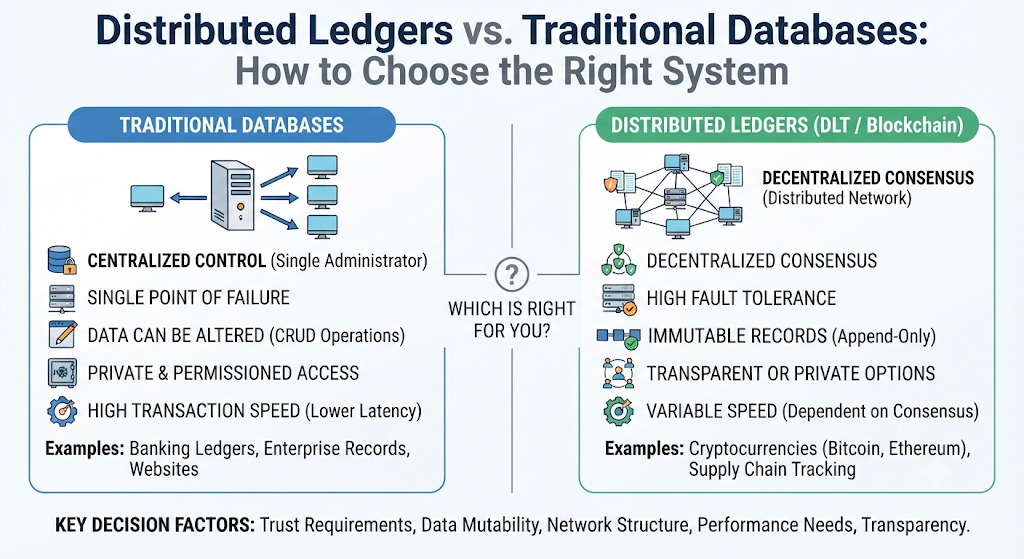
When organizations design modern software systems, choosing where and how data lives is one of the earliest architectural decisions. For decades, traditional databases—like PostgreSQL, MySQL, Oracle, and MongoDB—have powered almost every business application on the planet. Over the past decade, however, distributed ledger technology (DLT) has emerged as an alternative way to store and synchronize records across independent participants.
Because both technologies store digital records, people often confuse them or treat distributed ledgers as automatic upgrades over standard databases. In reality, they solve completely different problems. Understanding the trade-offs between distributed ledgers and traditional databases prevents expensive engineering mistakes and helps builders, investors, and decision-makers separate genuine utility from unnecessary complexity.
Core Architectural Differences: Central Control vs. Shared Consensus
A traditional database relies on a client-server model governed by a single administrator or organization. Even when a traditional database is replicated across multiple cloud regions for backup or speed, one entity ultimately owns the master permissions, controls who can read or write data, and manages schema updates. Users trust the database owner not to alter records unfairly or shut down access.
A distributed ledger removes the need for a single central authority. Instead of keeping one master copy in a private data center, the ledger is replicated across a network of independent computers called nodes. Before any new entry is added, those nodes must follow a shared agreement rule—known as a consensus mechanism—to verify that the transaction is valid. Once accepted, every node updates its own copy simultaneously, ensuring all participants look at the exact same record without relying on a middleman.
How Data Is Handled: CRUD Operations vs. Append-Only Records
The way each system treats stored information marks another major divide.
Traditional databases run on CRUD operations:
- Create new entries
- Read existing records
- Update fields when details change
- Delete outdated or erroneous information
This flexibility makes traditional databases ideal for everyday business software. If a customer changes their shipping address or an employee corrects a typo in an invoice, an administrator can overwrite the old field in milliseconds.
Distributed ledgers, by contrast, are built as append-only logs. Once a record is validated and cryptographically linked to previous entries, it cannot be silently edited or erased. If a mistake occurs, you cannot go back and delete the original line; instead, you must submit a brand-new compensating transaction that cancels out or corrects the error. Both the mistake and the correction stay visible in the permanent audit trail.
Side-by-Side Technical Comparison
| Evaluation Factor | Traditional Database | Distributed Ledger (DLT) |
|---|---|---|
| Ownership & Governance | Controlled by a single company, administrator, or consortium. | Shared across independent nodes; no single entity has unilateral control. |
| Data Modification | Supports full CRUD (Create, Read, Update, Delete). | Append-only; historical records are tamper-evident and immutable. |
| Transaction Speed | High throughput; processes tens of thousands of operations per second. | Lower throughput; every node must validate and synchronize updates. |
| Trust Model | Requires trusting the central operator and their security controls. | Replaces institutional trust with cryptographic proof and network consensus. |
| Privacy & Compliance | Easy to restrict access and permanently erase data under privacy laws. | High transparency; deleting personal records on public ledgers is difficult. |
| Infrastructure Cost | Predictable cloud or server hosting costs scaled to one organization. | Higher collective compute and storage overhead across redundant nodes. |
Performance, Cost, and Scalability Trade-Offs
Speed is where traditional databases hold an overwhelming advantage. Because a single server cluster does not have to ask hundreds or thousands of independent peers for permission before writing a row of data, latency stays near zero. High-frequency financial trading engines, e-commerce checkouts, and social media feeds depend on this raw throughput.
Distributed ledgers intentionally trade raw speed for resilience and verification. Broadcasting transactions across a peer-to-peer network, verifying cryptographic signatures, and reaching consensus take time. While modern Layer 1 networks and permissioned enterprise ledgers have dramatically improved confirmation times, they still carry higher computational overhead per transaction than a centralized SQL server.
Storage costs also behave differently. In a traditional setup, storing one gigabyte of data costs pennies on standard cloud hardware. On a public distributed ledger, that same gigabyte must be stored and verified by every full node in the network, making on-chain storage expensive and unsuitable for large media files, raw video, or heavy analytics datasets.
Real-World Scenarios: Choosing the Right Tool
Selecting between these two architectures becomes straightforward when you look at who owns the data and whether the participants trust one another.
When a Traditional Database Is the Better Choice
- Internal Company Operations: Payroll systems, employee directories, inventory tracking inside a single warehouse, and customer relationship management (CRM) tools belong in traditional databases. One company owns the data, and speed matters far more than external verification.
- High-Volume, Low-Latency Apps: Video streaming platforms, gaming leaderboards, and real-time analytics dashboards require rapid reads and writes that distributed consensus would slow down.
- Strict Data Deletion Requirements: Applications handling sensitive personal records under regulations like Europe’s GDPR must be able to permanently erase user profiles upon request—a task standard databases handle easily.
When a Distributed Ledger Makes Practical Sense
- Cross-Border Settlement and Digital Assets: Moving value between parties who do not share a single bank or clearinghouse benefits from a neutral, shared ledger that settles transactions without multi-day reconciliation delays.
- Multi-Party Supply Chains: When manufacturers, shipping carriers, customs brokers, and retailers all update the status of goods, keeping separate private databases creates constant discrepancies. A shared ledger gives every party a single, verifiable timeline.
- Tamper-Evident Audit Trails: Academic credentials, property title registries, and verifiable carbon credits gain credibility when independent verifiers can check their authenticity without calling a central office.
Hybrid Architectures: How Modern Systems Combine Both
In production environments, engineering teams rarely treat this choice as an all-or-nothing battle. Most practical Web3 and enterprise blockchain applications use a hybrid architecture that pairs both technologies together.
In a hybrid setup, a traditional database handles user profiles, interface caching, search indexing, and large files off-chain for instant performance. Meanwhile, the distributed ledger acts as a settlement and verification layer—recording cryptographic hashes, ownership transfers, or final balances on-chain. This approach keeps user experiences fast while preserving an auditable, tamper-resistant record where trust actually matters.
Frequently Asked Questions
Is a blockchain the exact same thing as a distributed ledger?
No. A distributed ledger is the broader category of shared, synchronized databases spread across multiple locations. A blockchain is one specific type of distributed ledger that groups transactions into chronological blocks linked together with cryptographic hashes. Other distributed ledgers, such as Directed Acyclic Graphs (DAGs), organize records without using traditional blocks.
Can a distributed ledger replace SQL or NoSQL databases?
Not for general-purpose computing. Distributed ledgers are not designed to run complex relational queries, store large files, or support rapid data deletion. They complement traditional SQL and NoSQL databases rather than replacing them.
Are distributed ledgers completely immune to hacking?
No technology is 100% immune to security failures. While an append-only ledger makes altering confirmed history extremely difficult, attackers can still target poorly written smart contracts, compromised private keys, or weak endpoint security.
What is the difference between a permissioned ledger and a private database?
A private database is controlled by a single organization. A permissioned distributed ledger is shared among several distinct organizations—such as a group of banks or logistics partners—where access is restricted to approved participants, yet no single member can unilaterally rewrite the shared history.
Why are distributed ledgers slower than centralized databases?
Centralized databases only need to write data to one primary system. Distributed ledgers must broadcast transactions across a network, validate signatures, and wait for independent nodes to reach consensus before finalizing an entry, which adds network latency.
Key Takeaway for Builders and Decision-Makers
Choosing between a distributed ledger and a traditional database comes down to one practical question: Does a single trusted party manage the data, or do multiple independent parties need to verify a shared truth without trusting one another? If one organization controls the environment and needs high speed, flexible edits, and low storage costs, a traditional database remains the clearest engineering choice. When multiple stakeholders require transparent, tamper-evident records across organizational boundaries, a distributed ledger provides guarantees that standard databases simply cannot match.