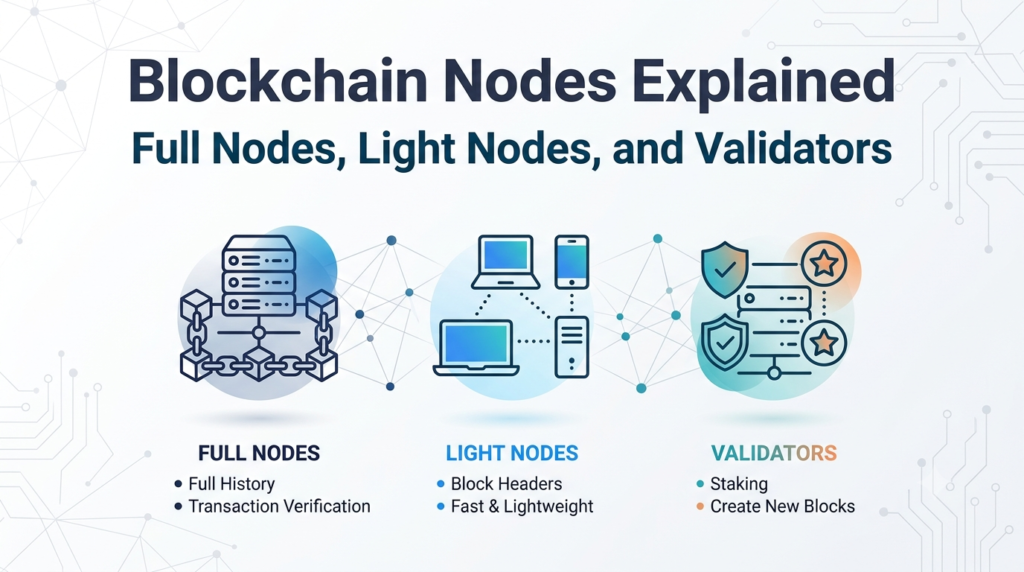
Every time you send cryptocurrency, check a wallet balance, or interact with a decentralized application, your request travels through a distributed network of computers. There is no central data center owned by a single bank or tech company processing that transaction. Instead, independent machines scattered across the globe communicate with one another to verify, record, and share data.
In blockchain terminology, each of these connected computers is called a node.
While people often talk about nodes as if they are all identical, modern blockchains rely on specialized participants that carry very different workloads. Some machines store the entire history of a network on heavy-duty hard drives. Others run silently inside your smartphone wallet, downloading only tiny slivers of data. Another group actively locks up capital or computing power to approve new blocks of transactions.
Understanding how full nodes, light nodes, and validators divide these responsibilities makes it much easier to grasp how decentralized networks stay secure, fast, and resistant to tampering.
The Core Purpose of a Blockchain Network Participant
At its simplest level, a node is any device running blockchain client software that connects to a peer-to-peer network. Think of it as an active member of a global bookkeeping club.
Before a blockchain updates its ledger, nodes perform several behind-the-scenes tasks:
- Broadcasting transactions: When you hit “send” in a crypto wallet, your transaction goes to a nearby node, which passes it along to its peers until the entire network knows about it.
- Checking protocol rules: Nodes inspect incoming data against the network’s rulebook. They check whether the sender actually owns the funds, whether digital signatures are valid, and whether the transaction format matches protocol standards.
- Rejecting invalid activity: If someone tries to spend the same coins twice or create tokens out of thin air, honest nodes immediately drop the invalid transaction without forwarding it.
- Maintaining ledger state: Nodes keep track of current account balances and smart contract states so anyone querying the network gets accurate information.
Without independent operators running this software, a blockchain would either grind to a halt or collapse into a centralized database controlled by whoever owns the servers.
Full Nodes: The Network’s Independent Auditors
A full node downloads and verifies every single block and transaction from the very first block (known as the genesis block) up to the present moment. Because it independently checks every piece of historical data against the network’s consensus rules, a full node never has to trust anyone else’s word about who owns what.
What Full Nodes Actually Do
When a new block arrives, a full node replays the transactions inside it to confirm that every calculation adds up. On networks like Bitcoin, a full node verifies every signature and script execution back to 2009. On smart contract platforms like Ethereum, a full node executes every smart contract call to verify that the resulting state matches what the block proposer claims.
In addition to auditing blocks, full nodes serve as the backbone for network data. They store copies of the blockchain and upload historical blocks to new nodes joining the network for the first time.
Standard Full Nodes vs. Archive Nodes
Within the full node category, operators generally choose between two storage configurations:
- Pruned or Standard Full Nodes: These verify the entire transaction history from day one, then delete older raw transaction details once they are confirmed, keeping only recent blocks and the current state of all balances. This saves disk space without sacrificing security.
- Archive Nodes: These retain every historical state of the blockchain at every single block height. Block explorers, analytics platforms, and wallet providers rely on archive nodes when they need to look up what an account balance was three years ago on a specific Tuesday.
Hardware and Setup Realities
Running a standard full node does not require a supercomputer, though it demands steady storage and bandwidth. Most home operators use a dedicated mini-PC or desktop with a fast solid-state drive (NVMe SSD), 16 GB to 32 GB of RAM, and an uncapped broadband internet connection. Depending on the blockchain, initial synchronization—downloading and verifying years of history—can take anywhere from several hours to multiple days.
Light Nodes: Fast Access for Everyday Devices
Most people interact with cryptocurrency through mobile wallets or browser extensions. Expecting a smartphone to download hundreds of gigabytes of blockchain history and stay online 24/7 would make crypto unusable for everyday life.
Light nodes (often called Simplified Payment Verification, or SPV, clients) solve this problem by trading complete independence for speed and minimal storage.
How Light Clients Verify Data Without Downloading Everything
Instead of downloading entire blocks packed with thousands of transactions, a light node downloads only block headers. A block header is a tiny summary—often less than a few hundred bytes—containing metadata such as a timestamp, a reference to the previous block, and a cryptographic fingerprint (a Merkle root) of all transactions inside that block.
When you check your balance or wait for a payment in a light wallet:
- Your light node connects to one or more full nodes.
- It requests proof that your specific transaction is included in a recent block header.
- The full node sends back a small cryptographic proof (a Merkle branch) showing how your transaction connects to the block header’s fingerprint.
- Your device verifies the math locally without ever downloading the rest of the block.
Trade-offs of Using a Light Node
Light nodes run smoothly on phones, laptops, and browser wallets using minimal battery and mobile data. However, they rely on full nodes to feed them accurate headers and transaction proofs. If all full nodes connected to a light client were malicious, they could withhold information or feed false data—though cryptographic proofs still prevent a full node from fabricating a valid signature from your private key.
Validators: Securing Consensus and Producing New Blocks
A common point of confusion in crypto is assuming that every node creates new blocks or earns staking rewards. In reality, standard full nodes only verify blocks created by others. Creating and finalizing new blocks is the job of block producers—called miners in Proof-of-Work networks and validators in Proof-of-Stake networks.
How Validators Earn Their Role
On Proof-of-Stake blockchains such as Ethereum, Solana, Cardano, and Cosmos, anyone wanting to become a validator must lock up a minimum amount of the network’s native cryptocurrency as collateral, known as a stake. For example, running an independent Ethereum validator requires staking 32 ETH.
This financial commitment aligns incentives:
- Block Proposal: The protocol randomly selects active validators to bundle pending transactions from the memory pool into a new block and broadcast it to the network.
- Attestation and Voting: Other validators inspect the proposed block, confirm that its transactions are valid, and cast cryptographic votes (attestations) approving it.
- Rewards and Penalties: Validators earn newly issued tokens and a share of transaction fees for staying online and behaving honestly. If a validator goes offline for extended periods, it loses small amounts of its stake. If it tries to attack the network—such as signing two conflicting blocks at the same height—the protocol triggers slashing, permanently destroying a portion of its staked funds and ejecting it from the network.
Why Validators Also Run Full Nodes
A validator cannot safely approve transactions it has not verified. Therefore, every validator node also operates as a full node (or connects directly to one it controls), maintaining an up-to-date copy of the ledger so it can validate incoming transactions before signing off on new blocks.
Side-by-Side Comparison: Full Nodes, Light Nodes, and Validators
The table below outlines how these three participant types differ in responsibilities, resource demands, and incentives.
| Feature | Full Node | Light Node | Validator Node |
| Primary Role | Audits all rules and stores ledger history | Queries balances and verifies specific transactions | Proposes new blocks and votes on network consensus |
| Data Downloaded | Entire blockchain history (or pruned current state) | Block headers only | Entire blockchain history plus consensus messages |
| Storage Needs | High (hundreds of GBs to multiple TBs) | Very low (megabytes) | High (same as full node, often higher I/O speed) |
| Financial Stake Required | None | None | Yes (requires locked native tokens as collateral) |
| Direct Protocol Rewards | None (voluntary infrastructure) | None | Yes (block rewards and priority transaction fees) |
| Typical Device | Dedicated home server, mini-PC, or cloud VPS | Smartphone, laptop, or browser wallet | High-uptime dedicated server with redundant internet |
Why Different Node Types Matter for Decentralization
A healthy blockchain depends on balance among these three layers.
If running a full node becomes too expensive because block sizes grow too large, regular users stop running them. When only a handful of large corporations can afford the hardware to verify the chain, those companies effectively control what counts as valid history.
At the same time, light nodes allow millions of everyday users to hold their own private keys and verify payments on mobile devices without surrendering custody to centralized exchanges. Meanwhile, a broad, geographically distributed set of validators ensures no single government, data center provider, or wealthy entity can censor transactions or rewrite recent blocks.
Practical Considerations Before Running Your Own Node
If you are thinking about setting up a node at home, your hardware and budget depend entirely on your goal:
- For personal privacy and self-verification: A standard pruned full node is ideal. Pointing your personal crypto wallet to your own full node means you never leak your IP address or wallet balances to third-party RPC providers. You do not need to stake any coins to do this.
- For earning staking yield: You will need to run a validator, which brings financial risk alongside technical responsibility. Internet outages, power failures, or misconfigured key setups can lead to missed rewards or slashing penalties. Many smaller holders choose to delegate tokens or use liquid staking protocols rather than maintaining 24/7 validator infrastructure themselves.
- For everyday spending: A reputable light wallet is sufficient for most daily transactions, provided you understand that you are relying on public full nodes to relay accurate header data.
Frequently Asked Questions
Do you earn cryptocurrency just for running a full node?
No. Standard full nodes on networks like Bitcoin and Ethereum do not earn block rewards or transaction fees. Operators run them to verify their own transactions privately, support network decentralization, or provide reliable data endpoints for their own apps and wallets.
What is the difference between a miner and a validator?
Both secure the network and add new blocks to the chain, but they use different consensus mechanisms. Miners compete using specialized hardware and electricity in Proof-of-Work systems (like Bitcoin), whereas validators lock up cryptocurrency as financial collateral in Proof-of-Stake systems (like Ethereum and Solana).
Can a light node operate if all full nodes go offline?
No. Light nodes do not store the full ledger or transaction pool, so they depend entirely on full nodes to supply block headers and cryptographic inclusion proofs. If no full nodes are reachable, a light node cannot verify new transactions.
What happens if a validator node loses its internet connection?
In most Proof-of-Stake networks, temporary downtime results in minor inactivity penalties—essentially losing roughly the same amount of tokens the validator would have earned during that period. Severe penalties like slashing are typically reserved for provable malicious behavior, such as double-signing conflicting blocks.
Is running a blockchain node legal?
In most jurisdictions, running software that listens to and validates public blockchain data is legal. However, operating a validator that earns staking rewards can carry tax reporting obligations or regulatory considerations depending on your country’s laws regarding digital assets.
Bringing It Together
Blockchains stay trustworthy not because one central authority watches over them, but because thousands of independent machines check each other’s work. Light nodes make the network accessible from a phone in your pocket, full nodes act as uncompromising auditors that enforce the rulebook without trusting anyone, and validators put capital on the line to keep new blocks moving forward. Together, these three roles turn a collection of independent computers into a resilient, self-verifying financial network.