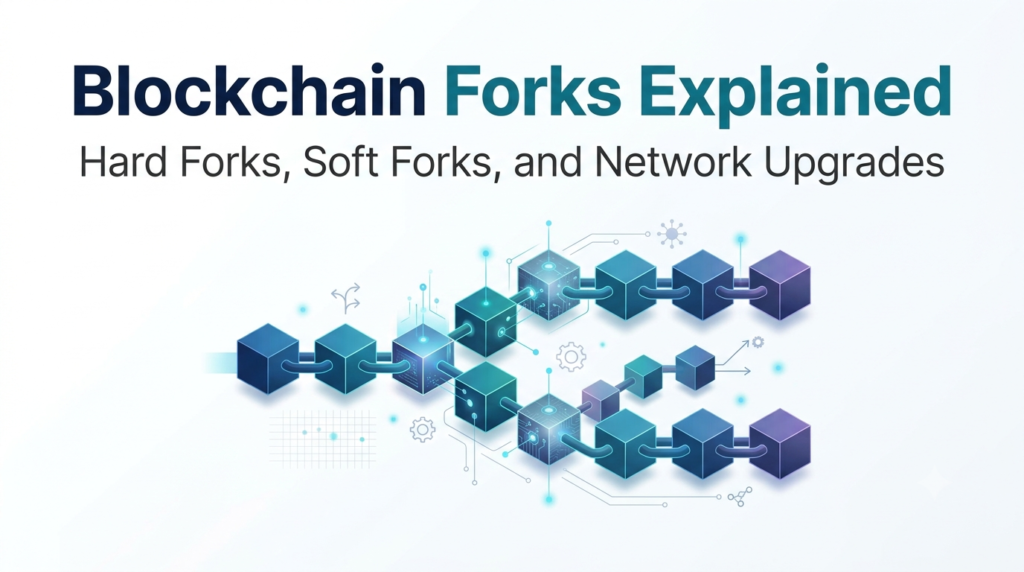
Traditional software updates happen quietly in the background. A central company pushes new code to its servers, users click “update,” and everyone moves forward on the same system. Decentralized blockchains cannot work that way. Because thousands of independent computers—called nodes—maintain the network without a central boss, changing the underlying software requires community-wide agreement.
When developers propose changes to a blockchain’s rules, the network goes through a process known as a fork. Depending on how those new rules interact with older versions of the software, a fork can be a routine upgrade or a permanent split that creates an entirely new cryptocurrency.
Why Decentralized Networks Need Protocol Upgrades
A blockchain runs on open-source code that defines its consensus rules. These rules govern everything from block size limits and transaction verification to how new coins are minted. Once a blockchain launches, those rules are not frozen in time. Networks must evolve to stay secure, competitive, and functional.
Developers and node operators typically propose protocol upgrades for four main reasons:
- Fixing security vulnerabilities: If researchers discover a flaw that could allow double-spending or network spam, the code must be patched quickly.
- Improving scalability and speed: Early blockchains often struggle with network congestion and high transaction fees, prompting upgrades that process more data per second.
- Adding new features: Networks frequently introduce capabilities like smart contracts, improved privacy tools, or support for Layer-2 scaling solutions.
- Resolving community disagreements: Sometimes developers, miners, or validators hold fundamentally different visions for a project’s direction, leading to competing versions of the software.
What Actually Happens During a Blockchain Fork?
At a technical level, a fork occurs whenever a blockchain diverges into two potential paths forward. This can happen accidentally for a few seconds when two miners find a valid block at the exact same time—a temporary conflict the network automatically resolves by choosing the longer chain.
Intentional forks, however, happen when developers release updated client software with modified consensus rules. Because nodes are run by independent participants around the world, nobody can force an operator to install the update. Whether the network stays unified or splits into two separate blockchains depends on backward compatibility—whether nodes running the old software recognize blocks created by nodes running the new software as valid.
Soft Forks: Tightening the Rules Without Splitting the Chain
A soft fork is a backward-compatible upgrade. It works by narrowing or tightening the existing consensus rules rather than rewriting them completely. Under a soft fork, any block or transaction that follows the new rules is also considered valid under the old rules.
Think of a soft fork like adding a new rule to an existing game without breaking the board. Suppose a network previously allowed blocks up to 2 megabytes in size, and a soft fork restricts new blocks to 1 megabyte. Upgraded nodes will only accept blocks under 1 megabyte. Meanwhile, older nodes that still expect blocks up to 2 megabytes will see a 1-megabyte block and accept it without issue, because 1 megabyte is still under their 2-megabyte limit.
Because old and new nodes continue recognizing the same transaction history, a soft fork does not create a new cryptocurrency—provided a majority of the network’s computing power or staked tokens enforces the new rules.
Real-World Examples of Soft Forks
- Bitcoin’s Segregated Witness (SegWit) in 2017: SegWit changed how transaction signature data was stored to free up block space and fix transaction malleability. By structuring signature data in a way older nodes could safely ignore, SegWit upgraded Bitcoin without splitting the coin.
- Bitcoin’s Taproot Upgrade in 2021: Taproot improved smart contract efficiency and transaction privacy on Bitcoin. Like SegWit, it was deployed as a soft fork, allowing non-upgraded nodes to remain connected to the same ledger.
Hard Forks: Rewriting the Rules and Risking a Chain Split
A hard fork is a non-backward-compatible change to a blockchain’s protocol. It introduces new rules that relax previous restrictions or fundamentally alter how blocks are structured and validated. Nodes running the older software will reject blocks produced under the new rules as invalid.
Using the block size example in reverse: if a network increases its maximum block size from 1 megabyte to 4 megabytes, upgraded nodes will accept 4-megabyte blocks. Non-upgraded nodes will immediately reject those blocks as rule violations. From that specific block height onward, the two groups no longer agree on what the valid ledger looks like.
Hard forks play out in one of two ways:
- Planned Network Upgrades (Consensus Hard Forks): When the entire community agrees an upgrade is necessary, virtually all node operators update their software before a scheduled block height. The old chain dies out naturally because no one mines or validates on it, and the network continues smoothly under the new rules.
- Contentious Hard Forks (Permanent Chain Splits): When a significant portion of the community refuses to adopt the new rules, both versions of the software stay active. The blockchain permanently splits into two independent networks. Both chains share the exact same transaction history up to the moment of the split, after which they operate as completely separate cryptocurrencies.
Notable Hard Forks in Crypto History
- Ethereum and Ethereum Classic (2016): Following a major exploit of a decentralized fund known as The DAO, the Ethereum community debated whether to alter the blockchain’s history to return stolen funds. The majority executed a hard fork to restore the funds, forming modern Ethereum (ETH). A smaller group opposed altering the ledger, continuing the original chain as Ethereum Classic (ETC).
- Bitcoin and Bitcoin Cash (2017): Disagreements over how to scale Bitcoin led one faction to launch a hard fork that increased the block size limit, creating Bitcoin Cash (BCH) while Bitcoin (BTC) retained its original block size rules.
- Ethereum’s Scheduled Upgrades: Networks like Ethereum regularly use planned, non-contentious hard forks—such as the 2022 transition from Proof-of-Work to Proof-of-Stake (The Merge)—to roll out major architectural improvements without creating competing coins.
Hard Fork vs. Soft Fork: Key Differences Compared
| Feature | Soft Fork | Hard Fork |
|---|---|---|
| Backward Compatibility | Yes; old nodes accept new blocks | No; old nodes reject new blocks |
| Rule Modification | Tightens or restricts existing rules | Expands, loosens, or replaces rules |
| Node Upgrade Requirement | Recommended for full validation, but not strictly mandatory | Mandatory for all nodes wishing to follow the new chain |
| Risk of Permanent Chain Split | Low (if majority of hash power/stake upgrades) | High if the community is divided; zero if planned unanimously |
| New Cryptocurrency Created? | No | Only during a contentious split |
How Network Upgrades and Forks Affect Crypto Holders
For everyday users holding cryptocurrency, most routine network upgrades require zero action. However, contentious hard forks introduce specific operational and financial considerations:
- Exchange and Wallet Support: During major upgrades, centralized exchanges and custodial wallets temporarily pause deposits and withdrawals to prevent transactions from getting lost while nodes update.
- New Coin Allocations: If a contentious hard fork creates a second blockchain, anyone holding private keys on the original network at the exact block height of the split technically controls an equal balance on the new chain. Whether you can access those coins depends on whether your wallet provider or exchange chooses to support the new asset.
- Replay Attack Risks: Immediately after a chain split, transactions broadcast on one network might be valid on the other if developers did not implement replay protection. Without replay protection, sending coins on Chain A could accidentally broadcast the same transaction on Chain B, resulting in unintended transfers.
- Market Volatility: Uncertainty around contentious forks often triggers sharp price swings as traders speculate on which chain will retain developer support, user adoption, and liquidity.
Disclaimer: Cryptocurrency networks and digital assets carry technical and financial risks. This article is for informational purposes only and does not constitute financial or investment advice.
Frequently Asked Questions
Do I lose my crypto during a hard fork?
No. Your existing coins remain safe on the original blockchain, provided you keep your private keys secure and avoid interacting with unverified third-party claiming tools. In a planned upgrade, your balance simply carries forward onto the upgraded network.
Why do developers sometimes prefer soft forks over hard forks?
Soft forks minimize disruption. Because older nodes do not crash or get kicked off the network immediately, soft forks allow for gradual adoption and greatly reduce the risk of fracturing the community into two competing tokens.
What is a “fork” in open-source software development versus a blockchain fork?
In general software development, “forking” simply means copying a project’s public source code to build a separate software project (such as Litecoin copying and modifying Bitcoin’s early codebase). A blockchain protocol fork specifically refers to changing the live consensus rules of an active network with a shared transaction history.
How do nodes know when to activate a network upgrade?
Developers embed a specific block height or timestamp into the updated client software. Once the blockchain reaches that exact block number, upgraded nodes automatically switch over to enforcing the new consensus rules.
Conclusion
Blockchain forks are the primary governance and engineering mechanism that allows decentralized networks to evolve without relying on a central authority. Whether implemented as a backward-compatible soft fork that tightens validation rules on a single chain or a hard fork that enables sweeping architectural upgrades—or permanently splits a divided community into two independent networks—forks ensure that blockchains remain adaptable, secure, and responsive to changing technical demands. For everyday crypto holders and builders alike, knowing how these upgrades work makes it much easier to navigate protocol changes safely, protect digital assets during chain splits, and evaluate the long-term resilience of any blockchain ecosystem.