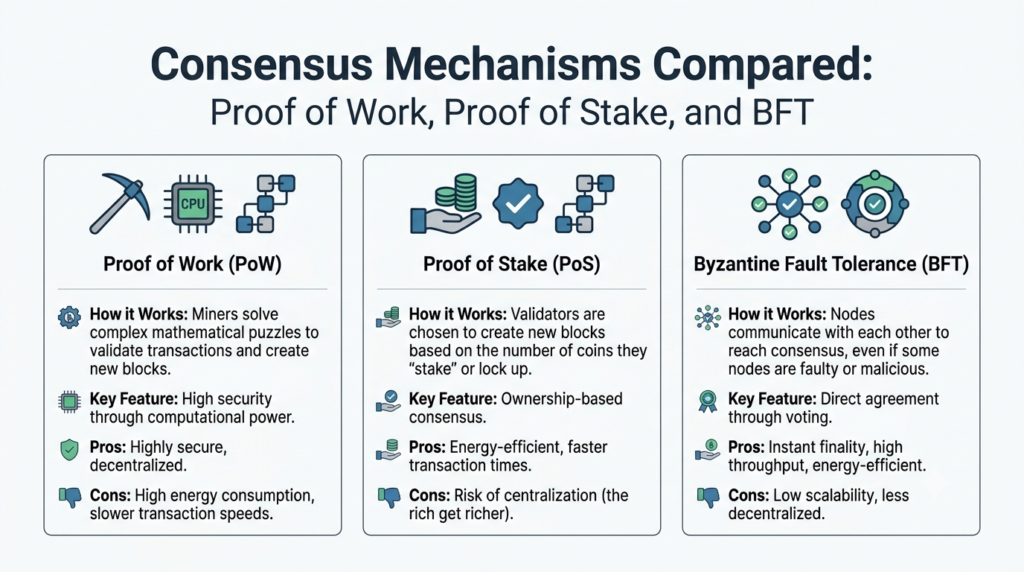
Every public blockchain operates without a central clearinghouse, bank, or administrator. Yet thousands of independent computers across the globe consistently agree on the exact balance of every wallet and the precise order of every transaction. That coordination happens through a consensus mechanism—the set of rules and cryptographic incentives that allow distributed nodes to verify data and prevent fraud without trusting one another.
Over the past decade, blockchain architecture has coalesced around three foundational approaches to achieving agreement: Proof of Work (PoW), Proof of Stake (PoS), and Byzantine Fault Tolerance (BFT). Each model solves the core problem of decentralized trust differently, trading off energy efficiency, transaction finality, decentralization, and throughput in distinct ways.
The Core Problem Every Consensus Model Must Solve
Before comparing specific designs, it helps to understand what consensus mechanisms actually defend against. In an open network where anyone can spin up a server, two major threats emerge:
- Double-Spending: An attacker attempts to spend the same digital tokens twice by broadcasting conflicting transactions to different parts of the network simultaneously.
- Sybil Attacks: A single malicious actor creates thousands of fake node identities to outvote honest participants and rewrite transaction history.
To neutralize both threats, a consensus mechanism must make it prohibitively expensive or mathematically impossible for a bad actor to forge valid blocks, while giving honest nodes a clear, unambiguous rule for deciding which version of the ledger is the truth.
Proof of Work (PoW): Security Through Computational Effort
Introduced with Bitcoin in 2009, Proof of Work anchors digital security to real-world physical resources—specifically electricity and specialized computing hardware (ASICs).
How PoW Achieves Agreement
In a PoW network, participants called miners gather pending transactions into a candidate block and compete to solve a cryptographic puzzle. Using the SHA-256 hashing algorithm (in Bitcoin’s case), miners repeatedly run block data through a mathematical function until they find an output below a specific target threshold.
Finding a valid hash requires trillions of random guesses, making it computationally expensive. However, once a miner finds the solution, every other node on the network can verify its validity in milliseconds. The winning miner broadcasts the block, appends it to the chain, and receives newly minted coins plus transaction fees as a reward.
Strengths and Trade-Offs of PoW
- Battle-Tested Security: Attacking a major PoW chain requires controlling more than 50% of the network’s total hashing power—an effort that demands billions of dollars in hardware and massive ongoing electrical capacity.
- True Permissionless Entry: Anyone with hardware and power can mine without needing prior token holdings or permission from existing validators.
- Probabilistic Finality: A PoW transaction is never 100% irreversible at the exact moment it enters a block. Instead, certainty grows with each subsequent block mined on top of it (commonly six confirmations on Bitcoin).
- Energy and Throughput Limits: High electricity consumption and deliberate block-time intervals (such as Bitcoin’s 10-minute target) limit base-layer transaction throughput.
Proof of Stake (PoS): Security Through Economic Collateral
Proof of Stake replaces physical energy expenditure with financial capital locked directly inside the protocol. Ethereum famously transitioned from PoW to PoS in September 2022 (“The Merge”), joining networks like Cardano, Solana, and Avalanche in relying on staked assets to secure their ledgers.
How PoS Achieves Agreement
Instead of competing with raw computing power, network participants—known as validators—lock up a native cryptocurrency deposit as collateral. The protocol algorithmically selects a validator to propose the next block, usually weighted by the size of their stake and other randomization factors, while a committee of other validators attests to the block’s validity.
Honest participation earns staking yield generated from issuance and transaction fees. Conversely, if a validator signs conflicting blocks or attempts to manipulate the chain, the protocol automatically destroys a portion or all of their locked collateral—a penalty known as slashing.
Strengths and Trade-Offs of PoS
- Dramatic Energy Reduction: Because validators do not race to solve brute-force puzzles, PoS networks consume over 99% less electricity than PoW equivalents.
- Explicit Economic Penalties: Slashing creates an immediate financial deterrent against malicious behavior that goes beyond mere wasted electricity.
- Capital Concentration Risks: Large token holders and institutional staking providers can accumulate disproportionate influence over block production and governance over time.
- Complex Protocol Rules: Managing validator entry/exit queues, slashing conditions, and inactivity leaks requires significantly more intricate protocol code than PoW’s longest-chain rule.
Byzantine Fault Tolerance (BFT): Security Through Deterministic Voting
Byzantine Fault Tolerance originates from computer science research published in 1982 (the Byzantine Generals Problem), long before Bitcoin existed. Classic BFT protocols—and modern blockchain adaptations like Tendermint (CometBFT) used across the Cosmos ecosystem—focus on multi-round communication and explicit voting among a known set of validators.
How BFT Achieves Agreement
In a BFT system, nodes communicate directly with one another in structured voting rounds (often called pre-vote and pre-commit phases) to agree on a single block before moving to the next. As long as more than two-thirds (over 66.7%) of the voting power behaves honestly, the network can tolerate up to one-third of nodes going offline or sending malicious, conflicting messages.
Modern blockchains rarely run pure BFT in isolation on an open network because open membership allows Sybil attacks. Instead, they pair BFT voting engines with Proof of Stake Sybil resistance—using staked tokens to determine which validators hold voting seats and how much weight each vote carries.
Strengths and Trade-Offs of BFT
- Instant Deterministic Finality: Once two-thirds of validators commit a block, the transaction is mathematically final and cannot be reverted without a coordinated protocol fork.
- High Throughput and Low Latency: BFT chains routinely finalize blocks in one to three seconds, making them well-suited for decentralized exchanges and high-frequency applications.
- Communication Overhead: Because validators must exchange messages with each other during every round, network bandwidth requirements grow rapidly as the number of validators increases. As a result, BFT networks often cap active validator sets at roughly 100 to 200 nodes.
Side-by-Side Comparison: PoW vs. PoS vs. BFT
| Feature | Proof of Work (PoW) | Proof of Stake (PoS) | Byzantine Fault Tolerance (BFT / PoS-BFT) |
| Sybil Resistance Mechanism | Computational work & electricity | Locked cryptocurrency collateral | Staked collateral or permissioned validator registry |
| Block Selection Method | Cryptographic hash race | Pseudo-random selection weighted by stake | Round-robin proposer with multi-round committee voting |
| Transaction Finality | Probabilistic (requires multiple confirmations) | Economic / checkpoint-based (minutes) | Deterministic and immediate (1–5 seconds) |
| Fault Tolerance Threshold | Up to 49% of total hash rate | Up to 33%–49% of staked tokens (varies by design) | Strictly up to 33.3% (one-third) of voting weight |
| Validator Scalability | Unlimited open miners | Thousands to hundreds of thousands of validators | Typically 50 to 200 active validators due to messaging overhead |
| Energy Footprint | Very high | Very low | Very low |
| Notable Implementations | Bitcoin, Litecoin, Dogecoin | Ethereum, Cardano, Polkadot | Cosmos Hub (CometBFT), Aptos, Hyperledger Fabric |
How Hybrid Models Blend These Approaches
In practice, modern Layer 1 blockchains rarely rely on a textbook version of just one model. Instead, engineers combine elements from each category to balance security, speed, and decentralization:
- Ethereum (Gasper): Combines a PoS slot-and-epoch proposer system (LMD-GHOST) for continuous block production with a BFT-style finality gadget (Casper FFG) that finalizes batches of blocks every two epochs (~12.8 minutes).
- Solana: Pairs Proof of Stake validator voting with Proof of History (PoH), a cryptographic clock that orders transactions before consensus votes occur, reducing messaging delays.
- Avalanche: Uses a repeated random sub-sampling voting protocol where validators query small, random subsets of peers rather than broadcasting votes to the entire network simultaneously.
Choosing the Right Architecture for Different Use Cases
No single consensus mechanism is universally superior; each optimizes for a different priority:
- Maximum Censorship Resistance and Neutrality: Proof of Work remains unmatched for base-layer monetary settlement where resistance to state-level interference and simplicity of protocol rules matter more than transaction speed.
- Broad Decentralization with Sustainable Scaling: Proof of Stake enables hundreds of thousands of independent validators to secure a general-purpose smart contract platform without massive energy overhead.
- Sub-Second Settlement and Enterprise/App-Chain Control: BFT-based consensus excels when applications require immediate finality, predictable block times, and high transaction throughput among a curated or stake-capped validator set.
Frequently Asked Questions
Can a Proof of Stake network suffer a 51% attack like Proof of Work?
Yes, though the mechanics differ. In Proof of Work, an attacker rents or buys majority hash power and can repeatedly reorganize blocks without losing their hardware. In Proof of Stake, an attacker must acquire a majority (or over one-third to halt finality in BFT-PoS) of the circulating staked supply—which drives up token prices—and risks having their entire stake destroyed via slashing, after which the community can fork the attacker out of the ledger.
Why do BFT blockchains limit the number of active validators?
Classic BFT protocols require validators to broadcast votes to every other validator across multiple rounds per block. As the validator count grows, network message volume increases quadratically ($O(n^2)$), creating bandwidth bottlenecks that slow down block times. Capping the active set preserves sub-second to multi-second finality.
Is Delegated Proof of Stake (DPoS) the same as BFT?
Not exactly, though they often work together. DPoS is a governance and validator-selection layer where token holders vote for a small group of block producers (such as 21 or 100 delegates). Those elected delegates then typically run a BFT-style consensus engine to validate and finalize blocks quickly.
Which consensus mechanism is best for private or enterprise blockchains?
Enterprise and consortium blockchains almost always use BFT variants (such as Raft, IBFT, or PBFT) rather than PoW or public PoS. Because participating organizations are already known and legally vetted, enterprise networks do not need energy-intensive mining or public token staking to prevent Sybil attacks.
Understanding the differences between Proof of Work, Proof of Stake, and Byzantine Fault Tolerance makes it much easier to evaluate any blockchain project beyond surface-level speed claims. Every design choice represents an explicit trade-off between how many participants can validate the network, how quickly transactions become irreversible, and what resources secure the ledger against manipulation.