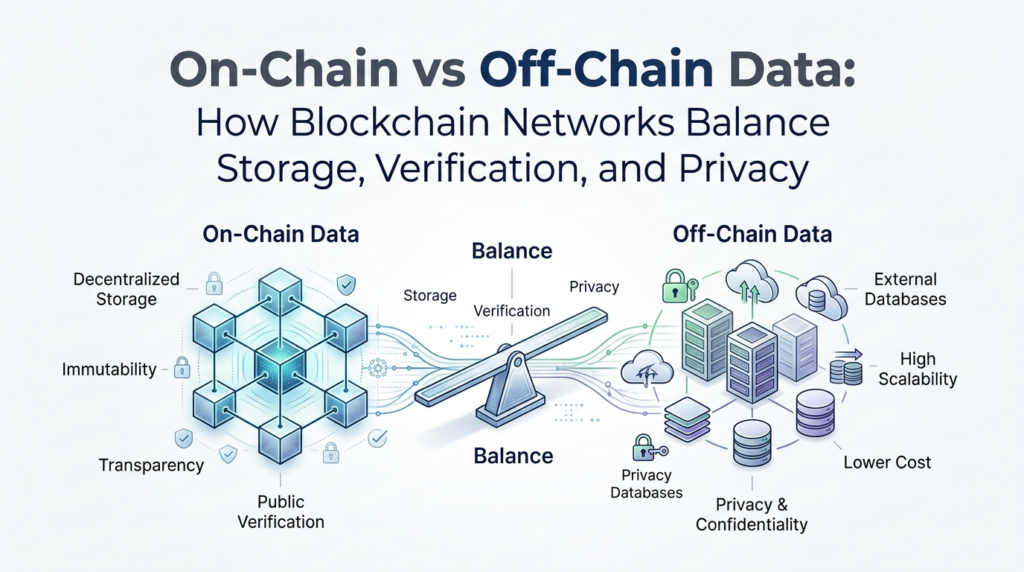
Every time you send cryptocurrency, mint a digital collectible, or interact with a decentralized application, the underlying network makes a strict architectural choice about where your information lives. Storing everything directly on a distributed ledger sounds ideal in theory, yet doing so would quickly make blockchains too expensive and sluggish for everyday use.
To solve this bottleneck, developers split information into two distinct categories: on-chain data and off-chain data. Understanding how these two layers divide the workload explains why decentralized networks remain secure without collapsing under the weight of massive files, and how sensitive user details stay protected on otherwise public networks.
Defining the Two Data Layers
The distinction between on-chain and off-chain comes down to whether information is recorded directly onto the blockchain’s shared ledger or maintained outside of it.
What Lives On-Chain
On-chain data encompasses every piece of information written directly into the blocks of a blockchain. Once network validators or miners confirm a block, this data replicates across thousands of independent nodes worldwide. Common examples include:
- Wallet addresses involved in a transfer
- Transaction amounts and timestamps
- Smart contract code and state changes
- Cryptographic hashes (digital fingerprints) of external files
Because every full node stores a copy of this history, on-chain data is permanent, transparent, and tamper-resistant. Nobody can alter a confirmed record without overpowering the consensus mechanism of the entire network.
What Stays Off-Chain
Off-chain data includes any information stored, processed, or transmitted outside the main blockchain network. Even when an application relies on smart contracts for settlement, the bulk of its heavy lifting often happens off-chain. Typical off-chain records include:
- High-resolution media files (such as NFT artwork or videos)
- Personal identity documents (KYC records, names, and physical addresses)
- Detailed medical histories or supply chain sensor logs
- Rapid micro-transactions bundled inside Layer 2 payment channels
Off-chain storage relies on traditional cloud servers, private enterprise databases, or decentralized file networks like the InterPlanetary File System (IPFS).
Storage Economics: Why Blockchains Avoid Heavy Files
A blockchain is designed as a secure consensus engine, not a hard drive. Every byte added to a block must be transmitted across the peer-to-peer network, verified by validators, and stored indefinitely by node operators.
Because block space is scarce, networks charge transaction fees (often called gas) proportional to the computational effort and storage space required. Uploading a single high-resolution photograph directly onto a major Layer 1 network like Ethereum could cost thousands of dollars in fees, whereas storing that same file on a standard cloud server costs fractions of a cent per month.
If networks allowed unrestricted file uploads, the total size of the ledger would balloon into hundreds of terabytes. Ordinary users could no longer afford the hardware needed to run full nodes, which would force the network to centralize around a handful of wealthy data centers. Keeping bulky files off-chain preserves decentralization while keeping transaction fees manageable.
Comparing Storage, Verification, and Privacy
Choosing between on-chain and off-chain architectures involves balancing cost, trust, and confidentiality.
| Feature | On-Chain Data | Off-Chain Data |
| Storage Cost | High; users pay network fees per byte of block space. | Low; relies on standard servers or decentralized storage nodes. |
| Speed & Scalability | Limited by block size and network consensus times. | Fast; updates happen instantly without waiting for block confirmations. |
| Verification Method | Directly verified by network consensus rules. | Verified indirectly using cryptographic proofs or trusted oracles. |
| Immutability | Permanent; virtually impossible to edit or delete. | Mutable; administrators or file hosts can modify or remove data. |
| Privacy Level | Public or pseudonymous; visible to anyone with a block explorer. | High; access can be restricted via encryption and permissions. |
How Off-Chain Data Is Verified Without Blind Trust
Moving data off the blockchain introduces a clear risk: if a file sits on an external server, how do users know the host hasn’t secretly altered or deleted it? Developers solve this using cryptographic anchoring and decentralized oracles.
Cryptographic Hashing
Instead of uploading an entire document to the blockchain, a system runs the file through a cryptographic hash function (such as SHA-256). This process generates a unique, fixed-length string of characters—a digital fingerprint.
That tiny fingerprint is recorded on-chain. Later, anyone can download the off-chain document, run it through the same hash function, and compare the result to the on-chain record. If even a single comma in the off-chain file was changed, the resulting hash will look completely different, immediately exposing the tampering.
Oracles and Zero-Knowledge Proofs
When smart contracts need real-world off-chain data—such as the current market price of an asset or weather conditions for an insurance payout—they rely on oracles. Decentralized oracle networks gather data from multiple independent sources, verify accuracy through consensus, and feed the final number onto the blockchain.
For complex off-chain computations, newer systems use zero-knowledge proofs (ZK-proofs). A ZK-proof allows an off-chain processor to execute thousands of transactions or verify a user’s credentials, then submit a compact mathematical proof to the blockchain confirming the work was done honestly—without exposing the underlying raw data.
Privacy Trade-Offs and Regulatory Realities
Public blockchains achieve security through radical transparency. While wallet addresses do not display real names, sophisticated analytics firms can often link pseudonymous addresses to real-world identities by tracking exchange deposits and behavioral patterns. Once personal data is written on-chain, it stays visible forever.
This permanence clashes directly with modern data protection regulations, such as the European Union’s General Data Protection Regulation (GDPR), which grants individuals the “right to be forgotten.” Because you cannot delete data from an immutable blockchain, storing personally identifiable information (PII) on-chain creates severe legal and security liabilities.
Hybrid architectures resolve this conflict:
- Sensitive records stay off-chain inside encrypted, access-controlled databases where they can be updated or deleted to comply with privacy laws.
- Verification proofs go on-chain, allowing third parties to confirm that a user passed a background check or holds a valid license without ever viewing the underlying private documents.
Hybrid Architecture in Everyday Web3 Applications
Most production blockchain applications combine both approaches seamlessly:
- Non-Fungible Tokens (NFTs): The token’s ownership record and transfer history live on-chain. However, the image file and metadata description usually sit off-chain on IPFS or Arweave, linked to the smart contract via a content identifier hash.
- Decentralized Finance (DeFi): Core asset swaps, lending pools, and collateral liquidations happen on-chain via smart contracts. Meanwhile, order books for high-frequency trading or historical price charts are processed off-chain to prevent network congestion.
- Supply Chain Tracking: IoT sensors monitor temperature and humidity inside shipping containers every few seconds off-chain. Only milestone summaries and anomaly alerts are committed on-chain when cargo changes hands between logistics providers.
Frequently Asked Questions
Can off-chain data be permanently lost?
Yes, if it is stored on a single centralized server that goes offline or stops paying for hosting. To prevent broken links, developers use decentralized storage networks like IPFS combined with incentivized pinning services or permanent storage protocols like Arweave.
Is off-chain data completely centralized?
Not necessarily. While traditional cloud databases (like AWS) are centralized, off-chain data can also live on decentralized peer-to-peer storage networks or Layer 2 rollups that distribute data across multiple independent operators.
Why don’t Layer 2 networks count as purely on-chain?
Layer 2 solutions—such as Arbitrum, Optimism, and Lightning Network—execute transactions off the main Layer 1 chain to save fees and boost speed. They periodically bundle those results and post cryptographic proofs back to the Layer 1 blockchain, giving users inherited security without clogging the base layer.
Does storing data on-chain make it encrypted?
No. Standard on-chain data is encoded so computers can read it, not encrypted for secrecy. Anyone using a public block explorer can inspect transaction details and smart contract inputs unless the developer explicitly implements specialized privacy protocols.
Finding the Right Balance
Effective blockchain design is rarely an all-or-nothing choice between on-chain and off-chain systems. Putting everything on the ledger sacrifices speed, affordability, and user privacy, while keeping everything off-chain defeats the purpose of decentralized trust. By anchoring lightweight cryptographic proofs on-chain and keeping heavy, sensitive data off-chain, modern networks achieve verifiable security without sacrificing practical usability.