Introduction
If you have spent any time looking at cryptocurrency prices, you have probably noticed how wildly they swing up and down. A coin that is soaring today might crash tomorrow. Often, these massive price changes do not happen because of new technology or business news. Instead, they happen because of human emotion.
When prices go up, people get excited and throw money at the market. When prices drop, panic sets in, and everyone rushes for the exit door.
For beginners, these sudden shifts can be deeply confusing and stressful. It is hard to know whether a price crash means a coin is dying or just having a normal bad day. To help make sense of this emotional rollercoaster, traders use a metric called the Crypto Fear and Greed Index. This guide will break down what the index is, how it works, and how you can use it to protect your investments without getting caught up in the hype.
What Is the Crypto Fear and Greed Index?
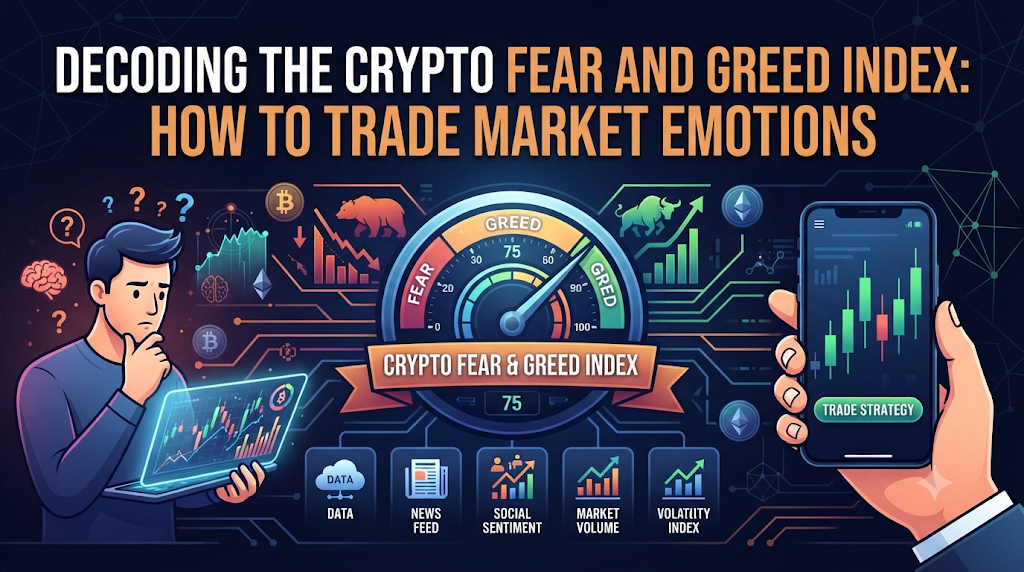
The Crypto Fear and Greed Index is a daily score that tracks whether cryptocurrency investors are feeling fearful or greedy.
In finance, market sentiment refers to the general attitude of investors toward a particular asset or financial market. When sentiment is positive, the market is bullish (expecting prices to rise). When sentiment is negative, the market is bearish (expecting prices to fall).
The index translates these complex feelings into a single number from 0 (Maximum Fear) to 100 (Maximum Greed).
Why It Matters
Markets are driven by humans, and humans are emotional creatures. Understanding market sentiment helps you see past the daily noise. When you know that an entire market is panicking, you can take a step back and look at your strategy objectively instead of joining the panic selling.
How the Crypto Fear and Greed Index Works
The index does not just guess how people are feeling. It calculates the score by gathering data from several different sources related to market behavior.
Here are the main components that make up the index:
1. Volatility (25%)
Volatility measures how much and how fast prices swing up and down. When volatility is unusually high, it usually means the market is fearful. Investors get nervous when their portfolio value changes by 20% in a single day.
2. Market Momentum and Volume (25%)
This looks at how much trading activity is happening and how fast prices are moving. High trading volume combined with rising prices is a strong sign of market greed, as more buyers jump in to catch the wave.
3. Social Media (15%)
Tools scan platforms like X (formerly Twitter) to count how often people talk about specific crypto topics, how fast posts spread, and whether the tone is positive or negative. A sudden spike in excited conversations usually points toward greed.
4. Dominance (10%)
Dominance measures how much of the total cryptocurrency market value belongs to Bitcoin. When Bitcoin’s dominance rises, it can mean investors are seeking safety in the largest asset, which often signals fear in smaller altcoins. When Bitcoin dominance falls, investors might be feeling greedy and exploring riskier coins.
5. Trends (10%)
Search engine data—specifically what people are Googling—reveals a lot. A surge in searches for phrases like “how to buy crypto” or “crypto scam” tells researchers a lot about public interest and anxiety levels.
Why Investors Watch Fear and Greed Cycles
The famous investor Warren Buffett once said: “Be fearful when others are greedy, and greedy when others are cautious.”
This quote captures the exact reason why the Fear and Greed Index is so popular.
- Extreme Fear (0–24): When the score drops very low, people are terrified. Coins are often sold at heavy discounts simply because everyone wants out. For long-term investors, extreme fear can sometimes present buying opportunities, because prices may have fallen lower than what the underlying technology is worth.
- Extreme Greed (75–100): When the score climbs very high, everyone thinks prices will go up forever. This is often a danger zone. When greed reaches its peak, the market may be overvalued, meaning a sharp correction could happen soon.
Practical Example: The Psychology of a Market Cycle
Imagine a popular cryptocurrency called CoinX.
- The Climb: CoinX slowly rises in price over three months. The index moves from 40 to 65. People are feeling optimistic.
- The Greed Phase: News outlets start talking about CoinX. The index hits 85 (Extreme Greed). Your coworker, who knows nothing about technology, starts asking how to buy it. This is FOMO in action.
- The Reality Check: Because too many people bought based on emotion rather than value, the price suddenly drops by 30%.
- The Panic: The index instantly crashes to 15 (Extreme Fear). Panic sets in. Investors sell their coins at a loss to stop the bleeding, even though the project’s long-term goals haven’t changed.
By watching the index climb into extreme greed territory, a smart investor would know to take profits or stay cautious, rather than buying at the absolute peak.
Common Mistakes Beginners Make With the Index
Using the Fear and Greed Index sounds easy, but many beginners run into trouble because they misinterpret the data. Here are common mistakes to watch out for:
- Treating the index as a crystal ball: The index tells you how people feel right now, not what prices will do tomorrow. Extreme fear can turn into even more fear before the market recovers.
- Making decisions based on a single day: A one-day drop in the score does not mean a long-term trend has changed. Look at weekly and monthly patterns instead.
- Buying every single dip blindly: Just because the market is fearful does not mean every plunging coin is a good investment. Some projects fail permanently.
- Ignoring your own financial goals: Letting an index dictate every trade can lead to over-trading. Always match your investments with your personal risk tolerance.
Risks and Limitations
Like any financial tool, the Crypto Fear and Greed Index has clear limitations.
- It is a lagging indicator: The index measures what has already happened to sentiment and prices. It does not predict future black swan events, regulatory bans, or unexpected economic news.
- Emotional distortion: In a severe bear market, the index can stay in “Extreme Fear” for months. Buying every time the index dips during a long-term downturn can quickly drain your funds.
- Manipulation: Social media sentiment can sometimes be manipulated by coordinated groups or bots trying to pump or dump specific tokens, which can slightly distort the broader sentiment score.
Decision-Making Framework: How to Use the Index Safely
Instead of guessing, follow a structured process when looking at market sentiment:
- Check the Score: Look at the current daily index reading.
- Evaluate the Context: Ask yourself why the market is feeling this way. Is there a major global economic event, or is it just normal price movement?
- Check Your Plan: Does your current action match your long-term investment strategy, or are you reacting purely to fear or excitement?
- Scale Your Actions: If the index is in extreme greed, consider taking some profits off the table rather than buying more. If it is in extreme fear, avoid panic selling what you planned to hold long-term.
- Manage Risk: Never invest money you cannot afford to lose, regardless of what the sentiment score says.
Key Terms
- Bull Market: A market condition where prices are rising or expected to rise over a sustained period.
- Bear Market: A market condition where prices fall significantly and remain low for an extended period.
- FOMO (Fear Of Missing Out): The anxiety that you might miss out on a profitable investment opportunity if you do not buy immediately.
- Sentiment: The overall attitude, mood, or feeling of investors toward a market or asset.
- Volatility: A measure of how drastically and quickly an asset’s price moves up and down.
- Altcoin: Any cryptocurrency other than Bitcoin.
- Correction: A sudden downward price adjustment that follows a period of rapid growth.
- Liquidity: How easily an asset can be bought or sold in the market without drastically changing its price.
FAQs
Can the Crypto Fear and Greed Index predict exact price crashes?
No. The index only shows current emotional states. It can tell you when the market is overheated or overly panicked, but it cannot tell you the exact day or hour a price trend will reverse.
How often does the index update?
The index updates once every 24 hours. Because cryptocurrency markets trade 24/7, sentiment can shift quickly between updates.
Is the index only for Bitcoin?
While the index was originally designed with Bitcoin in mind—due to Bitcoin’s heavy influence on the rest of the crypto market—it generally reflects the overall mood of the entire cryptocurrency ecosystem.
Should I sell everything when the index reaches “Extreme Greed”?
Not necessarily. Selling everything is a drastic move. However, extreme greed is often a sign to be cautious, avoid taking on new high-risk trades, and consider locking in some profits.
Can the index stay at Extreme Fear for a long time?
Yes. During prolonged bear markets, the index can remain in fear or extreme fear for weeks or even months as investor interest fades.
Where does the data for the index come from?
The data is pulled from publicly available market statistics, trading platforms, search engines, and social media channels using automated collection tools.
Conclusion
The Crypto Fear and Greed Index is a valuable mirror reflecting the emotional state of the digital asset market. It reminds us that behind every candlestick chart and price ticker are real people feeling excited, hopeful, or terrified.
By understanding that extreme emotions often lead to poor financial decisions, you can use the index as a reality check. The next time the market is gripped by frantic greed or paralyzing fear, take a step back, review your goals, and remember that staying calm is often your greatest advantage.