Introduction
The landscape of modern technology is being shifted by the integration of artificial intelligence within operational workflows. As systems become more complex, especially in the realms of decentralized networks and large-scale cloud environments, manual intervention is often found to be insufficient. A new standard for operational excellence is being established through the marriage of AI and IT operations.
In this guide, the path toward becoming a Certified AIOps Professional is explored. This certification is designed to provide the necessary skills for managing automated environments where data-driven decisions are made by intelligent algorithms. Whether a professional is based in India or working within the global market, the need for these specialized skills is being recognized by organizations everywhere. The transition from traditional DevOps to AI-enhanced operations is no longer considered an option; it is viewed as a necessity for maintaining system stability and performance.
What is Certified AIOps Professional
The Certified AIOps Professional program is defined as a specialized credential that validates an individual’s ability to implement artificial intelligence and machine learning within the IT operations lifecycle. It is not merely a theoretical course but is structured as a practical framework for applying algorithmic solutions to real-world infrastructure challenges.
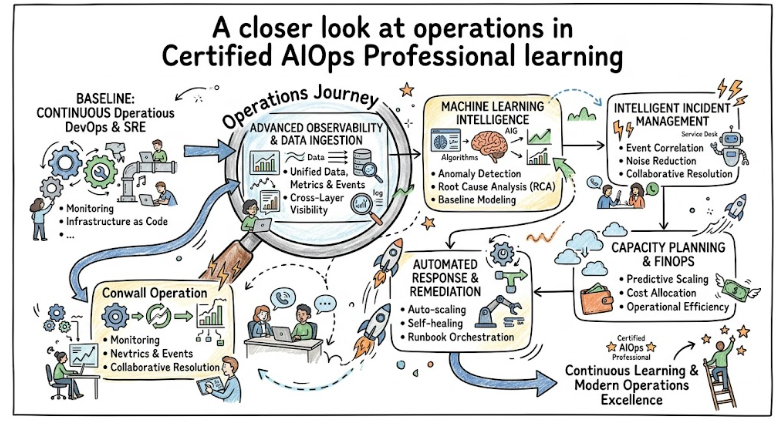
By this certification, a deep understanding of how telemetry data is collected, processed, and analyzed is demonstrated. The focus is placed on the automation of root cause analysis, anomaly detection, and predictive maintenance. This credential is recognized as a mark of expertise for those who wish to lead the next generation of technical operations.
Why it matters today?
In the current era of rapid digital transformation, the volume of data generated by modern applications is often overwhelming for human teams. Traditional monitoring tools are frequently bypassed by the sheer speed and scale of modern deployments. This is where AIOps becomes essential.
Efficiency is increased when routine tasks are handled by intelligent systems, allowing engineers to focus on high-value architecture. Downtime is significantly reduced when potential issues are identified by predictive models before they impact the end user. In competitive markets, such as those seen in fintech and blockchain, the ability to maintain high availability through automation is considered a primary business advantage.
Why Certified AIOps Professional certifications are important
A standardized way to measure competence in AI-driven operations is provided by this certification. For an employer, the risk of hiring underqualified staff is mitigated when candidates hold a recognized credential. For the professional, career growth is accelerated as they are distinguished from their peers in a crowded job market.
A structured learning path is offered, ensuring that all critical domains of AIOps—from data ingestion to automated remediation—are covered. Complex problems are solved more effectively when a formal methodology is followed. Furthermore, the global recognition of this certification ensures that professional mobility is supported across different geographic regions.
Why choose AIOps School?
When a platform for learning is being selected, AIOps School is often chosen for its specialized focus on the intersection of AI and operations. A curriculum that is aligned with the latest industry requirements is provided, ensuring that the knowledge gained is immediately applicable.
The learning experience is enhanced by access to hands-on labs and real-world scenarios that simulate actual production environments. Support is offered by a community of experts who are dedicated to the field of automated operations. By choosing this provider, a commitment to a high standard of technical education is made.
Certification Deep-Dive: Certified AIOps Professional
What is this certification?
This certification is a professional validation of an individual’s skills in using AI and ML to enhance IT operations. It is designed to prove that the holder can manage automated systems effectively.
Who should take this certification?
It is recommended for Software Engineers, DevOps Engineers, Site Reliability Engineers, and Engineering Managers who wish to transition into AI-driven operational roles.
Certification Overview Table
| Track | Level | Who it’s for | Prerequisites | Skills Covered | Recommended Order |
| AIOps / MLOps | Professional | Experienced Engineers | Basic DevOps Knowledge | ML Models, Data Analysis | 1 |
| DevOps | Intermediate | Junior Developers | Coding Knowledge | CI/CD, Scripting | 2 |
| SRE | Advanced | Senior Engineers | Infrastructure Knowledge | Observability, SLIs/SLOs | 3 |
| DevSecOps | Professional | Security Specialists | Security Fundamentals | Automated Compliance | 4 |
| DataOps | Professional | Data Engineers | SQL, Data Pipelines | Data Lifecycle Management | 5 |
| FinOps | Professional | Finance & Cloud Ops | Cloud Cost Knowledge | Cloud Economics | 6 |
Skills you will gain
- The ability to implement machine learning models for system monitoring is developed.
- Expertise in automated root cause analysis is acquired.
- Skills in handling large-scale telemetry data are mastered.
- Predictive maintenance strategies are learned and applied.
- Knowledge of anomaly detection algorithms is deepened.
- The capacity to automate complex incident response workflows is built.
Real-world projects you should be able to do after this certification
- A predictive monitoring system for a high-traffic web application is built.
- An automated incident remediation pipeline is designed and deployed.
- A data-driven capacity planning tool for cloud infrastructure is created.
- An anomaly detection dashboard for microservices architecture is implemented.
- A self-healing infrastructure layer using AI triggers is developed.
Preparation plan
7–14 days plan
A focus is placed on the core concepts and the exam syllabus. The official documentation is reviewed, and basic practice questions are attempted daily. Key terminology related to AIOps and ML is memorized.
30 days plan
Hands-on labs are completed to reinforce theoretical knowledge. A deeper study of data ingestion methods and model training is conducted. Practice exams are taken to identify weak areas that require further review.
60 days plan
A comprehensive review of all domains is performed. Real-world scenarios are simulated using personal lab environments. Advanced topics, such as neural networks in operations and long-term data trends, are explored in detail.
Common mistakes to avoid
- Theoretical knowledge is prioritized over practical lab experience.
- The importance of data quality is often underestimated.
- The foundational DevOps principles are ignored before jumping into AI.
- Only one type of monitoring tool is relied upon during study.
- The business context of AIOps is forgotten during technical implementation.
Best next certification after this
Same track
The Certified MLOps Professional is recommended to deepen the understanding of managing machine learning lifecycles at scale.
Cross-track
The Certified SRE Professional is suggested to blend AI skills with the core principles of site reliability and error budgets.
Leadership / management
The Certified Engineering Manager credential is advised for those who wish to oversee teams of AIOps and DevOps engineers.
Choose Your Learning Path
DevOps
This path is best for those who want to automate the software delivery process. It begins with CI/CD and progresses toward infrastructure as code.
DevSecOps
This route is ideal for security-minded professionals. Security checks are integrated into every stage of the development lifecycle.
Site Reliability Engineering (SRE)
This track is suited for those who focus on system availability and performance. Reliability is treated as a software problem.
AIOps / MLOps
This is the recommended path for data-driven operations. Intelligence is added to the infrastructure layer to handle complex scaling.
DataOps
Best for engineers who manage data pipelines. The focus is placed on the quality and flow of data throughout the organization.
FinOps
This path is tailored for professionals managing cloud costs. Financial accountability is brought to the variable spend of the cloud.
Role → Recommended Certifications Mapping
| Role | Recommended Certification |
| DevOps Engineer | Certified DevOps Professional |
| Site Reliability Engineer (SRE) | Certified SRE Professional |
| Platform Engineer | Certified Kubernetes Professional |
| Cloud Engineer | Certified Cloud Architect |
| Security Engineer | Certified DevSecOps Professional |
| Data Engineer | Certified DataOps Professional |
| FinOps Practitioner | Certified FinOps Professional |
| Engineering Manager | Certified Technical Leader |
Next Certifications to Take
One same-track certification
The Certified MLOps Professional is often pursued. This ensures that the deployment and monitoring of machine learning models are handled with the same rigor as traditional software.
One cross-track certification
The Certified SRE Professional is frequently chosen. A balance between rapid feature delivery and the stability provided by AIOps is maintained through this combination.
One leadership-focused certification
The Certified Engineering Manager program is highly valued. Leadership skills are refined so that large-scale AI transformations can be successfully managed within an organization.
Training & Certification Support Institutions
DevOpsSchool
A wide range of technical training programs is provided by this institution. A focus on practical, hands-on learning is maintained to ensure industry readiness for all students.
Cotocus
Specialized consulting and training services are offered here. Complex technical concepts are simplified through expert-led sessions and real-world project simulations.
ScmGalaxy
A community-driven platform for software configuration management and DevOps is provided. Extensive resources and tutorials are made available to help professionals stay updated with current trends.
BestDevOps
Premium training for DevOps and cloud technologies is delivered by this provider. A curriculum designed by industry veterans is followed to ensure high-quality educational outcomes.
devsecopsschool.com
A focus is placed exclusively on the integration of security into the DevOps lifecycle. Specialized certifications and training modules are provided for security professionals.
sreschool.com
The principles of site reliability engineering are taught with a focus on high availability. Modern observability and reliability frameworks are explored in depth.
aiopsschool.com
Expertise in artificial intelligence for IT operations is provided through dedicated certification programs. The transition to intelligent infrastructure is supported through comprehensive learning modules.
dataopsschool.com
The lifecycle of data management is covered by this institution. Quality, agility, and speed in data delivery are emphasized throughout the training.
finopsschool.com
Cloud financial management is the primary focus here. Tools and methodologies for optimizing cloud spend and ensuring financial accountability are taught.
FAQs Section
- What is the difficulty level of the Certified AIOps Professional exam?
The exam is considered to be of a moderate to advanced difficulty level, requiring a solid grasp of both IT operations and basic data science.
- How much time is typically required to prepare?
A period of 30 to 60 days is generally recommended for most professionals to fully understand the material and practice the labs.
- Are there any strict prerequisites for the certification?
While no formal prerequisites are mandated, a basic understanding of Linux, cloud environments, and DevOps workflows is highly beneficial.
- What is the recommended sequence for certifications?
It is often suggested that a DevOps or Cloud certification is completed before attempting the AIOps Professional track.
- What career value is added by this credential?
The career value is significant, as it positions a professional for high-demand roles in AI-driven infrastructure and automation.
- Which job roles are most suited for an AIOps specialist?
Roles such as AIOps Engineer, SRE, Automation Architect, and Platform Engineer are ideally suited for this specialization.
- How does this certification help in job growth?
Growth is supported by providing proof of a specialized skill set that is currently in short supply within the global tech market.
- Is the exam conducted online or offline?
The exam is usually provided in an online format, allowing candidates to take it from any location with a stable internet connection.
- Are practice labs included in the training?
Yes, hands-on lab environments are typically included in the training packages to ensure practical skills are developed.
- Is the certification recognized globally?
Yes, the credential is recognized by major organizations and technology firms across international borders.
- How long does the certification remain valid?
The certification is typically valid for two to three years, after which a renewal or advanced certification is recommended.
- Does AIOps replace traditional DevOps?
No, AIOps is viewed as an enhancement to DevOps, adding intelligence and automated decision-making to the existing framework.
Additional FAQs: Certified AIOps Professional
- What specific AI techniques are covered in this program?
Machine learning, pattern recognition, and predictive analytics as they apply to log and metric data are covered.
- Can a manager benefit from this technical certification?
Yes, a manager gains the technical context needed to lead teams and make informed decisions about AI investments.
- What tools are typically explored during the training?
Tools related to observability, data streaming, and automated remediation are explored in a vendor-neutral manner.
- Is coding required for the Certified AIOps Professional exam?
A basic understanding of scripting, such as Python or Bash, is useful for completing the practical aspects of the course.
- How is AIOps different from standard monitoring?
AIOps goes beyond monitoring by using AI to correlate events and predict issues, whereas standard monitoring only alerts on known thresholds.
- Is there a focus on specific cloud providers?
The principles taught are generally applicable across all major cloud providers, including AWS, Azure, and Google Cloud.
- Are there community forums for students?
Yes, access to dedicated student forums and community groups is provided for networking and troubleshooting.
- Is the training material updated regularly?
Yes, the curriculum is updated to reflect the latest advancements in AI and IT operations technology.
Testimonials
Arjun
The clarity provided by this program regarding automated operations was exceptional. Skills were improved significantly, allowing for the immediate implementation of AI triggers in my current project.
Sana
A great sense of career clarity was gained after finishing this certification. Real-world applications were demonstrated in a way that made complex concepts very easy to digest.
Vikram
Confidence in managing large-scale infrastructure grew after the hands-on labs were completed. The predictive maintenance strategies learned here are now being used to reduce system downtime.
Elena
The gap between traditional monitoring and modern AI solutions was bridged by this course. It was found to be incredibly valuable for understanding how data should be handled at scale.
Rohan
A new perspective on incident management was provided. The ability to automate root cause analysis has changed the way my team handles production issues every day.
Conclusion
The importance of evolving alongside automated technologies is emphasized through the pursuit of the Certified AIOps Professional designation, which is regarded as a cornerstone for future-proofed technical careers. By this path, the complexities of modern data environments are simplified, and the move toward predictive, intelligent maintenance is fully supported. Significant career growth and access to specialized roles in high-stakes industries are achieved when these advanced skills are demonstrated. A focused approach to strategic learning and certification planning is recommended so that a lead is maintained in an industry where human-led operations are being enhanced by artificial intelligence.