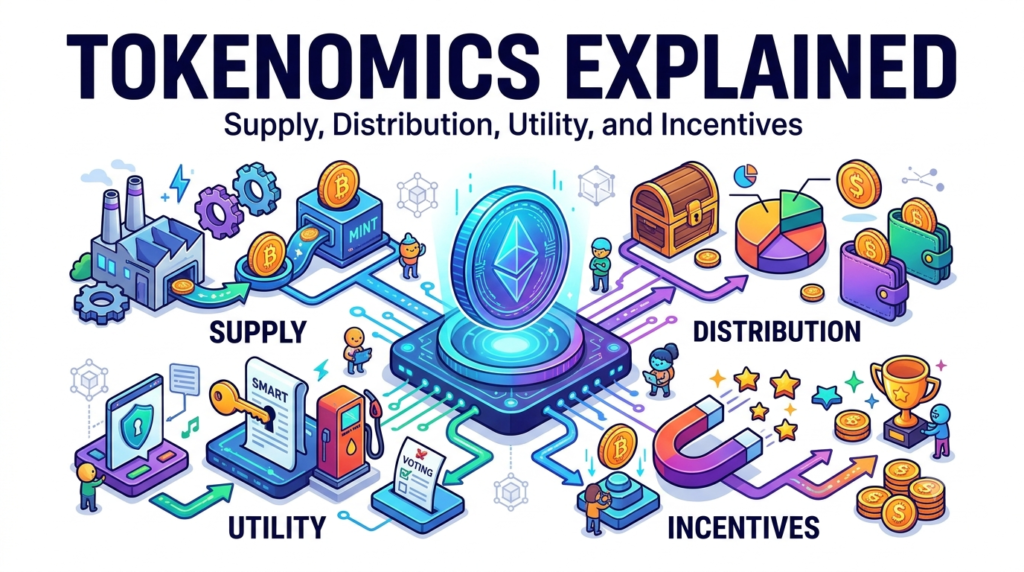
Two crypto projects can launch with identical software code, similar developer teams, and comparable marketing budgets—yet one builds lasting ecosystem value while the other collapses within months. The difference rarely comes down to technology alone. More often, it comes down to tokenomics.
Short for “token economics,” tokenomics refers to the rules, math, and behavioral incentives that govern how a cryptocurrency works. Just as central banks manage interest rates and money supply to keep an economy stable, blockchain founders design tokenomics to control how tokens are created, shared, used, and removed from circulation.
For readers exploring digital assets on cryptoblockcoins.com, understanding tokenomics is one of the most practical ways to evaluate whether a crypto project is built for real network usage or short-term speculation.
Why Token Design Shapes Long-Term Crypto Value
Every blockchain network faces a coordination problem: how do you get strangers around the world to secure servers, provide liquidity, build apps, and use the network without a traditional corporation paying salaries?
Tokenomics solves this through digital economic rules embedded directly into smart contracts. When designed well, a token aligns the interests of founders, early investors, validators, and everyday users. When designed poorly, early insiders dump their holdings onto retail buyers, inflation erodes purchasing power, or the token has no real reason to exist.
Think of tokenomics as an ecosystem’s plumbing. Even the best-looking house fails if the pipes leak faster than water enters.
Pillar 1: Token Supply and Emission Mechanics
The first place to examine any cryptocurrency is its supply structure. Knowing how many tokens exist today—and how many will enter the market tomorrow—helps reveal potential dilution?.
Three Core Supply Metrics
| Metric | What It Measures | Why It Matters |
|---|---|---|
| Circulating Supply | Tokens currently unlocked and tradable in the public market. | Used to calculate current market capitalization (Price × Circulating Supply). |
| Total Supply | All tokens currently created, including locked or staked tokens, minus burned tokens. | Shows how much supply already exists behind the scenes. |
| Max Supply | The hard cap on the total number of tokens that can ever exist. | Determines whether a token has built-in scarcity (like Bitcoin’s 21 million cap). |
Inflationary vs. Deflationary Models
Not every token needs a fixed cap to succeed, and a fixed cap does not guarantee price growth. Projects generally follow one of two monetary paths:
- Deflationary or Hard-Capped Tokens: Bitcoin is the clearest example, capping total issuance at 21 million coins and cutting mining rewards roughly every four years through halving events. Other networks use token burns, permanently sending a portion of transaction fees to an unrecoverable wallet address to shrink supply over time.
- Inflationary Tokens: Many Proof-of-Stake networks continuously mint new tokens to pay validators for securing the blockchain. While this increases total supply, steady issuance ensures network security remains funded long after initial launch funds run out.
A common mistake among newcomers is focusing only on a low token price while ignoring Fully Diluted Valuation (FDV)—the theoretical market cap if every single token were unlocked today. A token trading at $1 with only 10% of its supply in circulation faces heavy future sell pressure as the remaining 90% unlocks.
Pillar 2: Token Distribution and Vesting Schedules
How tokens are divided at launch tells you who holds power and who might sell first. Projects typically allocate tokens across several groups:
- Founding team and core developers
- Early venture capital or private seed investors
- Public sale participants
- Community rewards, airdrops, and ecosystem grants
- Project treasury for future operations
How Cliffs and Vesting Protect Markets
If founders and private investors received 100% of their tokens on day one, they could sell immediately at a massive profit, crashing the market for everyday participants. To prevent this, credible projects lock insider tokens using two mechanisms:
- The Cliff: A strict waiting period (often 6 to 12 months) after launch during which zero locked tokens are released.
- Vesting Period: The gradual release schedule after the cliff ends—such as unlocking 1/24th of an allocation each month over two years.
If a single entity or small group of insiders controls more than 40% to 50% of the total supply, the project carries high centralization and sell-off risk. Transparent projects publish clear unlock calendars on-chain so anyone can verify when large token batches will hit the market.
Pillar 3: Token Utility — Why Anyone Needs the Token
Supply limits mean very little if nobody actually needs the token. Token utility defines the real jobs a token performs inside its ecosystem. Without clear utility, demand relies purely on traders hoping someone else will pay a higher price later.
Common utility functions include:
- Transaction Fees (Gas): Users pay native tokens to process transfers or execute smart contracts, as seen with ETH on Ethereum or SOL on Solana.
- Network Security (Staking): Token holders lock up assets to validate transactions and earn protocol rewards, taking supply out of active trading circulation.
- Governance Rights: Holders vote on software upgrades, fee changes, or treasury spending. (Note: Governance alone often struggles to sustain value unless paired with protocol revenue or deeper utility.)
- Collateral and DeFi Access: Tokens serve as collateral for decentralized loans, liquidity pools, or payment discounts within specific applications.
A helpful test when researching a crypto asset is simple: If you removed this token from the platform and replaced it with a regular stablecoin, would the product still work just as well? If the answer is yes, the token may be unnecessary.
Pillar 4: Network Incentives and Behavioral Alignment
Incentives are the engine that keeps a decentralized network running without a central boss. Tokenomics uses financial rewards and penalties to guide participant behavior.
Rewarding Helpful Behavior
- Validators and Miners: Earn block rewards and transaction fees for keeping accurate records and processing transactions honestly.
- Liquidity Providers: Earn a share of trading fees or bonus tokens when they deposit assets into decentralized exchanges so other users can trade smoothly.
- Long-Term Stakers: Often receive boosted voting power or higher yield tiers when they commit tokens for longer periods.
Penalizing Harmful Behavior
Good incentive design also includes consequences. In Proof-of-Stake blockchains, validators who go offline repeatedly or attempt to approve fraudulent transactions face slashing?. By putting real money at risk, the protocol makes cheating far more expensive than following the rules.
The Danger of Unsustainable Yield
During bull markets, many projects attract users by offering triple-digit annual percentage yields (APYs) paid out in newly printed tokens. While this creates fast initial growth, these “mercenary” users usually sell their reward tokens immediately and leave the moment rewards drop. Sustainable incentives tie rewards to genuine protocol revenue—such as trading fees or borrowing interest—rather than endless token printing.
Red Flags to Watch Before Trusting a Token Model
When reviewing a project’s whitepaper or tokenomics dashboard, keep an eye out for these warning signs:
- Massive Upcoming Unlocks: More than 10% to 15% of the circulating supply unlocking in a single month can create sudden downward price pressure.
- Vague “Ecosystem” Allocations: Large pools of tokens set aside without clear rules or multi-signature wallet transparency can be spent without community oversight.
- No Clear Demand Sink: Tokens that are endlessly earned as rewards but never spent, locked, or burned almost always trend downward over time.
- Anonymous Teams with Short Lockups: If founders can cash out within three months of launch, their long-term commitment to building the product is questionable.
Frequently Asked Questions (FAQs)
1. Is a low maximum supply always better for a cryptocurrency?
Not necessarily. A token with a 10,000 max supply and zero real-world usage has no inherent value, while a network with a larger supply and strong daily transaction demand can thrive. Supply only matters in relation to actual demand and how quickly new tokens enter circulation.
2. What is the difference between a coin and a token in tokenomics?
A coin (like Bitcoin or Ether) operates on its own independent blockchain and is primarily used to pay transaction fees and secure that network. A token is built on top of an existing blockchain using smart contracts and usually powers a specific application, game, or decentralized finance protocol.
3. Why do crypto prices often drop right before or after a token unlock?
When large allocations for early investors or team members unlock, traders anticipate that some holders will sell to lock in profits. Even before the unlock date arrives, market participants frequently sell early to avoid expected price drops.
4. How does token burning affect holders?
Token burning permanently removes coins from circulation, reducing total supply. If demand stays the same or grows while supply shrinks, each remaining token represents a slightly larger share of the network—similar in concept to a corporate stock buyback, though price increases are never guaranteed.
5. Where can I verify a project’s actual tokenomics data?
Avoid relying solely on marketing graphics. You can cross-check live circulating supply, wallet concentration, and smart contract locks using blockchain explorers (such as Etherscan or Solscan) and independent analytics trackers like Tokenomist or DefiLlama.
Bringing the Four Pillars Together
Tokenomics is not a magic formula that predicts exact prices, nor does a great spreadsheet save a product nobody wants to use. Instead, evaluating supply, distribution, utility, and incentives together gives you a realistic lens into how a crypto project behaves under pressure. When supply emissions are predictable, insider unlocks are fair, utility creates genuine demand, and incentives reward long-term participation over quick exits, a digital asset stands a far stronger chance of surviving beyond hype cycles.