Imagine moving $200 between two digital wallets. On one network, the transfer settles in two seconds for less than a tenth of a cent. On another, the exact same $200 transfer costs $6 and takes ten minutes. To anyone new to cryptocurrency, this price gap feels arbitrary—as if networks pick numbers out of thin air.
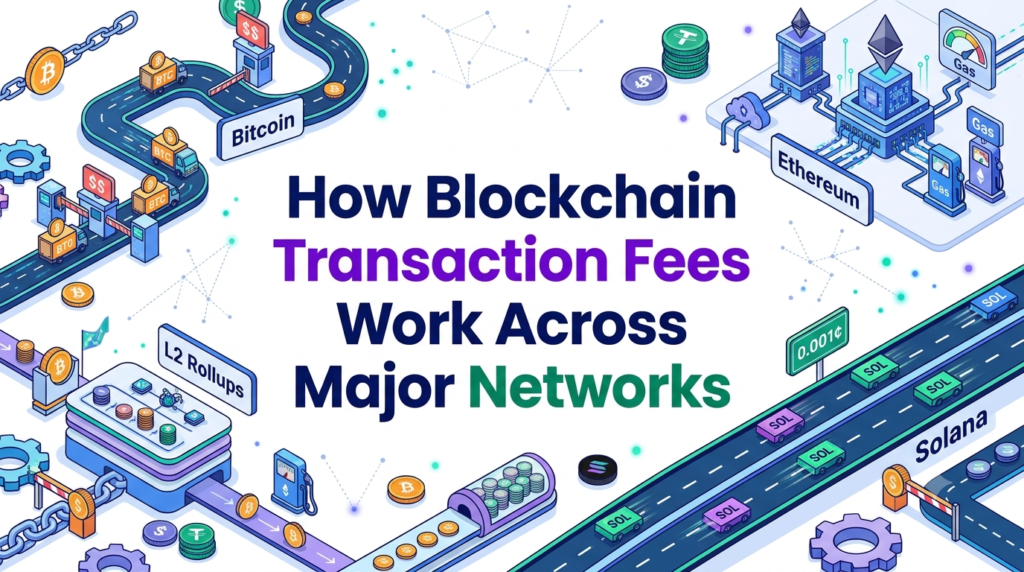
In reality, every public blockchain operates like a digital highway with its own toll system. Some charge by vehicle weight, others by engine power, and a few use prepaid commuter passes. Understanding how these toll systems work gives you control over how much you pay every time you move digital assets.
The Core Economics Behind Network Fees
Traditional banks absorb infrastructure costs behind the scenes and recoup them through account fees, merchant charges, or lending spreads. Public blockchains have no corporate owner paying for servers. Instead, independent computers—called miners or validators—process transactions and maintain the shared ledger.
Network fees exist to solve two operational problems:
- Paying for block space: Every block added to a blockchain has a strict data or computational limit. Fees pay validators for the hardware, electricity, or staked capital required to verify your transfer.
- Filtering out spam: If sending a transaction were completely free on every chain, anyone could flood the network with millions of automated requests and freeze legitimate activity. Even a fraction-of-a-cent fee makes large-scale spam expensive.
Crucially, blockchains do not charge a percentage of the dollar amount you send. Sending $5 and sending $5,000 require the exact same technical work from the network, so both cost the exact same fee.
Four Distinct Ways Blockchains Price Transactions
Because different blockchains are built for different purposes—some prioritize maximum security, while others prioritize high-speed payments—they rely on four main pricing architectures.
1. The Data-Weight Auction Model (Bitcoin)
Bitcoin treats block space like cargo space on a delivery truck. It does not care how valuable your package is; it only cares how much physical data space your transaction takes up, measured in virtual bytes (vB).
- Mempool bidding: When you hit send, your transaction enters a waiting queue called the mempool. You attach a bid measured in satoshis per virtual byte (
sat/vB). Miners pack the highest-paying transactions into the next block roughly every 10 minutes. - Input complexity: If you received Bitcoin across ten separate small payments and later send the combined total to someone else, your transaction references ten past inputs. That creates a larger data footprint and a higher fee than sending funds received in a single deposit.
2. The Computational Gas Model (Ethereum and EVM Chains)
Blockchains that run smart contracts—such as Ethereum, BNB Smart Chain, and Avalanche—must measure more than just data size. Executing a decentralized exchange swap or minting a digital collectible requires far more computing power than sending a simple payment.
These networks measure computing effort in gas:
- Fixed work, floating price: A standard ETH transfer always requires 21,000 units of gas. A complex decentralized finance (DeFi) swap might require 150,000 units.
- Dynamic base fee: Ethereum automatically adjusts its base gas price (quoted in gwei) depending on how full the previous block was. During quiet hours, the base price drops; during major market volatility, it rises.
- Validator tips: Users can add a small priority tip so validators pick up their transaction in the very next 12-second block.
3. The Bundled Rollup Model (Arbitrum, Base, Optimism)
Layer 2 (L2) networks sit on top of Ethereum to relieve congestion. Instead of making Ethereum process every single user transfer individually, an L2 executes thousands of transactions off the main chain, compresses them into a single data batch, and posts that summary back to Ethereum.
Because hundreds of users split the cost of posting one compressed batch—and Ethereum provides dedicated low-cost data storage (“blobs”) for rollups—individual L2 fees typically remain between $0.01 and $0.10.
4. Fixed-Rate and Resource-Staking Models (Solana, XRP Ledger, Tron)
Several networks avoid competitive fee auctions altogether to keep costs predictable:
- Solana: Charges a tiny, deterministic base fee per cryptographic signature (0.000005 SOL, usually well under a penny). Users only add extra priority fees when competing for speed during viral token launches.
- XRP Ledger & Stellar: Built specifically for rapid cross-border settlement, both networks destroy a minuscule amount of native tokens (fractions of a cent) per transfer to prevent spam without creating fee spikes.
- Tron: Replaces traditional gas with two account resources—Bandwidth and Energy. Basic TRX transfers use free daily Bandwidth, while smart-contract transfers like TRC-20 USDT consume Energy. If your wallet has not staked TRX to generate Energy, the network automatically burns roughly $1 to $3 worth of TRX to complete the stablecoin transfer.
Real-World Scenario: Moving $100 in Stablecoins
To see how network architecture affects your wallet in practice, compare what happens when you transfer $100 in USDC or USDT across four common routes under normal traffic:
- Via Ethereum Mainnet: You pay $1.50 to $5.00 in gas. That represents up to 5% of your transfer—expensive for a $100 payment, though negligible if you were moving $100,000.
- Via Tron (TRC-20): Without staked TRX energy in your wallet, the protocol burns around $1.00 to $3.00 in TRX.
- Via Base or Arbitrum (Ethereum L2): The transfer settles in seconds for $0.01 to $0.05, keeping 99.95% of your funds intact.
- Via Solana or Lightning Network: The transfer settles almost instantaneously for less than $0.01.
Comparing Fee Mechanics Across Popular Blockchains
| Blockchain | Architecture | What Determines the Price? | Typical Fee Range | Confirmation Time |
| Bitcoin | Layer 1 | Data size (vB) + mempool demand | $0.50 – $5.00 | ~10 minutes |
| Lightning Network | Bitcoin Layer 2 | Off-chain payment channel routing | Under $0.01 | Instant |
| Ethereum | Layer 1 | Smart contract complexity + network load | $1.00 – $10.00+ | ~12 seconds |
| Base / Arbitrum | Ethereum Layer 2 | L2 execution + shared L1 batch posting | $0.01 – $0.10 | ~1–2 seconds |
| Solana | Layer 1 | Fixed signature fee + optional priority | Under $0.001 – $0.02 | ~400 milliseconds |
| XRP Ledger / Stellar | Layer 1 | Minimal fixed anti-spam token burn | Under $0.001 | ~3–5 seconds |
| Tron | Layer 1 | Bandwidth & Energy (or TRX burn) | $1.00 – $3.00 (USDT) | ~3 seconds |
Why Exchange Withdrawal Fees Differ From On-Chain Fees
Many newcomers notice that withdrawing crypto from a centralized exchange costs $5 or $10 even when public blockchain trackers show network fees at $0.10.
This gap exists because exchange withdrawal fees are set by the platform, not the blockchain. Centralized exchanges batch customer withdrawals, maintain cold-storage security systems, and frequently apply a flat service markup. When you hold assets in a self-custodial wallet, you pay only the direct blockchain network fee with no middleman markup.
Habits That Keep Your Transfer Costs Low
- Check supported networks before withdrawing: Most major exchanges let you withdraw stablecoins like USDC across several chains. Selecting Arbitrum, Base, Polygon, or Solana instead of Ethereum mainnet often cuts withdrawal costs dramatically.
- Avoid peak market hours for L1 transactions: Bitcoin and Ethereum fees regularly dip during weekends and off-peak global trading hours when fewer traders are rushing to execute swaps.
- Never choose a network blindly: A cheap network only works if the receiving wallet or exchange explicitly supports that exact chain. Sending tokens over an unsupported network can make funds unrecoverable.
- Consolidate small balances during quiet periods: If you hold Bitcoin across many tiny incoming transactions, consolidating them into a single wallet address while
sat/vBrates are low saves money before an urgent transfer later.
Frequently Asked Questions
Can a blockchain transaction have zero fees?
A few specialized networks, such as Nano, eliminate direct monetary fees by requiring devices to perform a tiny anti-spam calculation instead. On mainstream chains like Bitcoin or Ethereum, however, zero-fee transactions are generally ignored by validators.
Why do NFT mints and DeFi swaps cost more than simple transfers?
Sending a coin only updates two account balances. Minting an NFT or swapping tokens forces the blockchain to run multi-step smart contract code, check liquidity pools, and write new ownership records—all of which consume more gas.
Does a faster blockchain always mean higher fees?
No. Speed depends on a network’s consensus design and hardware requirements, not its fee price. Networks like Solana and Stellar finalize transactions in a few seconds for fractions of a cent, whereas Bitcoin takes roughly ten minutes and often costs several dollars.
What should I do if a transaction gets stuck due to low fees?
On Bitcoin, many modern wallets offer Replace-by-Fee (RBF), which lets you rebroadcast the stuck transfer with a higher sat/vB rate. On Ethereum, you can submit a replacement transaction using the exact same “nonce” (transaction number) with a higher gas tip to override the pending one.
Matching the Network to Your Goal
Every blockchain fee structure reflects an intentional engineering trade-off. High-value settlements benefit from the deep security and liquidity of Bitcoin and Ethereum Layer 1, while everyday payments, stablecoin transfers, and active trading run far more efficiently on Layer 2 rollups or high-throughput chains like Solana. Checking how a network prices block space—and confirming address compatibility before hitting send—ensures your funds move smoothly without unnecessary expense.