Introduction
In the modern world of decentralized finance and rapid cloud expansion, the traditional methods of securing software are being replaced. Security is no longer seen as a final hurdle to be cleared before a product is launched. Instead, it is being integrated into the very foundation of the development process. This transition is being led by the Certified DevSecOps Engineer. For professionals who are navigating the complexities of global tech markets, mastering this discipline is essential for protecting digital assets and maintaining system integrity.
Defining the Certified DevSecOps Engineer
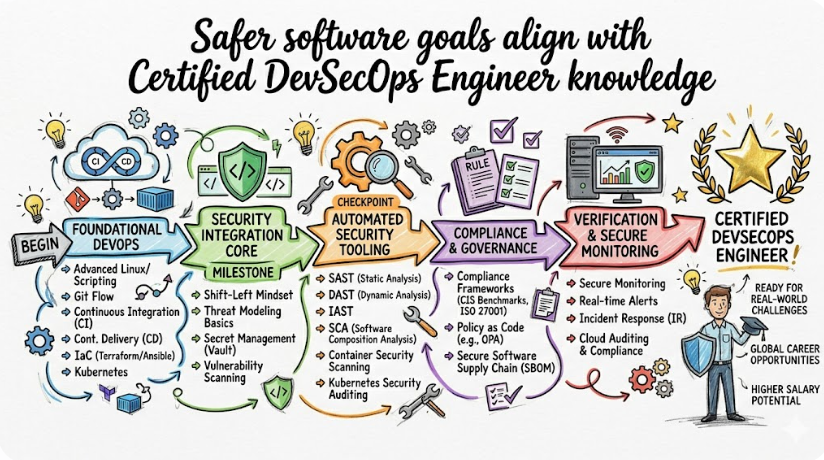
A Certified DevSecOps Engineer is a specialist who is trained to automate security within the DevOps lifecycle. The primary goal is for security testing to be shifted to the earliest stages of development, a concept known as “shifting left.” Instead of relying on manual audits that slow down production, automated tools are utilized to scan for vulnerabilities, manage secrets, and ensure compliance in real-time.
In this role, the focus is moved from being a gatekeeper to becoming a facilitator of secure code. The frameworks required for developers to catch security flaws before they ever reach a live environment are created by these experts. This approach is particularly vital in the blockchain space, where vulnerabilities can lead to immediate and irreversible losses.
Why it matters today?
The global technology landscape is currently facing a massive increase in automated cyber threats. As more infrastructure is moved to the cloud, the potential points of attack are multiplied. General IT knowledge is no longer sufficient to protect high-stakes environments. The expertise of a Certified DevSecOps Engineer is required to build systems that are secure by design rather than secure by accident.
For organizations involved in cryptocurrency and blockchain, security is the primary source of user trust. A single compromised pipeline or a leaked private key can result in a total loss of reputation. By integrating security into the automated workflow, these risks are significantly mitigated. Security is transformed from a bottleneck into a powerful business advantage.
Why Certified DevSecOps Engineer certifications are important?
Certifications are utilized by the industry to verify that a professional possesses verified, hands-on skills. While years of experience are valuable, a Certified DevSecOps Engineer credential provides a structured and standardized proof of competence. It is ensured through this program that the latest tools, methodologies, and compliance standards are understood and can be applied to real-world scenarios.
Furthermore, these credentials are often required by major engineering firms and government contractors during the recruitment process. A clear signal is sent to the market that a professional is dedicated to staying at the forefront of the industry. Career paths are often accelerated, and access to senior-level roles is granted to those who hold this specific certification.
Why Choose DevSecOpsSchool?
The decision of where to pursue training is a major factor in career success. DevSecOpsSchool is chosen by professionals worldwide because the training is built on real-world industry needs. Every module is designed to focus on the practical application of tools rather than just theoretical concepts.
Several reasons are found for selecting this institution:
Career Growth: Support is offered through interview kits and resume assistance, helping many individuals secure better roles in the tech market.
Real-World Expertise: Instruction is provided by mentors who have spent decades in the industry.
Hands-On Learning: A heavy focus is placed on lab environments where actual security scenarios are practiced.
Lifetime Support: Access to the Learning Management System (LMS) is provided for a lifetime, ensuring that resources are always available.
4. In-Depth Look: Certified DevSecOps Engineer
What is this certification?
This is a professional-grade program designed to teach the seamless integration of security into the automated software delivery process. The focus is placed on using security-as-code to automate audits, vulnerability scans, and compliance checks.
Who should take this certification?
This program is ideal for Software Developers, DevOps Professionals, Cloud Architects, and Security Analysts. It is also highly recommended for Engineering Managers who are responsible for overseeing secure digital transformations.
Certification Comparison Matrix
| Track | Level | Ideal For | Prerequisites | Core Skills | Recommended Order |
| DevSecOps | Intermediate | DevOps Engineers | Basic Linux | SAST, DAST, IAST | 2nd |
| DevOps | Foundation | Developers | Basic Coding | CI/CD, Automation | 1st |
| SRE | Advanced | Platform Engineers | DevOps Knowledge | Reliability, Monitoring | 3rd |
| AIOps/MLOps | Specialist | Data Scientists | Python | ML Security, AI Ops | 4th |
| DataOps | Specialist | Data Engineers | SQL Knowledge | Data Pipeline Security | 4th |
| FinOps | Management | Finance Leads | Cloud Knowledge | Cost Optimization | 5th |
Skills to be Acquired
- The ability to automate security scanning within Jenkins or GitLab pipelines is mastered.
- Expertise in Static and Dynamic Application Security Testing (SAST/DAST) is developed.
- Knowledge of securing containerized environments and Kubernetes clusters is gained.
- Skills in managing sensitive secrets and encryption keys are refined.
- The creation of automated compliance reports for regulatory audits is learned.
Real-World Projects to be Completed
- A fully automated and secure CI/CD pipeline is designed and implemented.
- A comprehensive security assessment is performed on a microservices-based application.
- Secure infrastructure is deployed using automated “Infrastructure as Code” templates.
- A centralized secret management system is built to protect sensitive production data.
- Automated vulnerability remediation workflows are created for a development team.
Preparation Strategies
The 14-Day Sprint
In this timeframe, the focus is placed entirely on the core exam objectives. Daily study sessions of several hours are required. The official documentation is reviewed, and basic labs are performed to gain familiarity with the primary tools.
The 30-Day Balanced Plan
This is the preferred approach for most working professionals. A few hours are dedicated each evening to learning. The first half of the month is spent on theoretical concepts, while the second half is used for practical projects and mock exams.
The 60-Day Comprehensive Path
This path is recommended for those who are transitioning from other fields. A deep dive is taken into every tool in the DevSecOps stack. Ample time is allowed for experimentation in lab environments and participation in community forums.
Mistakes to be Avoided
- The cultural shift required for DevSecOps is often ignored in favor of just learning tools.
- Relying solely on automated tools without understanding the underlying security principles is discouraged.
- Skipping the official provider documentation is a common error that leads to knowledge gaps.
- Failing to spend enough time in hands-on lab environments is a frequent cause of exam failure.
The Next Logical Steps
- Same Track: Advanced DevSecOps Professional.
- Cross-Track: Certified SRE to focus on system scalability and uptime.
- Leadership: Certified Engineering Manager for those moving into people management.
5. Selecting the Right Learning Path
1. The DevOps Foundation
This path is chosen by those who want to master the art of automation and software delivery. It serves as the essential starting point for all other technical tracks.
2. The DevSecOps Specialty
This is the path for security-minded individuals. It is designed for those who want to ensure that every release is safe, compliant, and protected from modern threats.
3. Site Reliability Engineering (SRE)
This path is best for professionals focused on the stability of large-scale systems. The management of high-traffic environments with zero downtime is the primary goal here.
4. AIOps and MLOps
This is best for those working at the intersection of AI and operations. The focus is placed on using machine learning to predict system failures and securing AI models.
5. DataOps Excellence
This path is for data professionals who need to ensure that information flows securely across an organization. Data privacy and pipeline integrity are the core focuses.
6. The FinOps Strategy
This is chosen by those responsible for the financial accountability of the cloud. The optimization of cloud costs while maintaining performance is learned here.
6. Role to Certification Alignment Table
| Professional Role | Initial Certification | Secondary Certification | Career Growth Cert |
| DevOps Engineer | Certified DevOps Engineer | Certified DevSecOps Engineer | Certified SRE |
| SRE | Certified SRE | Certified AIOps | Engineering Manager |
| Platform Engineer | Cloud Architect | Certified DevSecOps Engineer | FinOps Practitioner |
| Cloud Engineer | Cloud Foundation | Certified DevSecOps Engineer | Cloud Security Expert |
| Security Engineer | Certified DevSecOps Engineer | PenTest Specialist | Security Director |
| Data Engineer | Certified DataOps | Certified MLOps | Data Architect |
| FinOps Practitioner | FinOps Foundation | Cloud Governance Cert | IT Finance Manager |
| Engineering Manager | Management Cert | Certified DevSecOps Engineer | CTO Track |
7. Supporting Educational Institutions
DevOpsSchool
Full support for the Certified DevSecOps Engineer program is provided by this institution. A massive library of technical assets and professional mentorship is made available. Career transformation through practical skills is the primary focus.
Cotocus
Customized training programs for enterprise teams are offered here. The modules are designed to align with specific corporate security goals. High success rates are consistently reported by their students.
ScmGalaxy
A global community and extensive knowledge base are maintained by this platform. Free tutorials and industry blogs are provided to help professionals stay updated with the latest trends.
BestDevOps
Simplified and efficient learning paths are created for busy professionals. The goal is to make complex security topics easy to understand and apply in a professional setting.
devsecopsschool.com
This is the specialized hub for the Certified DevSecOps Engineer community. Deep-dive resources into security automation tools are found here. It is a primary destination for technical learners.
sreschool.com
A dedicated focus on system reliability and performance is maintained here. Training on how to manage enterprise-level systems with minimal downtime is provided.
aiopsschool.com
The use of Artificial Intelligence in IT operations is explored. Training on how to use machine learning for automated incident response is the core offering.
dataopsschool.com
The security and efficiency of data pipelines are addressed. This institution is ideal for data professionals who need to manage large-scale data securely.
finopsschool.com
The financial management of cloud resources is taught here. Training on how to balance cost, speed, and quality in the cloud is provided.
8. Frequently Asked Questions
1. How difficult is the certification exam?
The exam is considered to be of moderate difficulty. A strong grasp of both security principles and automation tools is required for success.
2. What is the typical preparation time?
Most professionals require between 4 to 8 weeks of consistent study to feel fully prepared for the exam.
3. Are there any strict prerequisites?
No official prerequisites are mandated, but a foundational knowledge of Linux and DevOps is highly recommended.
4. What is the career value of this credential?
The value is very high. Certified individuals are often eligible for senior roles and command higher salary packages in the global market.
5. Which job titles can be held after certification?
Titles such as DevSecOps Engineer, Security Architect, and Cloud Security Engineer are commonly held by certified professionals.
6. Is this program recognized internationally?
Yes, the certification is respected by top-tier technology companies and startups across the globe.
7. How is the training delivered?
A combination of live online classes and self-paced video modules is typically used to deliver the curriculum.
8. Are practical projects included?
Yes, completing hands-on, real-world projects is a mandatory part of the certification process.
9. Does the certification need to be renewed?
Renewal is generally suggested every two to three years to ensure that the professional stays current with new technologies.
10. Can a developer benefit from this?
Absolutely. Developers learn to write more secure code and understand the infrastructure on which their applications run.
11. Is there a community for graduates?
Yes, an active network of alumni and experts is available for ongoing networking and technical support.
12. What specific tools are learned?
A wide range of tools, including Jenkins, Docker, Kubernetes, Vault, and various scanning utilities, are covered.
Additional FAQs for Certified DevSecOps Engineer
1. Is the exam more focused on theory or practice?
A balanced approach is taken, but the ability to solve practical security problems is heavily tested.
2. Is a deep coding background required?
While you do not need to be a senior coder, the ability to read code and write basic scripts for automation is necessary.
3. How often is the course material updated?
The material is updated on a regular basis to include the latest security threats and tool updates.
4. Are there options for group training?
Yes, group training and corporate batches are often arranged by providers like Cotocus.
5. What is the passing score for the exam?
The passing score is usually set at around 70%, ensuring a high standard of expertise.
6. Can freshers apply for this?
Yes, though it is recommended that a basic DevOps course be completed first to build a solid foundation.
7. Is a lab guide provided for self-study?
Yes, a detailed lab guide is provided to ensure that all practical exercises can be completed successfully.
8. How does this help in a management role?
It provides the technical depth needed to oversee security projects and make informed decisions about infrastructure.
9. Testimonials
Kavya
A significant shift in my career was experienced after completing this program. The ability to automate security checks within our deployment pipeline was gained. My confidence in handling production environments has increased tremendously.
Ishaan
The way the complex security topics were broken down into simple steps was very impressive. The hands-on labs provided a level of practical understanding that is rarely found in other courses. It has been a highly valuable investment.
Rohan
As an SRE, understanding the security aspect was the missing piece of my professional profile. This certification helped me fill that gap. The skills are now applied daily to ensure our systems are resilient against attacks.
Sana
The structured learning path provided by the mentors made it easy to stay on track. The interview preparation was particularly helpful in securing my new role as a DevSecOps Lead. I highly recommend this program to anyone in the field.
Ankit
The practical insights shared during the training sessions were directly applicable to my current work. I am now able to lead security initiatives that were previously handled by external consultants. My value within the company has grown significantly.
10. Summary and Conclusion
The path to becoming a Certified DevSecOps Engineer is one of the most strategic choices a tech professional can make today. As the industry continues to move toward automated and decentralized systems, the need for secure delivery will only intensify. By mastering these skills, engineers are able to protect their organizations and significantly advance their own career trajectories.
Strategic learning and careful planning are encouraged for everyone. By choosing a reputable institution like DevOpsSchool, a solid foundation for long-term career growth is established. The future of technology is not just about speed; it is about the security and trust that only a DevSecOps mindset can provide.