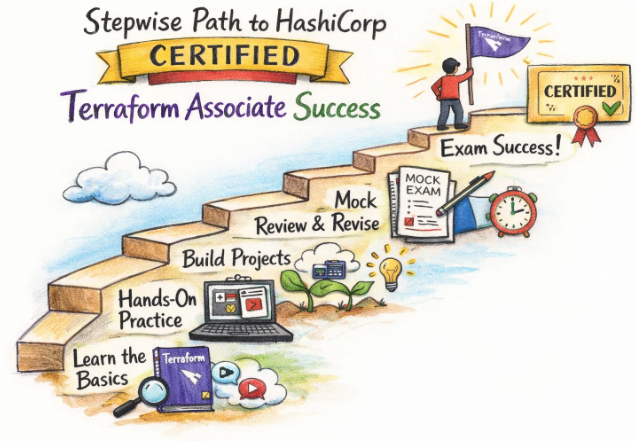
Introduction
The landscape of modern technology is being reshaped by the transition from manual operations to automated systems. In this new era, infrastructure is no longer viewed as a collection of physical hardware but is instead treated as software. For any professional aiming to remain relevant in the current job market, the ability to manage “Infrastructure as Code” (IaC) is essential.
One specific tool has risen to the top of this revolution: Terraform. It is used by the world’s largest organizations to build and manage their digital foundations. This guide is written to provide a fresh perspective on how the Hashicorp Certified Terraform Associate credential can be used to future-proof a career and achieve technical excellence.
Understanding the Hashicorp Certified Terraform Associate
The Hashicorp Certified Terraform Associate is a professional validation that confirms a person’s ability to use the Terraform toolset effectively. It is not just about knowing commands; it is about understanding how automated infrastructure is governed, secured, and scaled.
By earning this certification, a clear signal is sent to the industry. It proves that the fundamental principles of automation are understood. The certification covers the entire lifecycle of infrastructure, from the initial writing of configuration files to the ongoing management of the “state” which keeps everything synchronized.
Why it matters in today’s software, cloud, and automation ecosystem
The demand for speed in software delivery has never been higher. Systems are expected to be deployed across multiple regions and cloud providers instantly. When manual processes are used, errors are introduced and security risks are created. Terraform solves this by allowing infrastructure to be defined in a human-readable language that can be audited and versioned.
Because Terraform is designed to work with almost any service provider, it has become the “universal language” of the cloud. Knowledge of this tool is highly sought after because it allows a single engineer to manage complex environments across AWS, Azure, Google Cloud, and even on-premise data centers. The ecosystem is moving toward total automation, and this certification is the gateway to that world.
Why certifications are important for engineers and managers
For the individual engineer, a certification acts as a structured path for growth. It ensures that no gaps are left in the learning process. Instead of learning only the features needed for a specific project, a broad understanding of the entire tool is developed. This leads to better decision-making and more robust system designs.
For engineering managers, certifications provide a level of standardized quality across a team. When every member of a platform team is certified, a common language is spoken, and a shared set of best practices is followed. This reduces the time spent on “re-working” code and increases the overall reliability of the company’s infrastructure. It is a tool for risk management as much as it is a tool for professional development.
Why choose DevOpsSchool?
Success in the certification journey is often determined by the quality of the guidance received. DevOpsSchool is chosen by professionals because the training is built on practical, hands-on experience rather than just theoretical slides. The complex nature of cloud automation is translated into simple, actionable steps that can be applied immediately in a professional setting.
The programs at DevOpsSchool are updated constantly to reflect the latest changes in the industry. Students are supported by a network of experts who have seen and solved real-world infrastructure challenges. By choosing this institution, a commitment is made to a high standard of learning that goes beyond simply passing an exam. It is about building a foundation for a long-term career in automation.
Certification Deep-Dive
What is this certification?
This is a professional-level exam that validates a candidate’s grasp of basic Terraform concepts. It is designed to test the practical application of Infrastructure as Code.
Who should take this certification?
It is ideal for anyone working in a technical role where cloud resources are managed. This includes Platform Engineers, DevOps specialists, and even Developers who want to take full control of their deployment pipelines.
Certification Overview Table
| Track | Level | Who it’s for | Prerequisites | Skills Covered | Recommended Order |
| DevOps | Associate | System Engineers | Basic Linux | Automation, CI/CD | 1st |
| DevSecOps | Associate | Security Analysts | Networking | Policy, Compliance | 2nd |
| SRE | Associate | Reliability Leads | Scripting | Scalability, State | 1st |
| AIOps/MLOps | Associate | Data Scientists | Cloud Basics | Model Hosting | 2nd |
| DataOps | Associate | Data Engineers | Database Knowledge | Pipeline Provisioning | 2nd |
| FinOps | Associate | Cost Managers | Business Ops | Resource Tagging | 3rd |
Skills you will gain
- The ability to transform manual cloud tasks into repeatable code.
- Deep knowledge of how Terraform providers connect to different cloud APIs.
- Proficiency in managing sensitive data and secrets within infrastructure code.
- Expertise in using “Modules” to create reusable templates for entire departments.
- Understanding of how to manage “State” to ensure the cloud always matches the code.
- Knowledge of team collaboration features found in Terraform Cloud.
Real-world projects you should be able to do after this certification
- A fully automated “landing zone” for a new company on a major cloud provider can be built.
- A self-healing infrastructure that automatically replaces failed servers can be designed.
- A global content delivery network (CDN) can be deployed across multiple continents with a single command.
- Automated security audits can be integrated into the infrastructure deployment process.
- Cost-saving measures, such as automatically shutting down non-essential servers, can be implemented through code.
Preparation plan
7–14 days plan
This intensive approach is reserved for those with current hands-on experience. The focus is directed toward the “details” of the exam, such as command flags and specific state file behaviors. Mock exams are taken repeatedly to ensure the pace of the test is mastered.
30 days plan
This is the standard path for most working professionals. Time is split between reading documentation and performing lab exercises. Each week is focused on a different domain of the exam, such as “Providers” or “Variables,” to ensure a balanced understanding is achieved.
60 days plan
This comprehensive plan is best for those new to the world of automation. The first month is dedicated to learning the fundamentals of cloud architecture. The second month is used to go through every single section of the Terraform documentation while building small, practical projects from scratch.
Common mistakes to avoid
- Manual Changes: Making changes in the cloud console instead of the code should be avoided at all costs.
- Poor State Management: The state file should never be shared manually; a remote backend should always be used.
- Ignoring Documentation: Third-party tutorials are helpful, but the official documentation is what the exam is based on.
- Over-complicating Code: Keep the configuration simple and readable so others can maintain it.
Best next certification after this
- Same track: Hashicorp Certified Vault Associate to master secret management.
- Cross-track: Certified Kubernetes Administrator (CKA) to manage containerized applications.
- Leadership / management: Cloud Digital Leader or IT Service Management certs for broader organizational impact.
Choose Your Learning Path
DevOps Path
This is the foundational path for the modern engineer. It focuses on the bridge between writing code and deploying it. Terraform is used to ensure that the environment where the code lives is as reliable as the code itself.
DevSecOps Path
In this path, security is treated as an integral part of the infrastructure. Terraform is used to enforce security policies automatically, ensuring that no server is ever deployed with an open security hole.
Site Reliability Engineering (SRE) Path
For those who care about the “health” of a system. This path uses Terraform to build systems that can withstand failure. It is about creating infrastructure that manages itself with minimal human intervention.
AIOps / MLOps Path
This path supports the heavy workloads required for Artificial Intelligence. Terraform is used to provision specialized hardware, like GPUs, in a cost-effective and scalable way.
DataOps Path
Data is the most valuable asset of any company. This path focuses on building the pipelines and storage systems needed to move and analyze data quickly and safely.
FinOps Path
This path is focused on the “bottom line.” Terraform is used as a financial tool to track every dollar spent in the cloud. It ensures that the speed of the cloud does not lead to a massive, uncontrolled bill.
Role → Recommended Certifications Mapping
| Role | Primary Cert | Secondary Cert | Advanced Goal |
| DevOps Engineer | Terraform Associate | AWS/Azure Dev | Lead Platform Eng |
| SRE | Terraform Associate | Observability Cert | Reliability Architect |
| Platform Engineer | Terraform Associate | Kubernetes Cert | Infrastructure VP |
| Cloud Engineer | Terraform Associate | Cloud Networking | Multi-Cloud Lead |
| Security Engineer | Terraform Associate | Vault Associate | DevSecOps Lead |
| Data Engineer | Terraform Associate | Big Data Cert | Data Architect |
| FinOps Practitioner | Terraform Associate | Cloud Economics | FinOps Director |
| Engineering Manager | Terraform Associate | Project Management | CTO |
Next Certifications to Take
Once the Terraform Associate level is achieved, the learning should not stop. The industry evolves rapidly, and staying ahead requires a diverse set of credentials.
- For the same-track learner: It is suggested that the Hashicorp Certified Vault Associate be pursued next. Securely managing credentials and secrets is the most natural extension of infrastructure management.
- For the cross-track learner: The Certified Kubernetes Administrator (CKA) is recommended. Since Terraform is often used to build Kubernetes clusters, knowing how to manage those clusters is a highly valuable skill set.
- For the leadership-focused learner: A focus on “Enterprise Architecture” or “Digital Transformation” certifications is advised. These provide the high-level perspective needed to lead entire departments through technological change.
Training & Certification Support Institutions
DevOpsSchool
A practical, hands-on environment is provided for students to master the latest automation tools. It is well-known for its deep connection to industry needs and its focus on job readiness.
Cotocus
Comprehensive training programs are offered for teams looking to modernize their infrastructure. A focus is placed on large-scale cloud migrations and the implementation of best-of-breed automation tools.
ScmGalaxy
A vast community-driven resource is provided for anyone interested in the technical side of software delivery. It serves as a central hub for learning materials, troubleshooting guides, and certification support.
BestDevOps
Simplified, easy-to-follow courses are provided for those who are just starting their journey into the cloud. The focus is kept on the most important skills needed to land a first job in the field.
devsecopsschool.com
Specialized training is offered at the intersection of security and engineering. It is the leading resource for learning how to automate security checks within the software development lifecycle.
sreschool.com
Education is focused entirely on the principles of Site Reliability Engineering. Students are taught how to build systems that are not just fast, but also incredibly resilient and reliable.
aiopsschool.com
Forward-looking training is provided on how Artificial Intelligence is being used to manage IT operations. It prepares engineers for a future where systems are managed by intelligent algorithms.
dataopsschool.com
Training is focused on the unique challenges of managing data at scale. It teaches how DevOps principles can be applied to data pipelines to increase speed and accuracy.
finopsschool.com
A clear path is provided for learning the art and science of cloud financial management. It helps professionals bridge the gap between technical operations and financial accountability.
FAQs Section
1. Is the Terraform Associate exam considered difficult?
The exam is viewed as a fair test of knowledge. It is difficult enough to be respected by employers but can be passed with dedicated study and practice.
2. What is the recommended preparation time?
A period of 4 to 8 weeks is usually suggested for most candidates. This allows enough time for the concepts to be fully understood and practiced in a lab environment.
3. Are there any mandatory prerequisites?
No official prerequisites are required by Hashicorp. However, an understanding of basic networking and cloud services is very helpful.
4. In what order should DevOps certifications be earned?
It is often recommended to start with a foundational cloud certification, followed by Terraform, and then Kubernetes.
5. How much weight does this certification carry with employers?
It is highly valued because it proves that an engineer can work across different cloud providers using a standardized tool.
6. Can the exam be taken from a home office?
Yes, the exam is conducted online and is proctored remotely to ensure the integrity of the process.
7. When does the certification expire?
The credential is valid for two years. Periodic re-certification is required to ensure that the latest features and best practices are known.
8. What format is used for the exam questions?
Multiple-choice, multiple-response, and true/false questions are used. There is no requirement to write live code during the exam.
9. Is the exam available in multiple languages?
English is the primary language used for the exam, though other languages may be supported in the future.
10. What score is needed to pass?
While the exact passing score is not publicized, a high level of accuracy across all domains is expected.
11. Does the exam cover Terraform Enterprise?
Yes, a basic conceptual understanding of the difference between the open-source and enterprise versions is required.
12. Can resources be used during the test?
No, it is a strictly proctored, closed-book exam. No external notes or documentation are permitted.
FAQs specifically for Hashicorp Certified Terraform Associate
1. Which version of Terraform is used for the current exam?
The exam is generally focused on the most recent stable versions. Candidates are encouraged to check the official Hashicorp site for the exact version details.
2. Is knowledge of specific AWS or Azure services required?
Deep knowledge of specific cloud services is not tested. The focus is kept on how Terraform manages those services regardless of the provider.
3. What is “Sentinel” and is it on the exam?
Sentinel is a policy-as-code tool. Only a high-level understanding of what it does is needed for the Associate level.
4. How much time is given to complete the exam?
A total of 60 minutes is provided to answer approximately 60 questions.
5. What are the most heavily weighted topics?
Terraform CLI usage, State management, and the use of Modules are typically the most important areas.
6. Do I need to be a programmer to pass?
Coding skills are not strictly required, but a comfort with logical structures and text-based configuration is essential.
7. If the exam is failed, how soon can it be retaken?
A short waiting period is usually required before a second attempt can be made. The full fee must be paid for each attempt.
8. Is this certification still useful for users of other IaC tools?
Yes, because the principles of state management and modular infrastructure are universal across almost all IaC tools.
Testimonials
The gap between theory and practice was bridged through this certification. A much higher level of precision is now brought to every infrastructure project.
— Anjali
Career growth was accelerated after the Terraform Associate credential was added to my profile. It provided the confidence needed to lead complex cloud migrations.
— David
A new perspective on automation was gained. The ability to manage multiple cloud providers through a single tool has transformed the way my team operates.
— Sandeep
The structured learning path provided by this certification was invaluable. It ensured that even the most advanced features of Terraform were mastered and understood.
— Isabella
The value of Infrastructure as Code was truly realized through this process. It has become an essential part of the daily workflow for my entire platform team.
— Karthik
Conclusion
The pursuit of the Hashicorp Certified Terraform Associate certification is a vital step for any professional in the cloud and automation space. It represents a commitment to modern engineering standards and a mastery of the tools that are driving the industry forward.
The long-term benefits of this path include not only career advancement but also the ability to build systems that are more secure, scalable, and reliable. A strategic approach to learning and certification is highly recommended for anyone looking to make a lasting impact in the tech world.