Introduction
The traditional methods of keeping an eye on software health are being challenged by the sheer scale of modern infrastructure. It is no longer considered sufficient to simply know that a service is “up” or “down.” A much more granular level of insight is demanded by the business world today. When a failure occurs in a distributed environment, the root cause is often buried under layers of abstraction. Therefore, a specialized approach is needed to peel back these layers and reveal the truth of system performance.
The pursuit of system transparency is what defines the modern engineering mindset. It is recognized that a “black box” approach to operations is a liability. Instead, systems must be designed and instrumented in a way that allows their internal states to be inferred from their external outputs. This shift in perspective is the foundation of the Master in Observability Engineering (MOE) journey. By adopting this discipline, the gap between “knowing that a problem exists” and “understanding why it happened” is effectively bridged.
Defining the Master in Observability Engineering (MOE) Concept
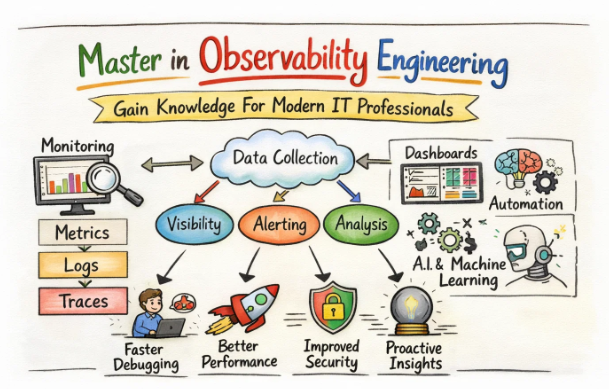
The Master in Observability Engineering (MOE) is understood as a high-level expertise that combines software development, system operations, and data analysis. It is not merely a job title, but a comprehensive understanding of how telemetry data—consisting of logs, metrics, and traces—is used to diagnose complex system behaviors. Through this expertise, the ability to ask arbitrary questions about a system without needing to ship new code is gained.
In this framework, the focus is shifted from reactive firefighting to proactive system design. The MOE practitioner is tasked with ensuring that every component of the architecture is capable of telling its own story. This involves the implementation of advanced tracing libraries, the management of high-volume log streams, and the creation of intelligent alerting thresholds. The ultimate goal of this discipline is to reduce the “mean time to resolution” (MTTR) and to provide a seamless experience for the end-user.
The Criticality of System Transparency in Today’s Ecosystem
The modern cloud and automation ecosystem is characterized by constant change. In such an environment, the presence of “silent failures” is a frequent occurrence. These are issues that do not trigger a traditional alarm but still negatively impact the user experience. Without a robust observability strategy, these problems are often left undetected for long periods.
Furthermore, the rise of automation means that systems are now making decisions on behalf of humans. Automated scaling and self-healing mechanisms are only as good as the data they receive. If the underlying data is incomplete or inaccurate, the automated actions taken can actually worsen a situation. Therefore, observability is seen as the vital sensory system for the modern automated enterprise. It provides the high-fidelity data required for both human engineers and automated systems to make informed decisions in real-time.
The Value of Professional Credentials for Technical Leadership
The importance of formal recognition in the form of certifications is often highlighted in the tech industry. For engineers, it is a way to prove that their skills have been vetted against a rigorous global standard. It provides a structured path for learning that covers all the necessary bases, from the basics of telemetry to the complexities of distributed debugging. A certification ensures that a professional is not just “familiar” with a tool, but is a master of the underlying principles.
For those in management or leadership positions, certifications are used as a tool for risk mitigation. When a project is staffed with certified experts, the likelihood of successful delivery and long-term stability is significantly increased. It also helps in establishing a common language and set of best practices across the organization. In a global job market, having a verified credential like the MOE is a clear signal of a professional’s dedication to staying at the forefront of their field.
Why the DevOpsSchool Methodology is Selected
The choice of a training institution is a critical decision for any professional. DevOpsSchool is frequently chosen because of its unique focus on real-world applicability. The curriculum is not just a collection of theoretical slides; it is a carefully crafted journey through the actual challenges faced by modern enterprises. The instructors are individuals who have spent years in the trenches of production environments, and this experience is reflected in the way the material is presented.
The support system provided by DevOpsSchool is another significant factor. From the moment of enrollment, students are integrated into a global network of practitioners. This community-driven approach ensures that learning continues long after the formal course is completed. By selecting this institution, an investment is made in a long-term career partner that provides the tools, knowledge, and connections needed to thrive in the competitive landscape of DevOps and SRE.
Certification Deep-Dive: Master in Observability Engineering (MOE)
What is this certification?
The MOE certification is a professional program that validates an individual’s ability to design, implement, and manage observability frameworks. It focuses on turning raw telemetry data into actionable business and technical insights.
Who should take this certification?
This program is intended for individuals who are currently working as software developers, site reliability engineers, or cloud architects. It is also suitable for technical managers who wish to understand the operational health of their products.
Certification Overview Table
| Track | Level | Who it’s for | Prerequisites | Skills Covered | Recommended Order |
| DevOps | Intermediate | Release Engineers | CI/CD Basics | Pipeline Visibility | 1 |
| SRE | Advanced | Reliability Leads | Cloud Admin | Incident Analysis | 2 |
| DevSecOps | Advanced | Security Analysts | Basic Security | Threat Observability | 3 |
| AIOps/MLOps | Expert | Data Scientists | ML Pipeline | Anomaly Detection | 4 |
| DataOps | Advanced | Data Engineers | SQL/ETL | Data Health Tracing | 5 |
| FinOps | Intermediate | Finance Leads | Cloud Billing | Cost Transparency | 6 |
Skills You Will Gain
- The ability to instrument various programming languages for custom telemetry.
- The mastery of distributed tracing to visualize request flow across services.
- The optimization of logging strategies to balance cost and visibility.
- The design of advanced dashboards that highlight system bottlenecks.
- The configuration of intelligent alerting systems to prevent burnout.
- The implementation of OpenTelemetry as a standardized data collection layer.
- The analysis of service-level indicators to ensure business goals are met.
Real-world projects you should be able to do after this certification
- A comprehensive observability stack for a multi-cloud environment is designed and deployed.
- A legacy monolithic application is successfully refactored to include modern tracing.
- An automated root-cause analysis system is built using telemetry data.
- A cost-tracking dashboard that maps infrastructure spend to specific features is created.
- A service mesh observability layer is implemented to monitor inter-service communication.
Preparation Plan
- 14 Days Plan: The fundamental concepts of the three pillars of observability are studied. Local environments are set up to experiment with basic open-source monitoring tools.
- 30 Days Plan: A deep dive into specific instrumentation libraries and data backends is conducted. Daily hands-on labs are completed to build practical familiarity with distributed tracing.
- 60 Days Plan: Advanced topics such as high-cardinality data management and eBPF are explored. A full-scale project is built, and several practice evaluations are completed to ensure readiness.
Common Mistakes to Avoid
- The collection of massive amounts of data without a clear plan for its use is avoided.
- The mistake of treating observability as a “tooling-only” problem is often made.
- The neglect of the developer experience during the instrumentation phase is prevented.
- The failure to align technical metrics with actual business outcomes is a common pitfall.
Best Next Certification After This
- Same track: Advanced SRE Masterclass.
- Cross-track: Certified Kubernetes Security Specialist.
- Leadership / management: Strategic Technology Leader.
Choose Your Learning Path
1. The DevOps Path: This route is chosen by those who want to ensure that code is observable from the moment it is written. The integration of telemetry into the build and deploy process is the main focus.
2. The DevSecOps Path: This journey is for professionals who believe that security is an operational concern. The use of observability to detect unauthorized access and unusual system behavior is taught.
3. The Site Reliability Engineering (SRE) Path: This is the most popular path for those in operations. It centers on using observability to maintain the delicate balance between feature velocity and system stability.
4. The AIOps / MLOps Path: This path is designed for the new generation of data professionals. It covers the unique challenges of monitoring machine learning models and data pipelines in production.
5. The DataOps Path: For those managing large data estates, this path provides the tools to ensure that data is accurate, timely, and flowing through the system as expected.
6. The FinOps Path: This specialized route is focused on the financial side of technology. It teaches how to use technical observability to drive financial accountability in the cloud.
Role → Recommended Certifications Mapping
| Role | Primary Certification | Secondary Focus |
| DevOps Engineer | MOE Practitioner | CI/CD Automation |
| Site Reliability Engineer | MOE Master | Chaos Engineering |
| Platform Engineer | MOE Expert | Kubernetes Internals |
| Cloud Engineer | MOE Practitioner | Multi-Cloud Architecture |
| Security Engineer | DevSecOps Specialist | MOE (Audit focus) |
| Data Engineer | DataOps Specialist | MOE (Data tracing) |
| FinOps Practitioner | FinOps Certified | MOE (Usage metrics) |
| Engineering Manager | MOE for Leaders | Agile Management |
Next Certifications to Take
A strategic approach to continuous learning is recommended for all professionals. Following the MOE, these steps are suggested:
- For the Technical Specialist:
- Same-track: Advanced Observability Patterns.
- Cross-track: Cloud Native Security Professional.
- Leadership: Technical Program Manager.
- For the Reliability Specialist:
- Same-track: Incident Response Master.
- Cross-track: Machine Learning for Operations.
- Leadership: Director of Reliability.
- For the Infrastructure Specialist:
- Same-track: Infrastructure as Code Expert.
- Cross-track: MOE (Advanced level).
- Leadership: VP of Engineering.
Training & Certification Support Institutions
DevOpsSchool is an institution where a massive variety of technical courses is provided. The focus is always kept on the practical needs of the industry, ensuring that every student is ready for a real-world role upon completion.
Cotocus is recognized for providing high-end training and consulting services. The curriculum is often adjusted to align with the specific digital transformation goals of various corporate clients.
ScmGalaxy acts as a hub for community learning and resource sharing. It is a place where thousands of tutorials and guides are made available to help engineers master their craft.
BestDevOps is known for its rigorous standards and high-quality certification programs. A credential from this institution is seen as a mark of true technical excellence in the job market.
devsecopsschool.com specializes in the fusion of security and operations. The courses are designed to teach how security can be built into every step of the software lifecycle.
sreschool.com focuses entirely on the principles of reliability. It is the go-to place for learning how to manage large-scale systems with precision and efficiency.
aiopsschool.com is where the future of operations is explored through the lens of artificial intelligence. It provides the skills needed to manage AI-driven infrastructures.
dataopsschool.com provides targeted training for data management professionals. The emphasis is on creating reliable and observable data pipelines for modern enterprises.
finopsschool.com is dedicated to the practice of cloud financial management. It teaches the cultural and technical shifts needed to manage cloud costs effectively.
FAQs Section
- What is the general difficulty of the MOE program?
It is considered a challenging but rewarding program that requires a baseline of technical knowledge. - How much time is usually dedicated to this course?
Most learners find that a period of one to two months is sufficient for mastery. - What are the standard prerequisites?
A basic understanding of Linux, networking, and cloud services is typically expected. - How is the certification sequence determined? It is usually recommended to start with general DevOps before moving into specialized observability.
- Is there a high career value for this certification?
Professionals with this credential are often in high demand for senior and lead roles. - Which specific roles benefit from MOE?
SREs, DevOps Engineers, and System Architects find the most immediate benefit. - Is the certification valid internationally?
Yes, it is recognized by leading tech firms across all major global markets. - Can someone from a management background take this?
Managers often take this course to better lead their technical teams. - Are practical labs included in the training?
Hands-on labs are a core part of the learning experience to ensure skill retention. - How is the exam administered?
The exam is conducted through a secure, proctored online environment. - What is the typical validity period?
The certification is usually held for two years before a refresh is suggested. - Is there post-certification support?
Alumni are often given access to updated materials and community forums.
Additional FAQs focused on Master in Observability Engineering (MOE)
- Is OpenTelemetry a major part of the MOE?
Yes, the use of OpenTelemetry for data collection is a primary focus of the syllabus. - How does MOE improve debugging?
It teaches how to use traces and logs together to find the exact location of a code failure. - Does the course cover eBPF technology?
The fundamentals of eBPF for deep system observability are included in the advanced modules. - Are Service Level Objectives (SLOs) discussed?
The creation and monitoring of SLOs based on observability data is a key topic. - Can MOE help with cloud cost reduction?
By providing visibility into resource usage, MOE helps in identifying and eliminating waste. - Which back-end tools are covered?
A variety of tools including Prometheus, Grafana, and Jaeger are explored in depth. - Is observability applicable to non-cloud systems?
Yes, the principles can be applied to any complex software system, including on-premises ones. - What is the focus on high-cardinality data?
The course teaches how to manage and query data that has a large number of unique values.
Testimonials
Arjun The clarity gained regarding system internals was beyond expectations. The practical approach to distributed tracing has been a game-changer for our team’s daily operations.
Sanya A very structured way to learn a complex subject was provided. The knowledge of how to build dashboards that actually tell a story has been highly valued by my employer.
Dev The transition from a traditional admin to an observability expert was made possible by this program. The labs were incredibly realistic and challenging.
Riya The confidence to manage large-scale production environments has increased. The focus on vendor-neutral tools like OpenTelemetry was particularly appreciated.
Amit The connection between technical metrics and business outcomes was finally made clear. This course is a must for anyone looking to move into technical leadership.
Conclusion
The journey toward becoming a Master in Observability Engineering (MOE) is seen as a vital step for any modern technologist. As systems grow more complex, the ability to maintain transparency and reliability becomes the hallmark of a true professional. By following a structured learning path and earning a recognized certification, the skills needed to navigate the future of software operations are acquired.
In the long term, the career benefits of this mastery are significant. It is not just about learning a new tool, but about adopting a new mindset that values data, clarity, and proactive design. All engineers and managers are encouraged to plan their learning strategically, ensuring that they remain at the cutting edge of this essential discipline.