Introduction
The shift toward cloud-native infrastructure has redefined the value of technical talent in the modern workplace. Today, the ability to bridge the gap between software development and IT operations is not just a job function—it is a critical business driver. As organizations race to modernize their applications and scale their services, DevOps professionals have become the architects of digital efficiency. Consequently, the conversation around compensation has shifted from simple salary ranges to understanding the high premium placed on specialized engineering skills.
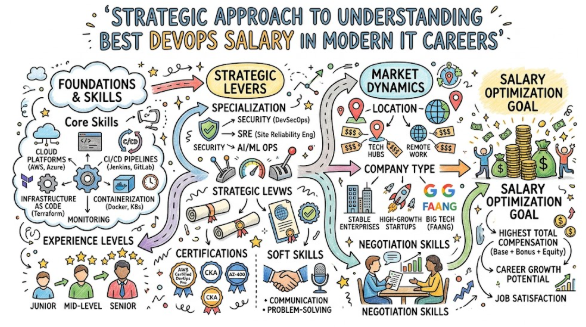
In an ecosystem where platform engineering, site reliability, and security are converging, “DevOps Salary” has become a complex metric influenced by much more than just years of experience. From regional economic factors and industry demand to the mastery of specific orchestration tools like Kubernetes, the path to a higher pay scale is paved with strategic skill acquisition. This guide is designed to cut through the noise, providing a comprehensive, analyst-style breakdown of what to expect in the current market. By exploring the data behind pay trends, you will gain the clarity needed to advocate for your worth and map out a growth-oriented career trajectory.
What Does “DevOps Salary” Mean?
When discussing DevOps compensation, it is important to distinguish between base pay and total compensation. Many companies offer a package that extends beyond a monthly or annual salary, which is crucial for candidates to understand when evaluating job offers. Base pay is the guaranteed portion of your income, but in the tech sector, additional components often constitute a large portion of your total earnings.
The components of a typical DevOps compensation package include:
- Base Salary: The fixed annual or monthly pay before taxes and deductions.
- Performance Bonuses: Annual or quarterly payments tied to individual or company KPIs.
- Equity/RSUs: Stock options or Restricted Stock Units, common in startups and large tech firms.
- Sign-on Bonuses: One-time payments used to incentivize talent acquisition.
- Benefits & Perks: Health insurance, remote work stipends, professional development budgets, and certification exam reimbursement.
DevOps Salary Overview
Global DevOps compensation is characterized by a strong premium on specialized technical expertise. While averages provide a baseline, they are often influenced by the high demand for professionals who can manage complex cloud-native architectures. The industry currently rewards individuals who possess a blend of development, operations, and security skills (DevSecOps) more highly than those who only handle legacy manual infrastructure tasks.
Key Highlights:
- Professionals with multi-cloud proficiency (AWS, Azure, GCP) command higher entry premiums.
- The gap between junior and senior roles often doubles as responsibilities shift from script execution to architectural strategy.
- Geographic location acts as a primary multiplier, with major tech hubs showing significantly higher figures than secondary markets.
- Certification-backed experts frequently negotiate higher starting salaries by demonstrating validated competency in high-stakes environments.
Table 1 – DevOps Salary by Experience Level
| Experience Level | Average Base Salary | Range | Typical Responsibilities |
| Entry-Level / Junior | $75,000 | $60k – $90k | Scripting, basic CI/CD, Linux support. |
| Mid-Level Engineer | $110,000 | $95k – $135k | Automating pipelines, cloud migration, monitoring. |
| Senior DevOps Engineer | $145,000 | $130k – $170k | Architectural design, Kubernetes management, security. |
| Lead / Principal | $180,000 | $160k – $220k+ | Team leadership, strategy, complex system scaling. |
| SRE / Platform Lead | $190,000 | $175k – $240k+ | Reliability engineering, incident response, SLOs. |
Factors That Influence DevOps Salary
Several variables dictate where you fall on the pay scale. It is rarely just about the title on your business card; rather, it is the combination of problem-solving ability, technical stack maturity, and business impact.
- Geographic Region: Your location dictates the cost of living and the local supply-demand balance for tech talent.
- Company Size & Industry: Large enterprises or high-growth tech firms typically offer better base salaries and benefits compared to small, non-tech-focused businesses.
- Cloud Proficiency: Depth of knowledge in platforms like AWS, Azure, or GCP is a primary salary driver.
- Container Orchestration: Expertise in managing Kubernetes and Docker environments is consistently linked to top-tier pay brackets.
- Infrastructure as Code (IaC): Proficiency in tools like Terraform or Ansible reduces manual overhead, making you more valuable.
- Security (DevSecOps): Integrating security into the pipeline is a highly sought-after skill that justifies salary premiums.
- Monitoring & Observability: The ability to maintain system uptime using tools like Prometheus and Grafana directly impacts business revenue.
- Leadership & Scope: Your ability to lead teams, mentor juniors, and manage project lifecycles adds significant value.
Regional Salary Comparisons
Salaries in DevOps are heavily dictated by regional market maturity. While remote work has started to normalize pay, localized demand remains the biggest factor in regional variations.
- United States: Continues to lead with high demand, particularly in hubs like Silicon Valley, Austin, and New York.
- India: Seeing explosive growth, with top-tier talent in cities like Bengaluru, Pune, and Hyderabad reaching significant pay milestones.
- Europe (UK/Germany/Netherlands): Offers competitive packages with a strong emphasis on work-life balance and social benefits.
- Australia & Middle East: Smaller markets but high salaries due to the scarcity of specialized cloud expertise.
Table 2 – DevOps Salary Comparison by Region
| Region | Average Salary | Cost of Living Adjustment | Key Demand Skills |
| USA | High | High | K8s, Security, Multi-Cloud |
| India | Competitive | Low | CI/CD, Cloud, Automation |
| UK/Europe | Moderate-High | Moderate | SRE, Observability, IaC |
| Australia | High | Moderate-High | Cloud Migration, Reliability |
Step-by-Step Guide to Increase Your DevOps Salary
Salary growth is a proactive process. Follow these steps to systematically increase your value in the market:
- Master Core DevOps Tools: Become proficient in Linux, Git version control, and CI/CD pipeline creation.
- Learn Cloud Platforms: Focus deeply on one major provider (AWS, Azure, or GCP) and understand its unique services.
- Specialize in Kubernetes: Orchestration is the modern standard for scaling; gain hands-on experience with K8s.
- Implement Observability: Learn how to monitor systems effectively to ensure reliability.
- Build a Portfolio: Document your real-world projects and push them to public repositories.
- Pursue Certifications: Use recognized certifications to validate your skills to HR and hiring managers.
- System Design: Practice architecture-level thinking to move beyond simple scripting.
- Negotiate with Data: Always back your salary requests with industry benchmarks and specific examples of your impact.
Skills That Maximize DevOps Salary
- Cloud Architecture: Designing scalable, cost-efficient environments.
- Kubernetes Mastery: Managing complex containerized workloads at scale.
- Terraform/IaC: Automating infrastructure to ensure repeatability and consistency.
- DevSecOps: Hardening pipelines and ensuring automated compliance.
- SRE Principles: Focus on SLIs, SLOs, and reducing “toil.”
- Observability Stack: Proficient use of Prometheus, Grafana, and ELK.
- Python/Scripting: Automating routine tasks to improve efficiency.
- Strategic Communication: Explaining technical decisions to business stakeholders.
Real-World Salary Growth Scenarios
- The Early Adopter: A fresh graduate starts as a junior engineer ($75k). After two years of mastering CI/CD and AWS, they transition to a mid-level role ($110k).
- The Specialist: A mid-level engineer ($110k) identifies a gap in security. They obtain relevant certifications, move into a DevSecOps role, and leverage the specialization for a raise to $140k.
- The Architect: A senior engineer ($150k) focuses on multi-cloud strategy and platform engineering, eventually landing a Principal Lead role with a total compensation package exceeding $200k.
Common Mistakes to Avoid
- Expectation of high salary without proven, hands-on experience.
- Ignoring the importance of cloud and container orchestration skills.
- Over-relying on theory while lacking real-world project portfolios.
- Failing to connect technical work to tangible business outcomes.
- Neglecting to practice salary negotiation techniques before interviews.
- Treating certifications as a replacement for deep architectural understanding.
FAQs
What is the average DevOps salary worldwide?
Global averages vary, but experienced DevOps engineers typically earn between $100,000 and $160,000, depending heavily on the region and specific toolset.
How much do entry-level DevOps engineers earn?
Entry-level professionals usually start between $60,000 and $90,000, assuming they possess foundational knowledge of Linux, Git, and basic cloud concepts.
Does DevOps salary vary by country?
Yes, salaries are significantly impacted by local market demand, cost of living, and the saturation of the local tech industry.
Which skills increase DevOps pay the most?
Kubernetes orchestration, multi-cloud architecture, and security-focused DevSecOps skills generally command the highest pay premiums.
Do certifications improve salary?
Yes, certifications provide a standardized validation of your skills, often acting as a bridge to higher-paying roles and negotiation leverage.
What is the difference in salary between DevOps and SRE?
SRE roles often carry a slight premium over standard DevOps roles because they focus on high-availability, scalability, and complex incident management.
Is cloud expertise necessary to earn more?
Absolutely. Cloud expertise is the foundation of modern DevOps; without it, your career growth will be severely capped.
Can I earn more as a DevOps engineer without a degree?
Yes, the DevOps industry is skills-driven. A robust portfolio, clear project results, and demonstrated expertise matter more than formal education.
What is the salary trend for DevOps in 2026?
The trend is upward, specifically for those moving into Platform Engineering and AI-integrated operations.
Do DevSecOps skills increase pay?
Yes, as companies face increased cybersecurity threats, those who can secure the pipeline are considered high-value assets and are paid accordingly.
Conclusion
The DevOps field remains one of the most lucrative and rewarding career paths in the IT industry. By focusing on constant skill refinement—specifically in cloud platforms, Kubernetes, and security—you can position yourself for significant salary growth. Remember that while the numbers are encouraging, they are a reflection of the value you bring to the business. Focus on solving real problems, documenting your achievements, and keeping your skill set aligned with current market needs to ensure long-term career success.