Introduction
Imagine you have been renting a house for years. Every time you want to paint the walls, change the layout, or even invite a guest over, you must ask the landlord for permission. If the landlord decides to sell the property or change the rules, you might be forced to leave with no say in the matter. For the past two decades, the internet has functioned much like this rental agreement. We have been “tenants” of large platforms, creating content and providing data that these platforms own and monetize, while we hold little control over our own digital identity.
This is where Web3 changes the narrative. It represents a fundamental shift in how we interact with technology, moving from a centralized model—where a few tech giants hold the keys—to a decentralized model where the users themselves own the data and assets they interact with. For beginners, understanding this concept is not just about keeping up with tech trends; it is about reclaiming agency in a digital world.
Whether you are an investor curious about blockchain, a creator looking to monetize your work directly, or simply someone concerned about online privacy, grasping the core principles of Web3 is essential. This guide is designed to peel back the layers of jargon and explain what Web3 actually is, how it works, and why it is being touted as the next iteration of the digital age. We will move beyond the hype and focus on the practical realities, risks, and benefits, ensuring you can navigate this space with clarity and confidence.
What Is Web3?
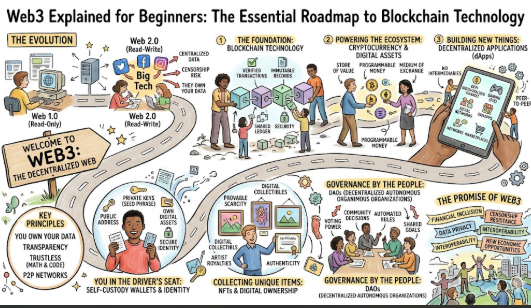
At its simplest, Web3 is the vision of a “read-write-own” internet. Unlike the current version of the web, where you mostly consume content or interact with platforms controlled by single entities, Web3 uses blockchain technology to allow users to own pieces of the platforms they use.
It connects deeply with finance and investment because it introduces the concept of “digital scarcity” and “trustless transactions.” By using decentralized networks, Web3 allows for peer-to-peer financial activities—often referred to as Decentralized Finance (DeFi)—without needing a traditional bank as a middleman. For example, in a Web3 world, you might hold your own digital assets in a personal wallet rather than an account on a centralized exchange, giving you full custody over your wealth.
Why This Topic Matters
Understanding Web3 is critical for financial literacy in the 21st century. As more assets move onto blockchains, the ability to manage your digital footprint and assets securely becomes a necessary skill. Without this knowledge, individuals are more likely to fall victim to scams, lose access to funds, or make uninformed investment decisions based on social media hype rather than technological utility.
Practical Example: Consider someone who stores their digital assets on a platform that goes bankrupt. If that person understood the principles of “self-custody” taught in Web3, they might have moved those assets to a private hardware wallet, keeping their funds safe regardless of the platform’s stability.
Detailed Breakdown: The Evolution of the Internet
The transition to Web3 can be understood through three distinct stages:
- Web1 (Read-Only): The early internet (circa 1990–2005) consisted of static web pages. You could read information, but interacting or creating content was rare.
- Web2 (Read-Write): The era of social media and cloud computing (2005–present). This allowed users to create content, but the data is hosted on centralized servers owned by corporations.
- Web3 (Read-Write-Own): The current shift utilizing blockchain. It enables decentralized applications (dApps) where users have ownership through tokens and smart contracts.
Step-by-Step Practical Guide to Getting Started
- Educate Yourself: Spend time reading verified whitepapers or educational resources before interacting with any platform.
- Set Up a Wallet: Download a reputable non-custodial wallet. This is your gateway to interacting with Web3.
- Secure Your Seed Phrase: This is the most critical step. Write your 12-24 word phrase on paper and store it in a fireproof, offline location. Never share it digitally.
- Acquire Small Amounts of Crypto: Start by purchasing a small amount of an established cryptocurrency to understand how transactions work.
- Explore dApps: Use well-known, established decentralized applications to get a feel for how they differ from traditional apps.
- Understand Gas Fees: Learn that every action on a blockchain requires a fee (gas) to compensate the network for processing.
- Practice Hygiene: Double-check every URL before connecting your wallet, as phishing sites are the most common entry point for attacks.
- Monitor Your Portfolio: Use portfolio trackers that allow you to view assets without connecting your wallet to untrusted sites.
Practical Real-Life Examples
- Situation: An artist wants to sell digital art. Mistake: Using a platform that takes 50% commission and hides ownership rights. Better Action: Using a decentralized marketplace where the artist retains ownership and receives royalties automatically via smart contracts.
- Situation: A user wants to save money. Mistake: Keeping money in a low-interest traditional bank account while inflation erodes value. Better Action: Exploring DeFi protocols that offer interest-bearing opportunities, while understanding the associated risks.
- Situation: A person loses their account password. Mistake: Trying to reset it via email support. Learning: In Web3, you are your own bank; if you lose your private key/seed phrase, the funds are permanently lost.
- Situation: A user sees a “guaranteed profit” project. Mistake: Investing their life savings. Better Action: Researching the project’s roadmap, team, and security audits, then only investing an amount they are willing to lose.
- Situation: A user connects their wallet to a random link. Mistake: Approving an unknown transaction. Better Action: Verifying the site’s legitimacy and rejecting any permission requests that seem suspicious.
Common Problems Readers Face
- Information Overload: The space moves too fast, leading to “FOMO” (Fear Of Missing Out).
- Technical Complexity: Managing keys and understanding network protocols is inherently difficult for non-technical users.
- Security Risks: Many beginners do not understand that a single click on a malicious site can drain a wallet.
- Unrealistic Expectations: Many enter the space expecting “get rich quick” results, which often leads to financial loss.
Mistakes to Avoid
- Sharing Keys: Never share your private keys or seed phrase with anyone, ever.
- Ignoring Research: Investing in tokens solely because of an influencer’s recommendation.
- Over-leveraging: Using borrowed money to invest in volatile assets.
- Using Hot Wallets for Large Savings: Keeping large amounts of assets on a browser-connected wallet instead of cold storage.
- Trusting “Help” from Strangers: No legitimate platform support team will ever ask for your seed phrase.
Comparison and Safety Tables
Table 1: Web2 vs. Web3 Comparison
| Feature | Web2 (Current Web) | Web3 (Decentralized Web) |
| Data Ownership | Controlled by Corporations | Owned by Users |
| Trust | Trust in Platforms/Banks | Trust in Code/Blockchain |
| Accessibility | Requires Middlemen (Banks/Servers) | Permissionless (Peer-to-Peer) |
| Identity | Managed via Emails/Passwords | Managed via Cryptographic Wallets |
Table 2: Safety Checklist for Web3 Interactions
| Action Item | Why It Matters |
| Use Cold Storage | Keeps assets offline and safe from hackers. |
| Verify URLs | Prevents phishing and malicious sites. |
| Review Permissions | Prevents apps from draining your entire wallet balance. |
| Only Connect to Trusted dApps | Reduces exposure to unverified, risky smart contracts. |
Essential Tools and Frameworks
- Hardware Wallets: (e.g., Ledger, Trezor) for secure, offline asset storage.
- Block Explorers: (e.g., Etherscan) to verify transaction statuses independently.
- Portfolio Trackers: To monitor asset performance across multiple chains.
- Risk Assessment Framework: A checklist that asks: “Is the contract audited? Is the team transparent? Is the liquidity locked?”
Expert Tips for Navigating Web3
- Keep it Simple: Start with one network (e.g., Ethereum) before diversifying.
- Stay Skeptical: If it sounds too good to be true, it is.
- Learn Basic Cryptography: Understand how public and private keys work.
- Back Up Everything: Keep physical copies of your passwords and keys.
- Use Burner Wallets: Use a separate, low-balance wallet for experimenting with new sites.
- Read Audits: Look for independent security audits for any protocol you use.
- Stay Calm: Markets are volatile; emotional trading is the fastest way to lose money.
- Automate Security: Use browser extensions that flag malicious websites.
- Engage with Community: Join reputable Discord or Telegram groups, but ignore DMs from “support.”
- Tax Compliance: Track every transaction for tax reporting purposes from day one.
Case Studies
- Case 1: The Phishing Victim. A user clicked a “Free Airdrop” link from a fake Twitter account and entered their seed phrase. They lost everything. Takeaway: Never share your seed phrase, no matter the context.
- Case 2: The Informed Investor. A user researched a DeFi protocol, verified its security audits, and allocated only 5% of their portfolio. They saw slow, steady growth. Takeaway: Research and diversification mitigate risk.
- Case 3: The Forgotten Password. A user set up a wallet but didn’t write down their seed phrase, assuming they could recover it via email. Their computer crashed, and they lost their assets. Takeaway: Your seed phrase is the only way to recover your funds.
Risk Awareness Section
Web3 involves significant risks, including:
- Market Volatility: Prices can fluctuate wildly in short periods.
- Smart Contract Risk: Flaws in code can lead to loss of funds.
- Platform Risk: Decentralized platforms are not immune to failure.
- Regulatory Risk: Laws regarding crypto are evolving and vary by region.
- Security/Fraud Risk: There is no “reset password” button if you lose your keys to a scam.
Always perform your own due diligence and consult a financial advisor.
Checklist Before Taking Action
- Understand the fundamental technology behind the project.
- Confirm the project has undergone multiple security audits.
- Compare the fees/costs against your budget.
- Check if you are using an official, verified website.
- Verify your repayment capacity if you are using a lending/borrowing protocol.
- Ensure you are not using emergency money or funds needed for basic living expenses.
- Check the tax implications in your local jurisdiction.
- Keep your personal identification and data offline.
- Make a written plan for your investment goals and exit strategy.
Key Terms Explained
- Blockchain: A digital, distributed ledger that records transactions across many computers.
- Wallet: A tool that allows you to interact with your blockchain assets.
- Seed Phrase: A series of words that act as the “master key” to your wallet.
- Smart Contract: Self-executing code that runs on the blockchain when conditions are met.
- dApp (Decentralized Application): An application that runs on a blockchain network.
- Gas Fees: Payments made to network participants for processing your transactions.
- Private Key: A secret cryptographic code that proves ownership of your assets.
- Public Key: An address (like an email) that you share to receive funds.
- DeFi: Financial services built on blockchain, removing traditional banks.
- Staking: Locking up tokens to support a network in exchange for rewards.
Who Should Read This Blog
This blog is intended for beginners, students, professionals interested in financial technology, new investors entering the crypto market, and anyone seeking to understand the shift toward a more decentralized digital world.
Frequently Asked Questions
- What is Web3 explained for beginners?
Web3 is the next evolution of the internet that uses blockchain to give users true ownership of their data and assets. - Is Web3 safe for beginners?
It can be, provided you follow strict security protocols like using cold storage and never sharing your seed phrase. - Do I need a lot of money to start learning Web3?
No, you can learn the fundamentals by reading documentation and using free resources without investing any money. - How is Web3 different from crypto?
Crypto refers to the digital currency, whereas Web3 is the broader infrastructure that enables ownership and decentralized applications. - Where do I store my Web3 assets?
You should store them in a non-custodial or hardware wallet where you, and only you, hold the private keys. - Can I lose money in Web3?
Yes, the space is highly volatile, and risks include market fluctuations, platform failure, and sophisticated scams. - What are the main risks of Web3?
The primary risks include security breaches, loss of private keys, smart contract vulnerabilities, and extreme market volatility. - Is Web3 regulated? Regulations are currently developing, so it is important to stay updated on your local tax and legal requirements regarding digital assets.
- Why is Web3 called ‘decentralized’?
It is decentralized because no single entity or company has total control over the network or user data. - How do I avoid scams in Web3?
Always verify URLs, never share your seed phrase, and be skeptical of any project promising guaranteed returns. - Do I need technical skills for Web3?
While basic tech literacy helps, many user-friendly tools are being built to make Web3 accessible to everyone. - What is the best way to start with Web3?
Start by learning the basics of blockchain security and setting up a personal, non-custodial wallet with a very small amount of assets.
Conclusion and Next Steps
The journey into Web3 is one of empowerment and education. By shifting away from centralized control, we enter an era where digital sovereignty becomes a reality. However, this freedom comes with responsibility. You are the architect of your own security, and the decisions you make regarding your digital assets have direct consequences.
To move forward, start by reinforcing your security habits—never prioritize speed over safety. Treat every interaction with the same caution you would apply to your physical bank account. As you grow more comfortable, continue to research and engage with the community, always keeping a healthy level of skepticism toward “too good to be true” offers. The world of Web3 is evolving daily, and staying informed is your best defense and your greatest advantage.