Introduction
Crypto looks exciting, but beginners can make risky decisions without understanding the basics. Many people hear about Bitcoin, Ethereum, blockchain, Web3, DeFi, NFTs, trading apps, and crypto wallets from friends, social media, online videos, or news. The first reaction is often curiosity. A beginner may think, “I should also try crypto before I miss something.” That excitement is natural, but without proper security habits, even a small mistake can become costly.
Unlike traditional banking, crypto gives users more personal control. That control can be powerful, but it also comes with responsibility. In a bank account, users may have recovery options, customer support, transaction dispute processes, and formal identity verification. In crypto, if a person shares a seed phrase, sends coins to the wrong address, clicks a phishing link, or trusts a fake investment scheme, recovery may be difficult or impossible.
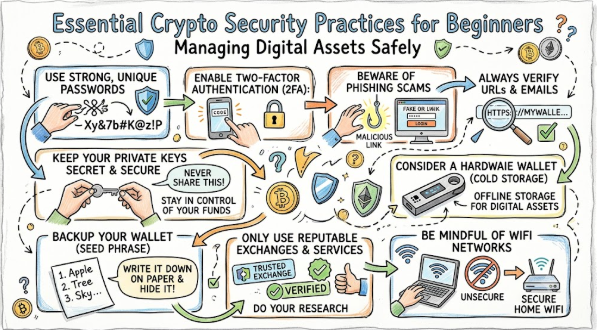
This is why Best Crypto Security Practices for Beginners are not optional. They are the foundation of safe participation in the crypto world. A beginner does not need to become a technical expert on the first day. However, they must understand the basic safety rules before storing money on an exchange, creating a wallet, sending crypto, or joining any online crypto group.
Most beginners feel confused because crypto uses unfamiliar words like private key, seed phrase, wallet address, gas fee, blockchain confirmation, cold wallet, hot wallet, smart contract, and custody. On top of that, online advice is often mixed with hype, fear, marketing, and unrealistic profit claims. This creates a dangerous environment where people may act quickly without checking safety.
Poor understanding can lead to serious mistakes. A beginner may keep all crypto on one exchange, use the same weak password everywhere, ignore two-factor authentication, trust fake support accounts, or take screenshots of seed phrases. Some may invest emergency savings after seeing fake profit screenshots. Others may join unknown Telegram or WhatsApp groups and unknowingly expose personal or financial information.
This blog explains crypto security in a practical and beginner-friendly way. It covers wallet safety, private key protection, exchange risk, scam awareness, transaction checking, password habits, device safety, and emotional discipline. It is useful for crypto learners, small investors, salaried people exploring digital assets, students studying blockchain, and finance bloggers who want to write responsibly about crypto.
The goal is not to create fear. The goal is awareness. Crypto security becomes easier when beginners follow simple habits consistently. Practical understanding is better than quick decisions because crypto mistakes often happen when people rush, copy others, or ignore warnings. With the right safety mindset, beginners can explore crypto more carefully, protect personal data, and avoid many avoidable risks.
Understanding Crypto Security in Simple Words
Crypto security means protecting your digital assets, wallet access, private keys, exchange accounts, devices, and personal information from theft, scams, mistakes, and unauthorized access. In simple words, it is the practice of keeping your crypto safe.
Crypto works on blockchain technology. A blockchain is a digital record where transactions are stored across a network. When you send crypto, the transaction is recorded on the blockchain. This system is different from normal banking because transactions are usually irreversible. Once sent to the wrong address, crypto cannot simply be pulled back like a cancelled card payment.
People search for Best Crypto Security Practices for Beginners because they want to know how to start safely. They may be opening their first exchange account, creating their first wallet, buying their first crypto asset, or learning how to avoid scams. Many beginners also search for wallet safety tips, crypto scam prevention, private key protection, secure crypto storage, and crypto exchange safety.
In real life, crypto security is used when:
- Creating a crypto exchange account
- Setting up a wallet
- Writing down a seed phrase
- Sending or receiving crypto
- Connecting a wallet to a website
- Joining a crypto community
- Checking investment opportunities
- Protecting passwords and devices
Crypto connects with money and financial planning because users may put real savings into digital assets. It also connects with investing and trading because crypto prices can move sharply. It connects with tax awareness because crypto activity may create reporting responsibilities depending on local rules. It connects with cybersecurity because hackers, phishing websites, malware, and fake apps target careless users.
Beginner-friendly example: Imagine a beginner creates a wallet and receives a 12-word seed phrase. The wallet app clearly says not to share it with anyone. But the beginner takes a screenshot and stores it in the phone gallery. Later, if the phone is compromised or the cloud backup is accessed, the seed phrase may be exposed. The better approach is to write the seed phrase offline and store it safely.
Common misunderstanding: Many beginners think crypto security only means choosing a popular exchange. Exchange choice matters, but it is only one part. Password strength, two-factor authentication, device safety, private key storage, transaction verification, and scam awareness are equally important.
Practical takeaway: Crypto security starts before buying crypto. Beginners should first learn how wallets, exchanges, private keys, and scams work before putting meaningful money into any digital asset.
Why Crypto Security Is Important
Crypto security affects real-life financial decisions because digital assets involve money, risk, technology, and personal responsibility. A beginner who understands security can make calmer and safer decisions. A beginner who ignores security may lose access, fall for scams, or make emotional mistakes.
Crypto security protects savings because many beginners use personal income or savings to buy crypto. If those assets are stored carelessly, the risk is not only market loss but also theft or access loss. Keeping emergency funds separate is also important because crypto should not replace basic financial stability.
It affects investing because secure storage helps investors think long term. If a person constantly worries about account hacking or wallet confusion, they may make rushed decisions. Good security habits create confidence and discipline.
It affects trading because active traders often use exchanges, apps, APIs, and multiple devices. More activity can mean more risk. Traders must protect login access, avoid fake trading platforms, and confirm withdrawal addresses carefully.
It affects tax planning because transaction records, exchange history, and wallet activity may be needed for reporting. Losing account access or not maintaining records can create confusion later.
Crypto security also affects emotional decision-making. Scammers often use fear and greed. They may say, “Act now,” “Limited offer,” “Guaranteed return,” or “Your wallet is at risk, click here.” Beginners who understand security are less likely to panic.
Practical scenario: A salaried person invests a small amount in crypto after hearing about it from a colleague. They create an exchange account but skip two-factor authentication because they are in a hurry. Later, their email password is leaked from another website. If the exchange account uses the same password and has weak security, the crypto account may become vulnerable. A better approach is to use a unique password, enable authenticator-based 2FA, and review account security before depositing funds.
Common mistake: Many beginners think crypto security becomes important only after they invest a large amount.
Better approach: Learn safety habits before depositing money, even if the amount is small.
Crypto security is important because it supports better planning, risk awareness, and long-term financial discipline.
The Real Problem Readers Face With Crypto Security
The real problem is not only lack of knowledge. It is the combination of confusion, excitement, online noise, weak planning, and unrealistic expectations.
Many beginners enter crypto through social media. They see videos, screenshots, influencer opinions, price predictions, and short posts. Some content may be educational, but much of it can be incomplete, biased, or risky. Beginners may not know how to separate learning from promotion.
Another problem is emotional decision-making. When prices rise, beginners may feel greed. When prices fall, they may feel panic. When friends talk about profits, they may feel pressure. When someone says an opportunity will “expire soon,” they may act without checking security.
Poor planning is also common. Beginners may not decide how much money they can afford to risk. They may not keep records. They may not understand wallet types. They may not know what to do if a device is lost.
Weak comparison creates another issue. A beginner may choose an exchange only because it has ads or because a friend uses it. They may not check security settings, withdrawal rules, support quality, fee structure, or account protection options.
Unrealistic expectations are dangerous. Crypto should never be treated as guaranteed income. Market prices are volatile, and security risks are real. Anyone promising fixed profits or risk-free returns should be treated with caution.
Many beginners ignore terms and conditions. They may not read withdrawal limits, account rules, recovery policies, platform risks, or local compliance responsibilities.
Common mistake: Beginners often ask, “Which crypto should I buy first?” before asking, “How do I protect my crypto safely?”
Better approach: First understand wallet safety, scam risks, account protection, and transaction security. After that, think about buying decisions.
The biggest issue is not knowing the right next step. Beginners often want fast answers, but crypto requires patient learning and careful action.
How Crypto Security Works Step by Step
Step 1: Learn the Basic Security Terms First
What it means: Before using crypto, beginners should understand wallet, exchange, seed phrase, private key, public address, transaction fee, and blockchain confirmation.
Why it matters: Crypto mistakes often happen when people use tools without understanding them. If you do not know what a seed phrase does, you may accidentally share it.
How to apply it: Write down key terms in simple language and review them before opening accounts or sending funds.
Practical example: A beginner learns that a wallet address can be shared to receive crypto, but a private key or seed phrase must never be shared.
Common mistake: Treating all wallet information as the same.
Better approach: Know the difference between public information and secret information.
Step 2: Choose a Reliable Exchange Carefully
What it means: An exchange is a platform where users can buy, sell, and sometimes store crypto. Beginners often start with exchanges because they are easier than self-custody wallets.
Why it matters: Exchange accounts can be targeted by hackers or fake login pages. Platform risk also exists if the exchange has poor security practices or unclear policies.
How to apply it: Compare security features, account protection options, withdrawal controls, reputation, transparency, and support quality.
Practical example: A beginner checks whether the exchange supports two-factor authentication, withdrawal address whitelisting, and account alerts.
Common mistake: Choosing an exchange only because it looks popular on social media.
Better approach: Compare security and usability before depositing funds.
Step 3: Use Strong Passwords and Two-Factor Authentication
What it means: A strong password is unique, long, and difficult to guess. Two-factor authentication adds another layer of protection.
Why it matters: Many account attacks begin with weak passwords, reused passwords, or compromised email accounts.
How to apply it: Use a password manager, create a unique password for every crypto account, and enable authenticator-based 2FA where available.
Practical example: Instead of using the same password for email and exchange accounts, a beginner creates separate strong passwords and stores them securely.
Common mistake: Using SMS-only verification without understanding SIM-swap risk.
Better approach: Use an authenticator app or hardware security key where possible.
Step 4: Protect Your Seed Phrase Offline
What it means: A seed phrase is a recovery phrase that can restore access to a wallet. Anyone with the seed phrase may control the wallet.
Why it matters: Seed phrase exposure is one of the most serious crypto security risks.
How to apply it: Write the seed phrase on paper or a durable offline backup and store it in a private, secure location.
Practical example: A beginner writes the seed phrase clearly and stores copies in safe offline places.
Common mistake: Taking a screenshot, saving it in email, or sending it to yourself on chat.
Better approach: Keep seed phrases offline and never share them.
Step 5: Verify Every Transaction Before Sending
What it means: Crypto transactions are usually irreversible. If you send funds to the wrong address or wrong network, recovery may be difficult.
Why it matters: Beginners often copy addresses quickly or ignore network selection.
How to apply it: Check the wallet address, network, amount, and fees before confirming. For larger amounts, send a small test transaction first.
Practical example: Before sending a large amount, a user sends a small amount to confirm the address works.
Common mistake: Copying an address without checking the first and last characters.
Better approach: Verify carefully and avoid rushing.
Step 6: Avoid Phishing Links and Fake Support Accounts
What it means: Phishing is when scammers create fake websites, emails, messages, or support profiles to steal login details or seed phrases.
Why it matters: Beginners may trust fake messages that look official.
How to apply it: Type official website addresses manually, bookmark trusted pages, and never share private keys or seed phrases with support staff.
Practical example: A scammer sends a message saying, “Your wallet needs verification.” The safer action is to ignore the link and check the official app directly.
Common mistake: Believing urgent messages without verification.
Better approach: Slow down, verify the source, and never reveal secret information.
Step 7: Keep Devices and Apps Secure
What it means: Your phone, laptop, browser, and apps are part of your crypto security system.
Why it matters: Malware, fake apps, browser extensions, and outdated software can create vulnerabilities.
How to apply it: Update devices, use antivirus where suitable, avoid unknown APK files, remove unused extensions, and keep crypto activity on trusted devices.
Practical example: A beginner avoids installing wallet apps from random links and uses official app stores only.
Common mistake: Using public Wi-Fi and unknown devices for crypto transactions.
Better approach: Use secure networks and trusted personal devices.
Step 8: Review Your Security Regularly
What it means: Crypto security is not a one-time task. It needs regular checking.
Why it matters: Passwords, devices, platforms, and scam methods change over time.
How to apply it: Review your exchange settings, wallet backups, transaction records, and device security monthly.
Practical example: A beginner checks account login history and updates passwords if unusual activity appears.
Common mistake: Setting up security once and forgetting it.
Better approach: Make security review a regular habit.
Key Factors That Influence Crypto Security
Volatility
What it means: Volatility means crypto prices can move sharply within a short time.
Why it matters: Price movement does not directly hack your wallet, but it can make you emotional. During fast price changes, beginners may rush into unsafe platforms or panic-send funds.
How to manage it: Decide your risk limit before buying and avoid using emergency money.
Common mistake: Buying or selling only because prices are moving fast.
Better approach: Follow a written plan and avoid emotional action.
Wallet Safety
What it means: Wallet safety means protecting wallet access, seed phrases, and private keys.
Why it matters: A secure wallet becomes unsafe if recovery details are exposed.
How to manage it: Keep seed phrases offline and use trusted wallet apps.
Common mistake: Saving seed phrases in screenshots or cloud storage.
Better approach: Store recovery details offline in a secure place.
Exchange Reliability
What it means: Exchange reliability refers to the safety, usability, transparency, and account protection features of a crypto platform.
Why it matters: Keeping crypto on an exchange means depending on the platform’s systems and rules.
How to manage it: Compare exchanges before depositing money.
Common mistake: Choosing an exchange only because it is trending.
Better approach: Check security features, withdrawal rules, and account controls.
Transaction Fees
What it means: Transaction fees are charges paid when moving crypto on a blockchain network.
Why it matters: Fees can reduce the value of small transfers and may change depending on network activity.
How to manage it: Review fees before confirming transactions.
Common mistake: Ignoring fees until after the transaction is submitted.
Better approach: Check the total cost before sending crypto.
Scam Awareness
What it means: Scam awareness means identifying fake offers, phishing links, impersonators, and unrealistic profit claims.
Why it matters: Crypto scams often target beginners who are excited but not fully informed.
How to manage it: Avoid guaranteed return claims and verify everything independently.
Common mistake: Trusting professional-looking messages without checking.
Better approach: Treat urgency and fixed-profit promises as warning signs.
Private Key Safety
What it means: Private key safety means keeping secret wallet access information protected.
Why it matters: Private keys and seed phrases can control wallet access.
How to manage it: Keep private keys secret and offline.
Common mistake: Sharing private information with fake support accounts.
Better approach: Never share private keys, seed phrases, OTPs, or passwords.
Platform Risk
What it means: Platform risk means a crypto service may face technical, legal, operational, or security issues.
Why it matters: Beginners may lose access or face withdrawal problems if they depend blindly on one platform.
How to manage it: Use platforms carefully and avoid unknown services.
Common mistake: Keeping all funds on one platform without understanding risk.
Better approach: Learn custody options and review platform rules.
Long-Term Risk Understanding
What it means: Crypto risk includes price risk, security risk, tax risk, platform risk, and emotional risk.
Why it matters: Beginners who understand only price movement may ignore other important dangers.
How to manage it: Learn slowly and review risks before taking action.
Common mistake: Thinking crypto risk only means price going down.
Better approach: Look at the full risk picture before investing or transferring funds.
Detailed Breakdown of Best Crypto Security Practices for Beginners
Crypto Meaning
Crypto is a type of digital asset that uses cryptography and blockchain technology. Some people use crypto for investment, payments, decentralized applications, or blockchain-based services. However, crypto is risky and should not be treated as guaranteed income.
Common mistake: Thinking crypto is only about buying low and selling high.
Better approach: First understand ownership, custody, storage, transaction rules, and security.
Blockchain Basics
A blockchain is a digital ledger that records transactions. Once a transaction is confirmed, it becomes difficult to reverse. This is why checking wallet addresses and transaction details is so important.
Common mistake: Assuming crypto transfers work like bank transfers.
Better approach: Treat every transaction carefully before confirming.
Wallet and Exchange Basics
An exchange account lets you trade or store crypto on a platform. A wallet lets you control crypto through keys. Some wallets are hot wallets connected to the internet. Others are cold wallets kept offline.
Common mistake: Not knowing who controls the keys.
Better approach: Understand custody before choosing where to store assets.
Transactions
Crypto transactions need accurate wallet addresses and correct network selection. Sending crypto to the wrong address or wrong network can create serious problems.
Common mistake: Sending funds quickly without checking all details.
Better approach: Check address, network, fee, and amount carefully.
Network Fees
Blockchain transactions often require fees. Fees vary by network and activity level. Beginners should check fees before sending funds, especially small amounts.
Common mistake: Ignoring fees until after confirmation.
Better approach: Review total cost before completing a transaction.
Volatility
Crypto values can rise and fall quickly. Security planning should be separate from price excitement. Even when prices move fast, users should not skip safety steps.
Common mistake: Rushing during price movements.
Better approach: Follow a written plan and avoid panic decisions.
Security Risks
Crypto users face phishing, fake apps, malware, fake investment schemes, social engineering, and account takeover attempts.
Common mistake: Trusting messages that appear urgent or official.
Better approach: Verify through official channels and never share secret information.
Scam Awareness
Scams may promise fixed returns, bonus rewards, fake airdrops, wallet verification, mining income, or exclusive trading signals. Beginners should be especially careful when someone asks them to deposit money or share wallet details.
Common mistake: Believing professional-looking websites without checking.
Better approach: Investigate, compare, and avoid pressure-based offers.
Private Keys and Seed Phrase Safety
Your seed phrase is the master recovery key for your wallet. Anyone who has it can control the wallet.
Common mistake: Storing seed phrases online.
Better approach: Use offline storage with careful backup.
Exchange Risk
Exchanges are useful, but they are not risk-free. Account restrictions, hacking attempts, policy changes, operational issues, and withdrawal delays can affect users.
Common mistake: Storing all crypto on one platform.
Better approach: Use exchanges carefully and understand custody options.
Beginner Safety Habits
Strong passwords, two-factor authentication, offline seed phrase storage, transaction verification, device updates, and scam awareness create a safer starting point.
Common mistake: Learning about security only after losing money.
Better approach: Learn safety habits before taking action.
Crypto Is Not Guaranteed Income
Crypto can be highly risky. No beginner should depend on it for fixed income, emergency money, rent, fees, or essential expenses.
Common mistake: Treating crypto as a shortcut to wealth.
Better approach: Treat crypto as a high-risk learning and investment area.
Common Mistakes Beginners Make With Crypto Security
Following Random Advice
Why it happens: Beginners often trust influencers, friends, or anonymous groups without checking facts.
Why it is risky: The advice may be biased, incomplete, promotional, or unsafe.
What can go wrong: A beginner may buy unsafe tokens, use fake platforms, or expose wallet details.
What to do instead: Learn basics and verify information before acting.
Ignoring Risk
Why it happens: Some beginners focus only on possible profit.
Why it is risky: They may ignore volatility, scams, custody risk, and tax responsibilities.
What can go wrong: They may lose money or access to assets.
What to do instead: Review risk before expected return.
Not Comparing Platforms
Why it happens: Beginners may choose the first exchange or wallet they see.
Why it is risky: Not every platform has the same safety standards or user protection features.
What can go wrong: They may face poor security, high fees, or weak support.
What to do instead: Compare security features, usability, and account controls.
Trusting Fake Profit Claims
Why it happens: Scammers use screenshots, fake testimonials, and guaranteed return language.
Why it is risky: Fixed-profit claims in crypto are often warning signs.
What can go wrong: Users may deposit funds into scams.
What to do instead: Avoid anyone promising fixed or risk-free returns.
Making Emotional Decisions
Why it happens: Fear, greed, and pressure can lead to unsafe choices.
Why it is risky: Emotional decisions reduce careful checking.
What can go wrong: A user may click fake links, send money quickly, or ignore warnings.
What to do instead: Pause before every important action.
Using Emergency Money
Why it happens: Some beginners believe crypto can quickly grow their savings.
Why it is risky: Crypto is volatile and not suitable for essential funds.
What can go wrong: Market loss can create financial stress.
What to do instead: Keep emergency funds separate.
Not Reading Terms and Conditions
Why it happens: Beginners often skip platform rules because they want to start quickly.
Why it is risky: Withdrawal limits, verification rules, fees, and restrictions can affect users.
What can go wrong: A beginner may face unexpected limitations.
What to do instead: Read key terms before depositing money.
Sharing Sensitive Information
Why it happens: Some users trust fake support accounts or strangers online.
Why it is risky: Seed phrases, passwords, and OTPs can give attackers access.
What can go wrong: Funds may be stolen.
What to do instead: Never share private keys, seed phrases, passwords, or OTPs.
Ignoring Tax and Legal Responsibilities
Why it happens: Beginners may think crypto activity is only a personal investment matter.
Why it is risky: Crypto activity may have tax or reporting implications depending on location.
What can go wrong: Poor records may create problems later.
What to do instead: Keep transaction records and consult a qualified professional when needed.
Depending Only on Social Media Advice
Why it happens: Social media content is easy to consume and often looks confident.
Why it is risky: Social media may not provide complete education.
What can go wrong: Beginners may copy risky decisions.
What to do instead: Use social media only as a starting point, not final advice.
Don’t Do This Checklist
- Do not share your seed phrase with anyone.
- Do not save private keys in screenshots or email.
- Do not click random wallet verification links.
- Do not trust guaranteed profit claims.
- Do not use the same password everywhere.
- Do not keep all funds on one platform without understanding risk.
- Do not send crypto without checking address and network.
- Do not use emergency money for risky crypto activity.
- Do not install wallet apps from unknown links.
- Do not panic during market movements.
Practical Real-Life Examples of Crypto Security
Example 1: Salaried Person Protecting Monthly Savings
Situation: A salaried person decides to buy a small amount of crypto from monthly savings.
Mistake or challenge: The mistake would be using emergency money or skipping account security.
Better action: First set a risk limit, enable 2FA, and keep emergency savings separate.
Learning: Crypto should not disturb basic financial stability.
Example 2: Beginner Avoiding Fake Investment Schemes
Situation: A beginner receives a message promising fixed daily profit from crypto trading.
Mistake or challenge: The offer looks professional and urgent.
Better action: Avoid the scheme, verify independently, and never send funds to unknown accounts.
Learning: Guaranteed return claims are major warning signs.
Example 3: Crypto Learner Handling a Seed Phrase
Situation: A new wallet shows a 12-word seed phrase.
Mistake or challenge: The mistake would be taking a screenshot and storing it online.
Better action: Write it offline and store it securely.
Learning: Seed phrase safety is one of the most important crypto habits.
Example 4: Trader Checking Transaction Details
Situation: A beginner trader wants to transfer crypto between an exchange and wallet.
Mistake or challenge: The challenge is selecting the correct network.
Better action: Verify the address, network, fee, and send a small test amount first.
Learning: One careful check can prevent a serious mistake.
Example 5: Finance Blogger Writing About Crypto Safely
Situation: A finance blogger writes about crypto for beginners.
Mistake or challenge: The mistake would be using hype language like guaranteed profit or risk-free income.
Better action: Explain volatility, wallet safety, scam risks, and responsible learning.
Learning: Trustworthy crypto content must be practical and risk-aware.
Two Useful Tables for Better Understanding
Table 1: Crypto Security Area vs Better Beginner Approach
| Crypto Security Area | Common Beginner Risk | Better Beginner Approach |
|---|---|---|
| Passwords | Reusing weak passwords | Use unique strong passwords |
| Two-Factor Authentication | Skipping extra protection | Enable authenticator-based 2FA where possible |
| Seed Phrase | Saving screenshots online | Store offline in a secure place |
| Exchange Account | Trusting any platform | Compare security features first |
| Transactions | Sending without checking | Verify address, network, amount, and fees |
| Apps and Links | Clicking random links | Use official apps and bookmarked sites |
| Social Media Advice | Following hype | Verify before taking action |
| Emergency Money | Using essential savings | Keep emergency funds separate |
Table 2: Beginner Mistake vs Correct Crypto Security Habit
| Mistake | Why It Is Risky | Correct Habit |
|---|---|---|
| Sharing seed phrase | Anyone can access the wallet | Never share seed phrase |
| Ignoring 2FA | Account becomes easier to attack | Enable strong 2FA |
| Trusting fake support | Scammers steal information | Contact support only through official channels |
| Rushing transactions | Wrong address or network can cause loss | Check details slowly |
| Using public Wi-Fi | Data may be exposed | Use secure private networks |
| Installing unknown apps | Malware risk increases | Download from official sources |
| Believing fixed profit claims | High scam risk | Avoid guaranteed return promises |
| No record keeping | Tax and tracking problems | Maintain transaction records |
Tools, Methods, and Frameworks Readers Can Use
Wallet Safety Checklist
What it is: A wallet safety checklist helps beginners confirm that their seed phrase, device, app source, and backup method are safe.
Why it helps: It reduces careless wallet setup mistakes.
How beginners can use it: Use it before creating a wallet and again after setup.
Mistake it helps avoid: Storing recovery information online or sharing it unknowingly.
Exchange Comparison Checklist
What it is: This method helps users compare exchanges based on security features, account protection, fees, withdrawal rules, and support quality.
Why it helps: It encourages safer platform selection.
How beginners can use it: Review platform features before depositing funds.
Mistake it helps avoid: Choosing platforms only because of ads or social media popularity.
Transaction Verification Habit
What it is: This means checking wallet address, network, amount, and fee before every transaction.
Why it helps: It reduces the chance of wrong transfers.
How beginners can use it: Pause before confirmation and send a small test transaction for larger transfers.
Mistake it helps avoid: Sending funds to the wrong address or network.
Scam Warning Checklist
What it is: A scam checklist helps identify red flags like guaranteed returns, urgent pressure, fake support, private key requests, and unknown links.
Why it helps: It protects beginners from emotional and pressure-based decisions.
How beginners can use it: Review it whenever they receive crypto offers or messages.
Mistake it helps avoid: Trusting fake offers without verification.
Private Key Safety Method
What it is: This method focuses on keeping seed phrases and private keys offline, private, and protected from damage or theft.
Why it helps: It protects wallet access.
How beginners can use it: Write recovery details clearly and store them in secure offline locations.
Mistake it helps avoid: Digital exposure of private wallet information.
Monthly Crypto Security Review
What it is: A monthly review helps users check passwords, 2FA, device updates, wallet backups, transaction records, and platform activity.
Why it helps: It keeps security habits active.
How beginners can use it: Set one date every month for this review.
Mistake it helps avoid: Long-term neglect of account and wallet security.
Risk Allocation Method
What it is: This method helps users decide how much money they can afford to risk before buying crypto.
Why it helps: It protects personal financial stability.
How beginners can use it: Separate essential savings, emergency funds, and high-risk investment money.
Mistake it helps avoid: Using money needed for daily life or urgent expenses.
Expert Tips to Make Better Decisions
1. Learn Before Taking Action
The tip: Understand wallets, exchanges, seed phrases, and transaction rules before buying crypto.
Why it matters: Crypto mistakes often happen when beginners act first and learn later.
How to apply it: Spend time reading beginner guides and practice only with small amounts after understanding basics.
2. Use Unique Passwords
The tip: Use a different strong password for every crypto-related account.
Why it matters: A reused password can expose multiple accounts if one website is compromised.
How to apply it: Use a password manager and create separate passwords for email, exchange, and wallet-related accounts.
3. Enable Two-Factor Authentication
The tip: Add 2FA to your exchange and email accounts.
Why it matters: 2FA adds another security layer beyond passwords.
How to apply it: Enable authenticator-based 2FA where available and store backup codes safely.
4. Protect Your Email Account
The tip: Treat your email account as part of your crypto security system.
Why it matters: Email is often connected to exchange login, password reset, and security alerts.
How to apply it: Use a strong password, 2FA, and regular security checks for your email.
5. Never Share Seed Phrases
The tip: Keep seed phrases completely private.
Why it matters: Seed phrases can control wallet access.
How to apply it: Refuse any request for seed phrase details, even if the person claims to be support staff.
6. Start Small
The tip: Begin with small amounts while learning crypto tools.
Why it matters: Starting small reduces the impact of beginner mistakes.
How to apply it: Test platforms and transfers with small amounts before larger activity.
7. Verify Links Carefully
The tip: Avoid clicking random crypto links.
Why it matters: Fake crypto websites may look real and steal login details.
How to apply it: Type official URLs manually, bookmark trusted pages, and avoid links from random messages.
8. Avoid Guaranteed Return Claims
The tip: Be careful with anyone promising fixed crypto profit.
Why it matters: Crypto markets are volatile and guaranteed returns are a warning sign.
How to apply it: Reject schemes that pressure you to deposit quickly.
9. Keep Emergency Money Separate
The tip: Do not use emergency funds for crypto activity.
Why it matters: Crypto is risky and prices can fall sharply.
How to apply it: Keep money for rent, EMI, medical bills, and daily expenses away from crypto risk.
10. Check Every Transaction Slowly
The tip: Verify address, network, amount, and fees before sending crypto.
Why it matters: Crypto transfers can be difficult to reverse.
How to apply it: Pause before confirming and use a test transaction for larger amounts.
11. Keep Written Records
The tip: Maintain records of crypto transactions.
Why it matters: Records help with tracking, learning, and possible tax reporting.
How to apply it: Save date, asset, amount, platform, wallet, fee, and transaction purpose.
12. Avoid Blindly Copying Others
The tip: Do not copy another person’s crypto decisions without understanding your own risk.
Why it matters: Their financial situation and risk capacity may be different from yours.
How to apply it: Make decisions based on your own plan, knowledge, and limits.
13. Review Security Monthly
The tip: Check your crypto security regularly.
Why it matters: Security settings can become outdated.
How to apply it: Review account activity, wallet backups, 2FA, and device updates each month.
14. Use Trusted Devices
The tip: Use only secure personal devices for crypto activity.
Why it matters: Unknown devices and public computers can expose login information.
How to apply it: Use your own updated phone or laptop for crypto accounts and wallets.
15. Consult Professionals When Needed
The tip: Take expert advice for tax, legal, or investment-related decisions.
Why it matters: Crypto rules and financial impact can be complex.
How to apply it: Speak with qualified professionals before major financial decisions.
Case Studies: How Better Understanding Changes Decisions
Case Study 1: A Beginner Investor Learning Wallet Safety
Profile: Rohan, a salaried employee exploring crypto for the first time.
Situation: He creates a wallet after watching a short online video.
Problem: He does not understand the importance of the seed phrase.
Wrong approach: He takes a screenshot of the seed phrase and stores it in his cloud gallery.
Better approach: After learning about wallet safety, he deletes the screenshot, creates a new wallet, writes the seed phrase offline, and stores it securely.
Result or learning: He understands that convenience can be risky when handling wallet recovery details.
Key takeaway: Seed phrase protection is one of the first crypto security habits beginners must learn.
Case Study 2: A Student Avoiding a Fake Crypto Offer
Profile: Neha, a student interested in blockchain and crypto learning.
Situation: She receives a message offering fixed weekly income through crypto deposits.
Problem: The offer creates excitement because it looks simple and profitable.
Wrong approach: She almost sends money without checking who is behind the platform.
Better approach: She reviews scam warning signs, notices pressure-based language, and avoids the offer.
Result or learning: She avoids a possible scam and learns not to trust guaranteed return claims.
Key takeaway: In crypto, pressure and fixed-profit promises are strong warning signs.
Case Study 3: A Small Investor Improving Transaction Safety
Profile: Amit, a beginner who uses an exchange and a personal wallet.
Situation: He wants to move crypto from the exchange to his wallet.
Problem: He is unsure about network selection and transaction fees.
Wrong approach: He almost sends the full amount without testing.
Better approach: He checks the address, confirms the network, reviews fees, and sends a small test amount first.
Result or learning: The test transaction confirms the process before a larger transfer.
Key takeaway: Careful transaction checking can reduce avoidable crypto transfer mistakes.
Risk Awareness: What Readers Must Check First
Volatility Risk
What it means: Volatility means crypto prices can move quickly.
Why it matters: Beginners may buy during excitement and panic during drops.
How to reduce the risk: Set limits, avoid emergency funds, and understand that prices can change sharply.
Platform Risk
What it means: Platform risk means an exchange or crypto service may face security, operational, legal, or withdrawal issues.
Why it matters: Users may lose access or face difficulty withdrawing funds.
How to reduce the risk: Compare platforms, use security settings, and avoid depending blindly on one service.
Fraud Risk
What it means: Fraud risk includes fake investment schemes, phishing websites, fake support profiles, and impersonation.
Why it matters: Scammers often target beginners.
How to reduce the risk: Avoid guaranteed return claims, verify sources, and never share private information.
Cybersecurity Risk
What it means: Cybersecurity risk includes malware, weak passwords, compromised email, fake apps, and unsafe devices.
Why it matters: A weak device or account can expose crypto access.
How to reduce the risk: Use strong passwords, 2FA, official apps, updated devices, and secure networks.
Private Key Risk
What it means: Private key risk means losing or exposing wallet access information.
Why it matters: Loss or exposure of private keys can lead to loss of access or theft.
How to reduce the risk: Store seed phrases offline and never share them.
Liquidity Risk
What it means: Liquidity risk means you may not be able to sell an asset easily at the expected price.
Why it matters: Some crypto assets may have low market activity.
How to reduce the risk: Understand the asset, market activity, and platform rules before buying.
Emotional Risk
What it means: Emotional risk comes from fear, greed, panic, and social pressure.
Why it matters: Emotional decisions can lead to unsafe actions.
How to reduce the risk: Follow a written plan and avoid rushed decisions.
Legal or Compliance Risk
What it means: Crypto rules may vary depending on location and may change over time.
Why it matters: Ignoring rules can create future problems.
How to reduce the risk: Verify local requirements and consult qualified professionals where needed.
Tax-Related Risk
What it means: Crypto transactions may create tax or reporting responsibilities.
Why it matters: Poor records may make reporting difficult.
How to reduce the risk: Keep records and take professional tax advice when required.
Misinformation Risk
What it means: Online crypto content can be incomplete, promotional, or misleading.
Why it matters: Beginners may act on wrong information.
How to reduce the risk: Check multiple sources, avoid hype, and focus on education.
Checklist Before Taking Action
Before buying, storing, transferring, or writing about crypto, beginners should review this checklist:
- I understand the basic crypto terms.
- I know the difference between exchange and wallet.
- I have reviewed the main risks.
- I have compared platform security features.
- I have created strong unique passwords.
- I have enabled two-factor authentication.
- I have protected my email account.
- I have stored my seed phrase offline.
- I have not shared private keys or recovery phrases.
- I have avoided guaranteed return claims.
- I have checked transaction address, network, amount, and fees.
- I have kept emergency funds separate.
- I have protected my personal data.
- I have checked tax, legal, or compliance impact where needed.
- I have prepared a written plan.
- I have avoided emotional decisions.
- I have considered professional advice where needed.
Use this checklist before every important crypto decision. It works like a pause button. When beginners slow down and review basic safety points, they reduce the chance of avoidable mistakes.
Strategic Insights for Better Crypto Decision-Making
Wallet Custody
What it means: Custody means who controls the crypto keys.
Why it matters: If an exchange controls access, you depend on the platform. If you control your wallet keys, you carry more personal responsibility.
Beginner-friendly example: A person keeping crypto on an exchange must trust the platform, while a person using a personal wallet must protect the seed phrase.
Better approach: Understand custody before choosing storage methods.
Exchange Risk
What it means: Exchange risk refers to the risks of using a crypto trading or storage platform.
Why it matters: Exchanges are convenient, but account security, withdrawal rules, and platform policies matter.
Beginner-friendly example: A beginner may not be able to withdraw quickly if the platform has verification or withdrawal restrictions.
Better approach: Use exchanges carefully and avoid leaving unnecessary funds exposed.
Transaction Confirmation
What it means: Transaction confirmation means a blockchain network has processed and accepted a transaction.
Why it matters: Confirmation may take time depending on the network.
Beginner-friendly example: A user should wait calmly and check transaction status instead of sending repeated transfers in panic.
Better approach: Understand transaction confirmation before sending funds.
Scam Patterns
What it means: Scam patterns are repeated tricks used by fraudsters.
Why it matters: Common scams include fake airdrops, wallet verification requests, guaranteed returns, fake support, romance scams, and impersonation.
Beginner-friendly example: A fake support account may ask for your seed phrase to “fix” your wallet.
Better approach: Treat urgency, secrecy, and guaranteed profit as warning signs.
Private Key Management
What it means: Private key management means protecting the secret information that controls wallet access.
Why it matters: Security is not only about hiding keys but also ensuring you can recover them when needed.
Beginner-friendly example: A person who hides a seed phrase too carelessly may lose access later.
Better approach: Create offline backups and store them safely.
Network Fee Awareness
What it means: Network fee awareness means understanding the cost of sending crypto.
Why it matters: Different blockchains may have different fees, and fees can affect small transactions.
Beginner-friendly example: Sending a very small amount may not make sense if the transaction fee is too high.
Better approach: Check fees before sending and avoid unnecessary transfers.
Risk Allocation
What it means: Risk allocation means deciding how much money you can afford to expose to crypto risk.
Why it matters: Crypto should not create pressure on essential expenses.
Beginner-friendly example: A salaried person should not use rent money or EMI money for crypto.
Better approach: Never invest money needed for daily life.
Record Discipline
What it means: Record discipline means maintaining transaction and platform activity details.
Why it matters: Good records help users track transactions, review decisions, and prepare for tax-related questions.
Beginner-friendly example: A simple sheet with date, asset, amount, fee, and platform can reduce confusion later.
Better approach: Maintain a simple transaction log from the start.
Long-Term Learning Mindset
What it means: A long-term learning mindset means building understanding slowly instead of chasing shortcuts.
Why it matters: Crypto knowledge grows with practice, patience, and careful observation.
Beginner-friendly example: A beginner who first learns wallet safety is better prepared than someone who only watches price prediction videos.
Better approach: Build safe habits first and explore advanced strategies later.
Key Terms Explained for Beginners
- Crypto: Crypto is a digital asset that uses blockchain and cryptography. It can be used for investment, transfers, or blockchain-based applications, but it carries risk.
- Blockchain: A blockchain is a digital record of transactions maintained across a network. It helps verify transactions without depending on one central record keeper.
- Wallet: A crypto wallet is a tool used to store and manage access to digital assets. It does not hold coins like a physical wallet; it manages keys.
- Exchange: An exchange is a platform where users can buy, sell, or trade crypto. Beginners often start here because exchanges are easier to use.
- Private Key: A private key is secret information that controls access to crypto. It must never be shared.
- Seed Phrase: A seed phrase is a group of words used to recover a wallet. Anyone with the seed phrase may control the wallet.
- Public Address: A public address is like an account number for receiving crypto. It can be shared, but it must still be checked carefully.
- Two-Factor Authentication: Two-factor authentication adds an extra login step. It helps protect accounts even if a password is compromised.
- Phishing: Phishing is a scam where fake websites, emails, or messages try to steal login details or wallet information.
- Gas Fee: Gas fee is a transaction fee paid to process activity on some blockchain networks. It can vary based on network demand.
- Hot Wallet: A hot wallet is connected to the internet. It is convenient but usually more exposed to online risks.
- Cold Wallet: A cold wallet keeps access offline. It can provide stronger protection when used correctly.
- Custody: Custody means who controls the private keys. Self-custody gives users control but also responsibility.
- Volatility: Volatility means prices can move up or down quickly. Crypto is known for high volatility.
- Scam Token: A scam token is a risky or fraudulent crypto asset created to mislead buyers. Beginners should research carefully before buying unknown tokens.
Who Should Read This Blog
Beginners
Beginners should read this blog to understand how crypto security works before making their first transaction.
Students
Students learning blockchain or crypto can use this guide to understand practical safety habits beyond theory.
Salaried Employees
Salaried people exploring crypto can learn how to protect savings and avoid using emergency money for risky decisions.
Small Business Owners
Business owners interested in crypto payments or blockchain tools can understand security and transaction risks.
New Investors
New investors can learn why risk management matters as much as buying decisions.
Traders
Traders can use this blog to improve account security, transaction checking, and emotional control.
Loan Seekers
Loan seekers should understand that borrowed money should not be used carelessly in high-risk crypto activity.
Crypto Learners
Crypto learners can use this blog as a beginner safety foundation before exploring advanced topics.
Casino Content Creators
Casino content creators writing about crypto casinos or payments can learn why responsible, risk-aware language matters.
Finance Bloggers
Finance bloggers can use these ideas to write safer and more trustworthy crypto education content.
People Improving Money Awareness
Anyone trying to make better financial decisions can learn how security, risk, and discipline connect.
People Trying to Avoid Financial Mistakes
This blog helps readers slow down, check risks, and avoid common beginner errors.
Frequently Asked Questions
1. What are Best Crypto Security Practices for Beginners?
Best Crypto Security Practices for Beginners are simple habits that help protect wallets, exchange accounts, seed phrases, passwords, and transactions. They include using strong passwords, enabling 2FA, avoiding scams, and checking every transfer carefully.
2. Why is crypto security important for beginners?
Crypto transactions are usually hard to reverse, and users are often responsible for protecting their own access. Beginners need security knowledge to avoid phishing, fake platforms, wrong transfers, and seed phrase exposure.
3. How can beginners start crypto safely?
Beginners should first learn wallet basics, exchange risk, private key safety, and transaction checking. They should start small, enable account security, and avoid acting on random social media advice.
4. What is the biggest crypto security mistake to avoid?
The biggest mistake is sharing or exposing a seed phrase or private key. Anyone who gets this information may control the wallet, so it should always be stored offline and kept private.
5. Are Best Crypto Security Practices for Beginners useful for salaried people?
Yes, they are useful because salaried people may use personal savings to explore crypto. Good security habits help protect money, avoid scams, and keep emergency funds separate from risky activity.
6. Should beginners keep crypto on an exchange or wallet?
Both options have different risks. Exchanges are easier but involve platform risk, while personal wallets require careful key management. Beginners should understand custody before deciding.
7. How can I identify a crypto scam?
Warning signs include guaranteed returns, urgent pressure, fake support messages, unknown links, and requests for seed phrases. A safe approach is to verify independently and avoid offers that sound too certain.
8. Is two-factor authentication enough for crypto security?
Two-factor authentication is important, but it is not enough alone. Beginners also need strong passwords, safe email security, device protection, phishing awareness, and careful transaction habits.
9. How often should I review my crypto security?
A monthly review is a practical habit. Check passwords, 2FA, account activity, wallet backups, device updates, and transaction records regularly.
10. Can crypto provide guaranteed income?
No, crypto should not be treated as guaranteed income. Prices are volatile, scams exist, and platform risks are real. Beginners should avoid fixed-profit promises and understand risk first.
11. Why do Best Crypto Security Practices for Beginners focus on seed phrases?
Seed phrases are critical because they can recover and control a wallet. If someone else gets your seed phrase, they may access your crypto. That is why offline storage is strongly recommended.
12. What is the best next step after reading this blog?
The best next step is to create a simple security checklist before buying or transferring crypto. Review passwords, 2FA, wallet safety, scam risks, emergency funds, and transaction verification before taking action.
Conclusion and Next Steps
Crypto can be an interesting area for learning, investing, technology exploration, and financial awareness. But beginners must understand that crypto security is not a small side topic. It is the base of every safe crypto decision. Without good security habits, even a careful investment plan can fail because of weak passwords, exposed seed phrases, phishing links, wrong transfers, or fake schemes.
The most important lesson from Best Crypto Security Practices for Beginners is simple: protect access before focusing on profit. Many beginners spend time asking which coin to buy, when to enter, or how much return they can make. But a safer first step is asking whether they know how to protect their wallet, exchange account, private key, device, and personal information.
The next step is to build a personal crypto safety routine. Before buying crypto, create a checklist. Before sending crypto, verify address and network. Before joining any offer, check scam warning signs. Before storing funds, understand custody. Before making major decisions, consider tax, legal, and financial guidance from qualified professionals.
Crypto security is not about becoming afraid. It is about becoming careful. A beginner who learns slowly, verifies details, and protects personal access can reduce many common risks. The crypto space may continue to evolve, but safe habits remain important. Start with education, act with discipline, and treat every crypto decision as a financial decision that deserves proper thought.