Introduction
Crypto looks exciting, but beginners can lose money not only because prices move up and down, but also because they do not understand how storage works. Many people buy cryptocurrency on an exchange and assume it is safe forever, while others download random wallet apps without checking security. The real problem is that crypto ownership depends heavily on private keys, passwords, seed phrases, and careful transaction habits. A small mistake, such as sharing a recovery phrase or sending funds to the wrong address, can create permanent loss. This blog explains How to Store Cryptocurrency Safely in a clear, practical, and beginner-friendly way so crypto learners, investors, salaried people, traders, and finance readers can protect digital assets with awareness instead of fear or guesswork.
Understanding How to Store Cryptocurrency Safely in Simple Words
Storing cryptocurrency safely means protecting your digital assets from theft, scams, device loss, exchange failure, wrong transactions, and careless handling of private keys. Unlike traditional bank money, crypto usually gives users more control, but that control also brings more responsibility.
In simple words, crypto is not stored like cash inside a physical locker. Your coins exist on a blockchain, and your wallet gives you access to them. The most important thing your wallet protects is the private key or recovery phrase that proves you can control those coins.
People search for How to Store Cryptocurrency Safely because they want to know where to keep crypto after buying it. Some keep it on exchanges, some use mobile wallets, some use hardware wallets, and some mix different storage methods based on risk and usage.
Crypto storage is used in real life when someone:
- Buys Bitcoin, Ethereum, or other digital assets
- Transfers crypto from an exchange to a wallet
- Saves crypto for long-term holding
- Uses crypto for DeFi, NFTs, or blockchain transactions
- Protects funds from phishing or fake investment schemes
A beginner-friendly example is this: Riya buys a small amount of crypto on an exchange. Instead of leaving everything there without security, she enables two-factor authentication, learns about wallets, writes down her recovery phrase offline, and moves long-term holdings to a safer wallet. Her practical takeaway is simple: crypto safety is not one action; it is a habit.
A common misunderstanding is thinking that a wallet “contains” coins. In reality, the wallet controls access to coins recorded on the blockchain. The better approach is to protect access carefully, because whoever controls the private key controls the crypto.
Why How to Store Cryptocurrency Safely Is Important
Learning How to Store Cryptocurrency Safely is important because crypto mistakes are often difficult or impossible to reverse. In banking, a wrong transaction or suspicious activity may sometimes be reported to customer support. In crypto, many blockchain transactions are final once confirmed.
Safe storage affects financial decisions because crypto is connected with savings, investing, trading, tax awareness, and long-term planning. A person may buy crypto as part of an investment strategy, but weak storage habits can create bigger risk than market volatility itself.
Safe crypto storage helps with:
- Savings protection: Long-term crypto holdings need stronger security than small spending balances.
- Investing discipline: Investors should separate storage planning from emotional buying.
- Trading safety: Traders may keep limited funds on exchanges but should avoid storing all assets there.
- Tax planning awareness: Proper records of transfers, purchases, and sales can help with future reporting.
- Risk awareness: Crypto has price risk, platform risk, scam risk, and cybersecurity risk.
- Better planning: Storage decisions should match the amount, purpose, and time horizon.
- Emotional control: Panic decisions often lead to wrong transfers, fake support scams, or unsafe wallet recovery attempts.
A practical scenario: A beginner buys crypto after seeing social media excitement. Without learning wallet safety, he stores all funds on an unknown platform. Later, he cannot access the account because he ignored security settings and recovery options. The better approach would be to start small, use a trusted platform, enable account protection, understand wallet custody, and maintain offline backups before increasing exposure.
The Real Problem Readers Face With Crypto Storage
The real problem is not only lack of knowledge. It is confusion, pressure, and overconfidence. Beginners often hear too many opinions at once: “Use an exchange,” “never use an exchange,” “buy a hardware wallet,” “use DeFi,” “earn passive income,” or “send funds here for high returns.” This noise can make simple decisions feel complicated.
Many readers face these challenges:
- They do not know the difference between an exchange and a wallet.
- They think password protection alone is enough.
- They do not understand private keys or seed phrases.
- They trust social media advice without verification.
- They use random wallet apps without checking authenticity.
- They ignore small security habits until something goes wrong.
- They chase unrealistic income claims without understanding risk.
- They forget to record transactions for future tax or compliance needs.
- They act in panic when prices move quickly or when they receive scam messages.
- They do not know the right next step after buying crypto.
The common mistake is treating crypto like a normal app balance. The better approach is to treat crypto like high-value digital property. This means protecting login access, wallet backups, devices, transaction details, and recovery information with discipline.
Beginners do not need to become blockchain engineers to store crypto safely. But they do need to understand the basic rules: protect your private keys, verify every transaction, avoid fake promises, use strong authentication, and never share recovery phrases.
How to Store Cryptocurrency Safely Step by Step
Step 1: Understand What You Are Storing
What it means:
Before choosing a wallet, understand the crypto asset you own, the blockchain it uses, and where it can be stored.
Why it matters:
Not every wallet supports every coin or token. Sending crypto to the wrong network or unsupported wallet can cause loss.
How to apply it:
Check the asset name, blockchain network, wallet support, and transaction rules before moving funds.
Practical example:
If you hold Ethereum-based tokens, make sure your wallet supports that token and the correct Ethereum network.
Common mistake:
Beginners sometimes send tokens through the wrong network because fees are lower.
Better approach:
Always confirm the asset, network, wallet address, and supported chain before sending.
Step 2: Choose the Right Type of Wallet
What it means:
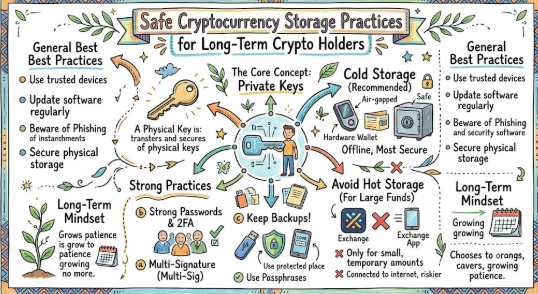
A wallet is a tool that helps you access your cryptocurrency. Wallets can be hot wallets, cold wallets, custodial wallets, or non-custodial wallets.
Why it matters:
Different wallets provide different levels of convenience and security.
How to apply it:
Use a hot wallet for small active amounts and a cold wallet for larger long-term holdings.
Practical example:
A trader may keep limited funds on an exchange for trading, while storing long-term holdings in a hardware wallet.
Common mistake:
Keeping all crypto in one place.
Better approach:
Use a storage strategy based on purpose, amount, and risk.
Step 3: Protect Your Seed Phrase Offline
What it means:
A seed phrase is a recovery phrase that can restore access to your wallet.
Why it matters:
Anyone who gets your seed phrase may control your crypto.
How to apply it:
Write it on paper or another offline backup method. Store it securely and never type it into unknown websites.
Practical example:
Keep one backup in a secure home location and another in a separate safe place.
Common mistake:
Saving the seed phrase in email, screenshots, cloud notes, or chat apps.
Better approach:
Keep seed phrases offline and private.
Step 4: Use Strong Account Security
What it means:
For exchanges and wallet accounts, use strong passwords, two-factor authentication, and secure email accounts.
Why it matters:
Many crypto losses happen because attackers access email or exchange accounts.
How to apply it:
Use a unique password, enable two-factor authentication, and avoid password reuse.
Practical example:
Create a separate email for crypto-related accounts and protect it with strong authentication.
Common mistake:
Using the same password for crypto, email, and social media.
Better approach:
Use unique passwords and a trusted password manager.
Step 5: Test Transactions Before Sending Large Amounts
What it means:
Send a small test amount before transferring a larger balance.
Why it matters:
Crypto transactions are usually final. A small test can prevent major loss.
How to apply it:
Send a small amount, confirm it arrives, then send the remaining amount carefully.
Practical example:
Before sending a large amount to a hardware wallet, transfer a small amount first and verify the address.
Common mistake:
Sending everything at once without checking details.
Better approach:
Use test transactions for new wallets, new networks, or large transfers.
Step 6: Avoid Scam Links and Fake Support
What it means:
Scammers often pretend to be wallet companies, exchanges, influencers, or support agents.
Why it matters:
Fake links can steal passwords, private keys, or seed phrases.
How to apply it:
Type website addresses manually, avoid clicking random links, and never share recovery phrases.
Practical example:
If someone messages you claiming to be wallet support and asks for your seed phrase, it is a scam.
Common mistake:
Trusting urgent messages that create fear.
Better approach:
Pause, verify, and use only official support channels.
Step 7: Review Your Storage Plan Regularly
What it means:
Crypto safety is not a one-time setup. It needs regular review.
Why it matters:
Devices change, accounts age, wallets update, and personal circumstances evolve.
How to apply it:
Review wallets, backups, security settings, and transaction records at fixed intervals.
Practical example:
Once a month, check whether your exchange security, wallet backups, and transaction records are updated.
Common mistake:
Setting up a wallet once and never checking it again.
Better approach:
Create a simple crypto security review habit.
Key Factors That Influence Crypto Storage Safety
Volatility
Crypto prices can move sharply. Volatility does not directly decide wallet safety, but it affects emotional behavior. When prices rise or fall quickly, beginners may rush into unsafe transfers, fake schemes, or panic selling. The better approach is to separate market decisions from storage decisions.
Wallet Safety
Wallet safety depends on how well you protect private keys, devices, passwords, and backups. A secure wallet used carelessly can still be risky. Beginners should learn wallet basics before transferring large funds.
Exchange Reliability
Exchanges are useful for buying, selling, and trading crypto, but they are still platforms controlled by third parties. Keeping all crypto on one exchange increases platform risk. A better approach is to keep only active trading funds on exchanges and store long-term holdings separately.
Transaction Fees
Blockchain transactions may require network fees. Beginners sometimes choose the wrong network to save fees, which can create bigger problems. Always check the correct network first, then compare fees.
Scam Awareness
Crypto scams often use fake profits, urgency, celebrity names, fake support, or giveaway claims. Scam awareness is a storage factor because attackers usually target your access, not just your investment decision.
Private Key Safety
Private keys and seed phrases are the heart of crypto ownership. If they are lost, recovery may be impossible. If they are stolen, the funds may be moved without permission. Protect them offline and never share them.
Platform Risk
A platform can face technical issues, account restrictions, withdrawal delays, security incidents, or business problems. Platform risk can be reduced by avoiding unknown platforms and not keeping all funds in one place.
Long-Term Risk Understanding
Crypto should not be treated as guaranteed income. Long-term holders need both market patience and storage discipline. Even if the price performs well, poor storage can destroy the value of the holding.
Detailed Breakdown of Cryptocurrency Storage
Crypto Meaning
Cryptocurrency is a digital asset that works through blockchain technology. It can be transferred between users without traditional banking systems. However, this independence also means users must take security seriously.
Blockchain Basics
A blockchain is a public digital record of transactions. When you send crypto, the transaction is recorded on the blockchain. Your wallet does not move physical coins; it signs transactions using private keys.
Wallet and Exchange Basics
An exchange is a platform where you can buy, sell, and sometimes store crypto. A wallet is a tool that allows you to access and manage crypto on the blockchain. Some wallets are controlled by companies, while others give full control to the user.
Hot Wallets
A hot wallet is connected to the internet. It may be a mobile app, browser wallet, or desktop wallet. Hot wallets are convenient for regular use but can be more exposed to online threats.
Common mistake: Keeping large long-term holdings in a browser wallet used for many websites.
Better approach: Use hot wallets only for smaller active balances.
Cold Wallets
A cold wallet keeps private keys offline. Hardware wallets are common examples. Cold storage is often preferred for larger or long-term holdings because it reduces online exposure.
Common mistake: Buying a hardware wallet but storing the seed phrase carelessly.
Better approach: Secure both the device and the recovery phrase.
Custodial Storage
Custodial storage means a platform controls the private keys for you. Exchanges are common custodial platforms. This is easier for beginners but creates dependence on the platform.
Common mistake: Assuming custodial storage has no risk.
Better approach: Use custodial storage carefully and understand withdrawal, security, and account recovery rules.
Self-Custody
Self-custody means you control your private keys. It gives more control but also more responsibility. If you lose your seed phrase, customer support may not be able to restore your wallet.
Common mistake: Moving to self-custody without learning backups.
Better approach: Practice with small amounts first.
Transactions
Crypto transactions require careful checking. Wallet address, network, amount, and fees must be reviewed before approval.
Common mistake: Copying an address once and sending without rechecking.
Better approach: Check the first and last characters of the address and use test transfers.
Network Fees
Network fees are charges paid to process blockchain transactions. Fees vary by blockchain and activity level. Beginners should understand fees before moving funds frequently.
Common mistake: Choosing a cheaper network without confirming compatibility.
Better approach: Pay attention to correct network support before fee savings.
Scam Awareness
Crypto scams often appear through social media, messaging apps, fake websites, fake airdrops, and fake investment groups. A safe storage plan includes scam prevention habits.
Common mistake: Connecting a wallet to unknown websites.
Better approach: Use separate wallets for testing and never approve unknown permissions.
Private Keys and Seed Phrase Safety
The seed phrase is the recovery key to your wallet. It should never be shared, photographed, emailed, or typed into random forms.
Common mistake: Believing support staff need your seed phrase.
Better approach: Treat anyone asking for your seed phrase as a scammer.
Exchange Risk
Exchanges can be useful, but they are not risk-free. Account compromise, withdrawal limitations, regulatory issues, or platform failures can affect access.
Common mistake: Keeping all assets on one exchange for convenience.
Better approach: Use exchanges for trading and wallets for long-term storage.
Beginner Safety Habits
Good crypto storage is built on small habits:
- Use strong passwords.
- Enable two-factor authentication.
- Keep backups offline.
- Avoid public Wi-Fi for crypto activity.
- Verify wallet apps before installing.
- Test transactions.
- Keep written records.
- Avoid emotional transfers.
The practical lesson is simple: storage safety is not about one perfect tool. It is about using the right tool with disciplined behavior.
Common Mistakes Beginners Make With Crypto Storage
Following Random Advice
Beginners often follow social media posts without checking whether the advice fits their situation. This is risky because crypto storage depends on wallet type, asset type, network, and personal risk level. Instead, learn the basics and make decisions slowly.
Ignoring Risk
Many people focus only on price growth and ignore storage risk. Even a profitable asset can be lost if the wallet is compromised. The better approach is to check security before investing larger amounts.
Not Comparing Options
Choosing the first wallet or exchange you see can be risky. Some platforms may have poor security, limited support, or unclear rules. Compare reputation, security features, withdrawal process, and ease of use.
Trusting Fake Profit Claims
Any message promising guaranteed crypto income should be treated with caution. Scammers use greed and urgency to make users share funds or wallet access. The safer approach is to avoid guaranteed return claims.
Making Emotional Decisions
Fear and greed can cause rushed transactions. A beginner may move funds quickly after hearing rumors or seeing market panic. The better approach is to pause, verify, and follow a written plan.
Sharing Sensitive Information
Private keys, seed phrases, passwords, and authentication codes must never be shared. Sharing these details can lead to permanent loss.
Ignoring Tax, Legal, or Compliance Responsibilities
Crypto transactions may have reporting or tax implications depending on location and personal situation. Keep records and consult a qualified professional when needed.
Depending Only on Social Media Advice
Social media can be useful for awareness but dangerous as a decision-making source. Verify information from multiple trusted sources and avoid pressure-based groups.
Don’t Do This Checklist
- Do not share your seed phrase with anyone.
- Do not store recovery phrases in screenshots.
- Do not send large funds without a test transaction.
- Do not use random wallet apps.
- Do not connect wallets to unknown websites.
- Do not keep all crypto on one platform.
- Do not believe guaranteed return claims.
- Do not ignore transaction records.
- Do not act in panic, greed, or pressure.
- Do not use weak or repeated passwords.
Practical Real-Life Examples of Safe Crypto Storage
1. Salaried Person Protecting Long-Term Holdings
A salaried employee buys a small amount of crypto every month. The mistake would be keeping everything on one exchange without strong security. The better action is to enable two-factor authentication, move long-term holdings to a safer wallet, and keep transaction records. The learning is that regular investing needs regular security habits.
2. Beginner Investor Avoiding Random Tips
A beginner hears about a new token from a social media group. The challenge is that the wallet link shared in the group may be fake. The better action is to verify the project, avoid unknown links, and never connect the main wallet to suspicious sites. The learning is that research and storage safety must work together.
3. Trader Managing Exchange Risk
A crypto trader keeps funds on an exchange for quick trades. The mistake would be storing long-term holdings there too. The better action is to keep only trading capital on the exchange and move inactive funds to a separate wallet. The learning is that convenience should not replace risk control.
4. Small Business Owner Tracking Crypto Records
A small business owner receives crypto payments from international clients. The challenge is managing wallet access and transaction records. The better action is to use a dedicated wallet, record transaction details, and consult a qualified professional for tax treatment. The learning is that crypto storage and documentation should be planned together.
5. Crypto Beginner Avoiding Fake Support Scam
A beginner faces a wallet issue and posts about it online. A fake support account messages and asks for the seed phrase. The better action is to ignore the message, use only official help channels, and never share recovery words. The learning is that real support will not need your seed phrase.
Two Useful Tables for Better Understanding
Table 1: Hot Wallet vs Cold Wallet vs Exchange Storage
| Storage Type | Best For | Main Benefit | Main Risk | Better Approach |
|---|---|---|---|---|
| Hot Wallet | Small active balances | Easy access for transactions | Online threats and phishing | Use for limited funds only |
| Cold Wallet | Long-term storage | Lower online exposure | Loss of device or seed phrase | Secure backups carefully |
| Exchange Storage | Buying, selling, trading | Convenience and liquidity | Platform and account risk | Keep only active trading funds |
| Paper Backup | Recovery phrase storage | Offline protection | Physical damage or loss | Store in a safe, private place |
| Separate Test Wallet | Trying new apps or DeFi | Limits exposure | Still needs caution | Avoid using main wallet for experiments |
Table 2: Beginner Mistake vs Safer Crypto Storage Approach
| Beginner Mistake | Why It Is Risky | Safer Approach |
|---|---|---|
| Saving seed phrase in phone gallery | Cloud sync or device theft can expose it | Store recovery phrase offline |
| Using one password everywhere | One breach can affect many accounts | Use unique passwords |
| Sending full amount first | Wrong address may cause major loss | Send a small test transaction |
| Trusting fake support | Scammers steal wallet access | Use official support only |
| Keeping all crypto on one platform | Platform issues can affect access | Spread storage based on purpose |
| Ignoring transaction records | Tax and tracking problems may arise | Maintain simple records |
| Connecting wallet to unknown sites | Malicious approvals can drain funds | Use caution and separate wallets |
Tools, Methods, and Frameworks Readers Can Use
Wallet Safety Checklist
A wallet safety checklist is a simple list of security steps before using any wallet. It helps beginners confirm that the wallet is official, the seed phrase is stored safely, and the device is secure. It prevents careless setup mistakes.
Exchange Comparison Checklist
This checklist helps compare exchanges based on security features, withdrawal process, account protection, support quality, and transparency. Beginners can use it before opening accounts or keeping funds on a platform. It helps avoid choosing platforms only because of popularity or low fees.
Transaction Verification Habit
This method means checking wallet address, network, amount, and fees before approving any transaction. Beginners can use a small test transaction first. It helps avoid wrong transfers.
Scam Warning Checklist
A scam warning checklist includes signs like guaranteed returns, urgent messages, fake support, private key requests, unknown links, and pressure to act fast. It helps users pause before making risky decisions.
Private Key Safety Method
This method focuses on storing private keys and seed phrases offline, away from screenshots, cloud apps, and public sharing. Beginners should use physical backups and keep them private. It helps avoid permanent wallet compromise.
Crypto Record Sheet
A simple record sheet can track purchase date, asset name, wallet address, transaction hash, amount, fees, and purpose. This helps with review, tax awareness, and personal tracking.
Monthly Security Review
A monthly review helps users check wallet backups, exchange security, password updates, device safety, and transaction records. It helps avoid forgotten risks.
Expert Tips to Make Better Decisions
1. Learn Wallet Basics Before Buying More Crypto
Understanding wallets, private keys, and seed phrases helps you avoid storage mistakes. Beginners should practice with small amounts before increasing holdings.
2. Keep Long-Term Holdings Separate
Do not mix active trading funds with long-term savings. Use separate wallets so one mistake does not expose everything.
3. Never Share Your Seed Phrase
Your seed phrase is the master recovery key. No support agent, exchange employee, friend, or online form should ask for it.
4. Use Two-Factor Authentication
Two-factor authentication adds another layer of security to exchange and email accounts. Use it wherever available.
5. Avoid Public Wi-Fi for Crypto Activity
Public Wi-Fi can expose users to security risks. Use trusted networks when accessing wallets or exchanges.
6. Verify Wallet Apps Carefully
Fake wallet apps can steal funds. Download only from official sources and check names, reviews, and publisher details carefully.
7. Use Test Transactions
Small test transfers reduce the risk of sending funds to the wrong address or network. This habit is especially useful for beginners.
8. Keep Emergency Money Separate
Crypto is volatile and risky. Do not use rent money, emergency savings, or essential funds for risky crypto activity.
9. Maintain Transaction Records
Records help you review decisions and may support tax or compliance needs. Keep details organized from the beginning.
10. Avoid Guaranteed Return Claims
Crypto does not provide guaranteed income. Promises of fixed profit, risk-free returns, or instant wealth are warning signs.
11. Review Wallet Permissions
Some blockchain apps ask for permissions. Review and revoke unnecessary approvals when possible.
12. Think Before Connecting Your Wallet
Do not connect your main wallet to unknown websites. Use separate wallets for testing risky platforms.
13. Protect Your Email Account
Your email may control exchange login and recovery. Secure it with a strong password and two-factor authentication.
14. Update Devices Carefully
Keep your phone and computer secure, but avoid downloading unknown software. A compromised device can create wallet risk.
15. Ask for Professional Guidance When Needed
For tax, legal, or investment decisions, consult qualified professionals. Crypto security knowledge does not replace financial advice.
Case Studies: How Better Understanding Changes Decisions
Case Study 1: Beginner Holder Learning Self-Custody
Profile: Arjun, a new crypto learner
Situation: He bought crypto on an exchange and wanted to hold it long term.
Problem: He did not know whether to keep it on the exchange or move it to a wallet.
Wrong approach: He planned to transfer the full balance to a new wallet without testing.
Better approach: He learned about seed phrases, wrote the backup offline, sent a small test transaction, and then moved only a portion.
Result or learning: He understood that self-custody requires preparation, not speed.
Key takeaway: Safe storage starts before the first transfer.
Case Study 2: Trader Reducing Platform Risk
Profile: Meena, a part-time crypto trader
Situation: She kept all her crypto on one exchange because it was convenient.
Problem: She did not separate trading funds from long-term holdings.
Wrong approach: She treated exchange storage as permanent storage.
Better approach: She kept only trading funds on the exchange and moved long-term holdings to a separate wallet.
Result or learning: She reduced platform dependency and improved control.
Key takeaway: Convenience should be balanced with security.
Case Study 3: Small Business Owner Managing Crypto Payments
Profile: Ravi, a small business owner
Situation: He started accepting crypto payments from clients.
Problem: He mixed personal and business crypto in the same wallet.
Wrong approach: He ignored records and stored recovery details casually.
Better approach: He created a separate business wallet, maintained transaction records, secured backups, and planned to consult a tax professional.
Result or learning: He improved organization and reduced confusion.
Key takeaway: Crypto storage should match real-life financial purpose.
Risk Awareness: What Readers Must Check First
Market Risk
Market risk means crypto prices may rise or fall sharply. It matters because storage safety does not protect you from price loss. Reduce this risk by investing only what you can afford to lose and avoiding emotional buying.
Platform Risk
Platform risk means an exchange or service may face technical, financial, security, or regulatory problems. Reduce this risk by not keeping all assets on one platform.
Fraud Risk
Fraud risk includes fake apps, fake support, phishing links, and false investment schemes. Reduce it by verifying sources and avoiding urgent requests.
Cybersecurity Risk
Cybersecurity risk comes from weak passwords, malware, unsafe devices, and exposed recovery phrases. Reduce it by using strong passwords, secure devices, and offline backups.
Liquidity Risk
Liquidity risk means you may not be able to sell or move an asset easily when needed. Reduce it by understanding the asset and platform before buying.
Emotional Risk
Emotional risk happens when fear, greed, or pressure controls decisions. Reduce it by following a written plan and avoiding rushed transfers.
Tax-Related Risk
Crypto transactions may have tax implications depending on your location. Reduce this risk by keeping records and consulting a qualified professional.
Misinformation Risk
Crypto information online can be biased, outdated, or misleading. Reduce this risk by checking multiple sources and avoiding influencer-only decisions.
Checklist Before Taking Action
Before buying, transferring, or storing crypto, check the following:
- I understand the crypto asset and network.
- I know whether I am using an exchange, hot wallet, or cold wallet.
- I have reviewed wallet safety.
- I have protected my seed phrase offline.
- I have enabled two-factor authentication where possible.
- I have used a strong and unique password.
- I have checked the wallet address carefully.
- I have confirmed the correct blockchain network.
- I have considered a small test transaction.
- I have avoided fake profit or guaranteed return claims.
- I have kept emergency money separate from crypto.
- I have protected personal and financial data.
- I have reviewed tax, legal, or compliance impact where needed.
- I have prepared a simple written storage plan.
- I am not acting under panic, greed, or pressure.
- I will consult a qualified professional where required.
Use this checklist before every important crypto action. A simple checklist can prevent careless mistakes, especially when handling larger amounts or using a new wallet for the first time.
Strategic Insights for Better Decision-Making
Wallet Custody
Custody means who controls the private keys. If an exchange controls them, it is custodial. If you control them, it is self-custody. Beginners should understand this difference before choosing storage.
Exchange Risk
Exchanges are useful, but they are not permanent safety solutions for every user. Keep exchange balances based on actual need, not laziness.
Transaction Confirmation
A transaction should be reviewed before and after sending. Check address, network, amount, and blockchain confirmation. This habit helps reduce costly errors.
Scam Patterns
Common scam patterns include fake airdrops, fake support accounts, investment groups, duplicate websites, and urgent recovery messages. Recognizing patterns helps users avoid traps.
Private Key Management
Private key management is the foundation of safe storage. Use offline backups, avoid digital exposure, and protect recovery phrases from people and devices.
Network Fee Awareness
Fees matter, but safety matters more. A cheaper network is not useful if it is the wrong network. Always confirm compatibility first.
Storage Segmentation
Do not keep everything in one wallet or one platform. Separate active funds, long-term holdings, testing wallets, and business funds where relevant.
Review Discipline
A good storage plan should be reviewed regularly. Security settings, wallet access, backups, and records should not be ignored after setup.
Key Terms Explained for Beginners
- Cryptocurrency: A digital asset that works on blockchain technology and can be transferred between users.
- Blockchain: A public digital record where crypto transactions are stored and verified.
- Wallet: A tool that helps you access and manage crypto on a blockchain.
- Private Key: A secret code that gives control over crypto. It must never be shared.
- Seed Phrase: A group of recovery words used to restore a wallet. It should be stored offline and privately.
- Hot Wallet: A wallet connected to the internet. It is convenient but more exposed to online threats.
- Cold Wallet: A wallet that keeps private keys offline. It is often used for long-term storage.
- Exchange: A platform used to buy, sell, trade, or sometimes store crypto.
- Custodial Wallet: A wallet where a third party controls the private keys for the user.
- Self-Custody: A method where the user controls private keys directly.
- Transaction Fee: A fee paid to process a crypto transaction on a blockchain.
- Phishing: A scam method where attackers use fake links or messages to steal sensitive information.
- Two-Factor Authentication: An extra login security step beyond a password.
- Wallet Address: A public address used to receive crypto.
- Volatility: Fast price movement that can create both opportunity and risk.
Who Should Read This Blog
- Beginners: This blog helps beginners understand crypto storage without technical confusion.
- Students: Students interested in blockchain can learn safe habits before experimenting.
- Salaried Employees: Employees investing small amounts can protect savings from careless mistakes.
- Small Business Owners: Business owners accepting crypto can learn wallet separation and record keeping.
- New Investors: New investors can understand storage risk before focusing only on price.
- Traders: Traders can learn why exchange balances should be managed carefully.
- Loan Seekers: Loan seekers can understand why emergency money should not be used for risky crypto decisions.
- Crypto Learners: Crypto learners can build strong safety habits before using advanced tools.
- Casino Content Creators: Writers covering crypto casinos or payments can use this knowledge for responsible, trust-based content.
- Finance Bloggers: Bloggers can explain crypto safety with better clarity and risk awareness.
- People Improving Money Awareness: Anyone learning financial discipline can understand how digital assets require careful planning.
- People Trying to Avoid Financial Mistakes: This guide helps readers slow down, verify details, and avoid risky shortcuts.
Frequently Asked Questions
1. What does How to Store Cryptocurrency Safely mean?
How to Store Cryptocurrency Safely means protecting your crypto access through secure wallets, private key safety, strong passwords, and careful transaction habits. It also includes avoiding scams, fake links, and unsafe platforms.
2. Why is crypto storage important for beginners?
Beginners often focus on buying crypto but ignore how to protect it. Safe storage matters because wrong transactions, stolen seed phrases, or fake wallet apps can lead to permanent loss.
3. Is it safe to keep cryptocurrency on an exchange?
An exchange can be useful for buying, selling, and trading. However, keeping all crypto on one exchange creates platform risk. Long-term holders often use separate wallets for better control.
4. What is the safest wallet for crypto?
There is no single perfect wallet for everyone. A cold wallet may be better for long-term holdings, while a hot wallet may be suitable for small active balances. The safest choice depends on usage and security habits.
5. What is a seed phrase?
A seed phrase is a recovery phrase used to restore a crypto wallet. Anyone with the seed phrase may access the wallet, so it should be stored offline and never shared.
6. How can beginners start safely with crypto storage?
Beginners should start with small amounts, learn wallet basics, enable two-factor authentication, protect seed phrases offline, and test transactions before sending larger amounts.
7. What is the biggest crypto storage mistake?
The biggest mistake is sharing or exposing the seed phrase. Saving it in screenshots, emails, cloud notes, or unknown websites can create serious risk.
8. How to Store Cryptocurrency Safely for long-term holding?
For long-term holding, many users prefer cold storage, offline seed phrase backups, strong account protection, and regular security reviews. The goal is to reduce online exposure.
9. Can crypto transactions be reversed?
Most blockchain transactions cannot be reversed after confirmation. This is why users should verify wallet address, network, amount, and fees before sending.
10. Should I use a hardware wallet?
A hardware wallet can be useful for larger or long-term holdings. However, it must be purchased carefully, set up properly, and backed up securely.
11. How often should I review my crypto storage plan?
Review your storage plan regularly, especially after buying more crypto, changing devices, using new wallets, or making large transfers. A monthly review is a practical habit.
12. Do I need professional advice for crypto?
For investment, tax, legal, or business-related crypto decisions, professional advice can be helpful. This blog is educational and should not replace qualified guidance.
Conclusion and Next Steps
Learning How to Store Cryptocurrency Safely is one of the most important steps for anyone entering the crypto world because buying crypto is only the beginning; protecting access is the real responsibility. A beginner may spend hours researching coins, price charts, or market predictions, but one weak password, one exposed seed phrase, one fake support message, or one wrong network transfer can create serious loss. The key lesson is that crypto storage should be handled with patience, structure, and awareness. Start by understanding the difference between exchanges, hot wallets, cold wallets, custodial storage, and self-custody. Then create a storage plan based on your purpose: small active balances can be kept for easy access, while long-term holdings may need stronger protection. Always protect private keys and seed phrases offline, use strong account security, test transactions, avoid unknown links, and keep proper records. Most importantly, do not treat crypto as guaranteed income or a shortcut to wealth. Crypto involves volatility, cybersecurity risk, platform risk, misinformation risk, and tax or compliance considerations. The better approach is to move slowly, verify everything, keep emergency money separate, and consult qualified professionals when needed. Safe crypto storage is not about fear; it is about responsible control. When readers build good habits early, they reduce avoidable mistakes and make better financial decisions over time. Your next step should be simple: review where your crypto is stored, check your security settings, protect your recovery phrase, and create a written plan before making your next transaction.