Introduction
Crypto looks exciting, but beginners can make risky decisions without understanding the basics of where their funds live. Many retail investors enter the market with enthusiasm, clicking the first download link they find on an app store without questioning how that application processes transactions behind the scenes. This initial point of entry is where critical financial choices are made, often silently determining whether you retain actual ownership of your capital. When the internal mechanics of a trading venue are hidden or misunderstood, a user cannot accurately assess the probability of a platform insolvency, a security exploit, or a regulatory freeze.
This deep educational breakdown addresses the exact point of confusion where centralized interfaces look identical to decentralized protocols on a smartphone screen, yet operate on diametrically opposed infrastructure. We explore asset custody, risk management, and execution design specifically to provide a clear roadmap for long-term safety over short-term speculation.
Understanding Centralized vs Decentralized Exchanges Explained in Simple Words
At its core, a crypto exchange is a digital platform that matches buyers and sellers of digital currencies. However, the path your funds travel during a swap depends entirely on whether that platform is centralized (CEX) or decentralized (DEX).
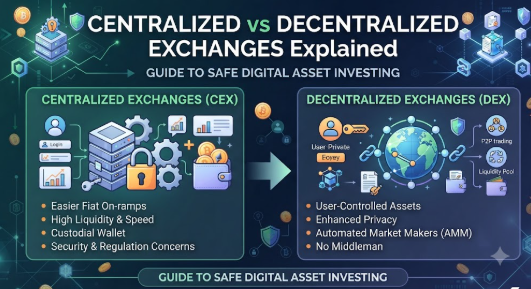
- Centralized Exchange (CEX): Think of a CEX like a traditional commercial bank or stock brokerage. A private company operates the platform, maintains an internal database to track ownership, balances the order books, and holds custody of your funds.
- Decentralized Exchange (DEX): A DEX replaces the corporate intermediary with self-executing code called smart contracts on a public blockchain network. Transactions occur directly between individual user wallets without an administrative middleman holding the assets.
People search for this comparison because they want to know who controls their money when a trade is executed. In real life, choosing between them dictates whether you log in with an email and password or connect an independent cryptographic hardware wallet.
Common Misunderstanding: Many beginners believe that buying a token on any mobile app means the token is sitting inside their personal possession. In reality, assets held on a centralized provider are simply IOUs on a corporate ledger until you withdraw them to an external, self-custodial wallet.
Why Understanding Your Exchange Infrastructure Is Important
The choice between exchange architectures directly influences your risk exposure, trading costs, and operational freedom. It shapes long-term financial discipline by forcing you to confront the realities of asset custody and cybersecurity.
- Risk Mitigation: A CEX exposes you to platform counterparty risk (the company going bankrupt or freezing assets). A DEX exposes you to smart contract exploits (bugs in the code that hackers exploit).
- Cost Management: Centralized platforms charge predictable, off-chain matching fees, whereas decentralized swaps require paying on-chain network validator fees (gas), which fluctuate based on network congestion.
- Regulatory Exposure: Centralized options comply with regional Know Your Customer (KYC) mandates, requiring government identities, while decentralized protocols operate pseudonymously via wallet addresses.
A Short Practical Scenario
Consider an investor who leaves their entire life savings on a high-yield centralized platform. If that platform encounters an unexpected liquidity crisis or regulatory shutdown, the investor’s account access can be instantly revoked. Conversely, an investor using a decentralized protocol retains their assets in their private wallet; even if the DEX website interface goes offline, the underlying smart contract remains accessible directly through the blockchain ledger.
The Real Problem Readers Face With Crypto Exchanges
The fundamental problem confronting retail market participants is an overwhelming volume of conflicting advice online, combined with slick marketing campaigns that prioritize user acquisition over risk transparency. Financial influencers frequently promote complex trading platforms using hype-driven language that promises seamless, instant wealth. This environment creates several distinct points of friction:
- Asymmetric Information: The technical documentation explaining liquidity pools, slippage, and cryptographic custody is often written for software engineers rather than everyday savers.
- Opaque Terms of Service: Users routinely click through legal agreements without realizing they are legally granting a centralized entity the right to rehypothecate (lend out) their deposited digital assets.
- UI/UX Deception: Because modern decentralized application interfaces look as polished as corporate banking apps, beginners frequently fail to recognize when they are interacting with high-risk, experimental smart contracts.
By presenting centralized vs decentralized exchanges explained objectively, this guide bypasses the superficial marketing layers to focus entirely on structural reality.
How Crypto Exchanges Work Step by Step
Step 1: Account Onboarding and Identity Integration
Account onboarding establishes your fundamental entry point and cryptographic identity within a trading ecosystem. This phase is critical because it determines who holds ultimate authority over your user data and access privileges from day one. To apply this, you either register an account on a CEX using an email address and multi-factor credentials, or connect an independent, self-custodial wallet directly to a DEX interface. A common mistake beginners make is reusing weak or compromised passwords across centralized venues, or typing a decentralized wallet’s seed phrase into an unverified webpage form. A much better approach is to deploy a dedicated hardware-isolated key device for all decentralized protocol connections while using a unique, randomly generated credential set for centralized accounts.
Step 2: Capital Funding and Asset Depositing
Capital funding is the mechanical process of moving purchasing power into your chosen venue to prepare for market operations. This step converts traditional fiat currency into tradeable digital assets or routes your existing on-chain tokens into active trading environments. To execute this step, you link a traditional bank account or wire transfer to a CEX, or fund an independent Web3 wallet with native network tokens sourced from a peer-to-peer provider to use a DEX. A common mistake during this phase is depositing funds into an exchange using an unsupported or incorrect blockchain network route, which leads to permanently unrecoverable assets. A better approach is to always perform a small, low-value test transaction to confirm network and address compatibility before transferring any substantial blocks of capital.
Step 3: Liquidity Discovery and Order Matching
Liquidity discovery is the operational process of finding an eligible counterparty willing to accept the exact opposite side of your desired trade. This phase directly influences your execution speed, platform efficiency, and the final clearing price you receive for your transaction. To apply this, you submit a trade request; a CEX matches it instantly via an internal, highly optimized electronic limit order book hosted on corporate servers, while a DEX routes your swap through an Automated Market Maker (AMM) mathematical formula that pulls from crowdsourced liquidity pools. A common mistake here is placing large market orders on low-liquidity asset pairs, which triggers massive, unfavorable price shifts known as slippage. A better approach is to utilize strict limit orders on centralized venues, and verify the maximum allowable slippage parameters in your wallet settings before approving decentralized protocol swaps.
Step 4: Transaction Fee Processing and Deduction
Transaction fee processing is the accounting phase where the venue extracts financial compensation for facilitating your trade. Monitoring these costs matters because high operational fees silently erode total portfolio performance over multi-year investment horizons. To navigate this, you must review your transaction receipts, noting that a CEX extracts a fixed percentage maker/taker fee from your account balance, whereas a DEX requires you to pay a blockchain network gas fee directly to network validators alongside a small liquidity provider fee. A common mistake beginners make is attempting decentralized swaps during peak network hours when the base gas costs actually exceed the total value of the trade itself. A better approach is to schedule decentralized on-chain modifications during low-congestion hours and evaluate tier-based volume discounts on centralized options.
Step 5: Trade Settlement and Clearing
Trade settlement is the official updating of ownership ledgers to reflect the finalized exchange of digital properties. This phase determines whether your transaction is legally and computationally finalized on a permanent record. In practice, a CEX updates its private, closed-source SQL database internally without broadcasting a transaction to the public blockchain ledger, while a DEX broadcasts your cryptographic swap directly to the distributed network, recording it into a public block. A common mistake is assuming that a completed trade status on a centralized website dashboard means the underlying tokens have been settled to a blockchain address under your personal jurisdiction. A better approach is to treat centralized balances as theoretical database entries until you initiate, confirm, and verify an outbound blockchain withdrawal request to your own wallet.
Step 6: Post-Trade Capital Custody and Storage
Post-trade capital custody involves managing the ongoing physical protection of your acquired digital properties after a transaction settles. This phase represents your ultimate line of defense in preventing total loss via corporate platform bankruptcies or malicious smart contract exploits. To execute this correctly, you must explicitly decide where the asset rests: leaving it inside the CEX repository if you are actively day trading, or letting it remain in your connected self-custodial wallet if operating on a DEX. A dangerous mistake is leaving long-term, multi-year investment allocations idle on a centralized platform’s corporate balance sheet indefinitely. A much better approach is to migrate non-trading core allocations out of corporate platforms into cold-storage hardware configurations where you maintain absolute, exclusive control of the recovery seed phrase.
Key Factors That Influence Exchange Security and Usability
Exchange Reliability and Counterparty Standing
When analyzing a CEX, you must evaluate corporate transparency, corporate registration locations, and asset confirmation metrics (Proof of Reserves). For a DEX, platform reliability shifts entirely to the historical performance of its code, the independence of its smart contract audits, and the total volume of liquidity locked within its parameters.
Wallet Safety and Private Key Administration
In the decentralized realm, private key isolation is your sole protection mechanism. If you expose your private phrases, there is no corporate customer support desk to reverse the theft. Centralized safety relies instead on robust account boundaries: biometric locks, time-delayed withdrawals, and hardware security keys.
Network Volatility and Transaction Fee Variables
On-chain execution costs on decentralized protocols scale directly with network demand. During intense market drops or speculative surges, executing a smart contract trade can become prohibitively expensive for small retail balances. Centralized entities isolate users from these immediate spikes by processing trades within an internal database, offering flat fee schedules regardless of live blockchain congestion.
Detailed Breakdown of CEX vs DEX Infrastructure
Centralized Exchange Design Architecture
Centralized exchanges operate as closed-source ecosystems built on traditional corporate database stacks. They mimic the high-frequency matching engines used by legacy stock markets. When you deposit capital, you surrender physical custody of your tokens to the exchange’s master wallets. In return, the exchange credits your internal account balance sheet.
- Order Matching Engine: Operates off-chain at microsecond speeds. It processes thousands of buy and sell limit requests simultaneously, ensuring high asset liquidity and minimal bid-ask spreads for major assets.
- Account Compliance Framework: Implements strict algorithmic surveillance tools to detect money laundering, track incoming token origins, and verify user documentation against global sanctions databases.
Decentralized Exchange Design Architecture
Decentralized platforms exist purely as open-source code deployed to a distributed network ledger. They do not possess central clearinghouses, corporate offices, or employee-managed databases. Instead, they rely on automated cryptographic designs to clear trades.
- Automated Market Makers (AMMs): Rather than matching specific buyers with specific sellers, AMMs collect tokens into shared liquidity pools. Prices adjust dynamically using deterministic mathematical equations such as:$$x \cdot y = k$$Here, $x$ and $y$ represent the total quantities of two paired tokens, and $k$ is a constant invariant that must remain unchanged during a swap.
- Smart Contract Execution: Every swap is an atomic transaction. This means the swap either succeeds entirely across the distributed network or fails completely, with no intermediate state where an intermediary can hold your funds hostage.
Common Mistakes Beginners Make With Crypto Platforms
Leaving Large Multi-Year Portfolios Idle on Corporate Balances
The single most damaging habit among new participants is treating a centralized trading platform exactly like a federally insured traditional savings account. If a centralized business encounters an insolvency event, retail deposits are frequently reclassified as unsecured debt during corporate liquidations, leaving users with minimal recourse.
Signing Unverified Cryptographic Permissions on Decentralized Web Applications
When interacting with a DEX, users must approve smart contract permissions to allow the protocol to interact with their tokens. A frequent error is connecting a primary asset wallet to an unverified clone website and blindly signing a malicious contract spend approval, giving bad actors unlimited access to deplete the wallet’s contents.
Don’t Do This Actionable Checklist
- Do not store your master recovery seed phrase inside an unencrypted digital notebook, email draft, or cloud storage drive.
- Do not execute substantial market orders on obscure, micro-cap decentralized pools without confirming the current price impact metrics.
- Do not disable Multi-Factor Authentication (MFA) or rely exclusively on easily intercepted SMS-based verification methods for centralized accounts.
- Do not assume an asset recovery company can reverse a verified on-chain blockchain transaction if you send funds to an incorrect address.
Practical Real-Life Examples of Exchange Decisions
- The Active Day Trader: A user wants to execute forty small, high-frequency trades per day across major pairs. They utilize a highly liquid, tier-one Centralized Exchange because the off-chain execution eliminates compounding network gas fees.
- The Privacy-Focused Accumulator: An investor prefers to acquire assets without sharing scanned government passports across third-party corporate networks. They utilize a Decentralized Exchange linked directly to an isolated hardware wallet.
- The Automated Yield Seeker: A market participant wants to earn a share of transaction fees by providing assets to a trading pair. They deposit equal values of two tokens directly into a DEX Liquidity Pool, managing the structural risk of impermanent loss.
- The Stable Income Saver: A salaried worker wants to allocate a fixed dollar amount from their bank account each month automatically. They use a CEX Recurring Purchase Program because it integrates smoothly with legacy banking systems.
- The Micro-Cap Explorer: A user seeks to purchase an early-stage utility token before it is listed on mainstream corporate platforms. They source the token directly on a native DEX Protocol where the project creators originally launched the liquidity pool.
Table 1: Core Architectural Comparison Matrix
| Structural Parameter | Centralized Exchange (CEX) | Decentralized Exchange (DEX) |
| Asset Custody Profile | Custodial (Exchange holds your private keys) | Self-Custodial (User maintains private key control) |
| Identity Verification | Compulsory KYC and AML documentation | Pseudonymous (Wallet connection only) |
| Order Execution Method | Centralized internal limit order book | On-chain Automated Market Maker (AMM) pools |
| Primary System Vulnerability | Corporate insolvency and internal system hacks | Smart contract exploits and phishing vulnerabilities |
| Transaction Processing Costs | Percentage-based platform maker/taker fees | Blockchain network gas fees + pool provider fees |
Table 2: Risk-to-Benefit Tradeoff Framework
| Platform Choice | Ideal Use Case Profile | Key Operational Drawback | Primary Risk Point |
| Centralized (CEX) | High-frequency trading, fiat onboarding, simple interfaces | High regulatory exposure and account freeze risks | Platform insolvency leading to loss of access |
| Decentralized (DEX) | Long-term custody asset swaps, global access, unlisted tokens | Complex user experience and volatile network fees | Code bugs or signing a malicious contract permit |
Tools, Methods, and Frameworks Readers Can Use
Smart Contract Verification Protocols
Before executing swaps on a decentralized platform, users should deploy automated security scanners like DeFiLlama, Tokensniffer, or Goplus Labs. These independent tools analyze token smart contract code in real-time, detecting embedded malicious code such as hidden mint functions, transfer blocks, or unequal fee structures.
Centralized Exchange Solvency Assessment Methods
When using centralized platforms, investors must monitor platform health metrics via tracking suites like CoinGecko or CoinMarketCap. Focus on the verified Proof of Reserves (PoR) dashboard data. A reliable CEX must show an independent cryptographic verification that its aggregate asset custody matches or exceeds 100% of all user liabilities.
Expert Tips to Make Better Decisions
- Separate Onboarding from Storage: Use centralized platforms purely as a temporary bridge to convert fiat currency into crypto, then immediately migrate assets to independent storage.
- Utilize Dedicated Wallet Segmentation: Maintain one isolated hardware wallet for long-term storage and a separate, low-balance software wallet for interacting with new decentralized applications.
- Audit App Approvals Regularly: Periodically connect your decentralized wallet to verified revocation tools like Revoke.cash to cancel historical smart contract spend permissions you no longer actively use.
- Account for Slippage Tolerances: When trading volatile tokens on a DEX, set your maximum slippage tolerance to a tight threshold (under 1%) to prevent front-running bots from manipulating your final execution price.
- Implement App-Based Authenticator Solutions: Never use phone-number-based SMS verification for centralized accounts due to the risk of SIM-swapping exploits; rely on hardware security keys or time-based one-time password applications instead.
- Verify Smart Contract Deployment Length: Avoid allocating capital to decentralized liquidity pools where the underlying smart contracts have been live for less than ninety days, as early-stage deployments carry unproven exploit risks.
- Monitor Blockchain Gas Trackers: Before sending decentralized transactions, check a live network gas meter to avoid getting your transaction stuck in the mempool due to underpaying base network validator fees.
- Confirm Destination Addresses Manually: Always double-check the first and last five characters of a destination wallet address before finalizing an outbound transfer to catch clipboard-hijacking malware.
- Implement White-Listed Address Restrictions: Turn on the withdrawal address whitelisting option inside your centralized exchange security panels, creating a mandatory 24-hour security delay for any new destination address.
- Document Cost Bases Continuously: Record your transaction history, execution fees, and swap dates in an independent ledger, as decentralized networks do not provide automated end-of-year tax statements.
Case Studies: How Better Understanding Changes Decisions
Case Study 1: The Corporate Insolvency Awakening
- Profile: A retail saver accumulating digital assets for a long-term retirement target.
- Situation: The user stored their entire crypto portfolio on a major centralized platform to earn an advertised interest yield.
- Problem: The platform suspended all outbound customer withdrawals overnight due to a corporate liquidity crisis and subsequent bankruptcy filing.
- Wrong Approach: Assumed the digital funds were legally protected by government deposit insurance, leaving the assets locked in legal proceedings.
- Better Approach: The user shifted their strategy for future allocations, using the CEX solely to buy tokens and immediately withdrawing them to a personal hardware wallet.
- Result: Reduced platform counterparty exposure to zero, ensuring their core capital remained safe during subsequent industry disruptions.
- Key Takeaway: Corporate digital asset platforms are not banks; true asset security requires self-custodial ownership.
Case Study 2: The Phishing Site Interaction
- Profile: An intermediate trader seeking an unlisted utility token via decentralized tools.
- Situation: The user searched for a prominent decentralized exchange using a standard internet search engine.
- Problem: They accidentally clicked a sponsored ad link that perfectly mimicked the authentic DEX user interface but was actually a malicious phishing clone.
- Wrong Approach: Connected their main software wallet and signed a transaction permission without analyzing the text inside the prompt popup.
- Better Approach: The user rejected the transaction when noticing the unusual website domain name, verified the correct contract address on an independent block explorer, and bookmarked the legitimate URL.
- Result: Saved their entire wallet balance from total drainage by catching the interface discrepancy before signing.
- Key Takeaway: In decentralized finance, you are your own compliance officer; always verify the exact browser URL and contract details before granting wallet permissions.
Case Study 3: The Gas Congestion Bottleneck
- Profile: A small-scale investor managing a three-hundred-dollar asset allocation.
- Situation: The user wanted to swap a small token balance on an Ethereum-based decentralized exchange during a major market liquidation event.
- Problem: The network transaction fee surged to eighty dollars due to massive block congestion, making the swap highly inefficient.
- Wrong Approach: Repeatedly submitted the transaction with low gas fees, causing the trade to hang unexecuted for hours while wasting money on failed transaction fees.
- Better Approach: Switched processing to a highly liquid centralized venue for short-term trades during high volatility, or used an optimized layer-2 decentralized scaling protocol.
- Result: Reduced transaction friction from 26% of total capital down to less than a fraction of a percent.
- Key Takeaway: Match your transactional size to the appropriate network infrastructure; small balances can get priced out of base-layer decentralized networks during high congestion.
Risk Awareness: What Readers Must Check First
Platform Counterparty and Liquidation Risk
When capital rests within a centralized entity, your financial standing is tied to the financial health of that corporation. If the firm mismanages its balance sheet, utilizes client deposits for corporate investments, or faces sudden regulatory enforcement, your access to those funds can be permanently severed.
Smart Contract Exploits and Logic Imperfections
Decentralized exchanges remove human managers but introduce software vulnerability risks. If an open-source smart contract contains an undiscovered mathematical flaw or logical vulnerability, malicious actors can drain the entire liquidity pool, causing immediate token devaluation or loss of deposited funds.
Phishing Architecture and Domain Spoofing
Because decentralized protocols rely on independent wallet connections, malicious actors deploy highly sophisticated web interface clones. These deceptive front-ends are designed to trick users into granting broad signature authority, enabling automated scripts to empty the user’s wallet without breaking the underlying blockchain security.
15. Checklist Before Taking Action
- Custody Framework Verification: Have you clearly identified whether the chosen venue is custodial or self-custodial?
- Fee Breakdown Assessment: Have you calculated both the platform execution fees and the estimated on-chain network gas costs?
- Liquidity Depth Confirmation: Have you checked the available liquidity for your specific trading volume to prevent excessive slippage losses?
- Multi-Factor Authentication Setup: Is your centralized account protected by an app-based authenticator rather than SMS?
- Recovery Seed Protection Check: Are your master recovery seed words safely written down and stored offline in a secure location?
- Contract Permitting Verification: Have you scanned the destination decentralized application address using an independent smart contract security checker?
- Network Integration Alignment: Have you verified that your wallet network setting exactly matches the destination address deposit network?
Before executing any financial transaction or connecting an asset wallet to an external platform, process each requirement listed above. This systematic approach transforms emotional trading into a disciplined, repeatable safety routine.
16. Strategic Insights for Better Decision-Making
Understanding Asset Custody Contexts
The debate of centralized vs decentralized exchanges explained clearly comes down to one core concept: private key management.
[Private Keys Controlled by Centralized Corp] ----> Account Balance is an IOU (CEX)
[Private Keys Controlled by Personal Hardware] --> Absolute Asset Ownership (DEX)
In a CEX framework, you do not hold the actual cryptographic tokens; you own a legal claim against the exchange’s inventory. In a DEX framework, you possess absolute, mathematical ownership of the cryptographic entries on the ledger, independent of any corporate entity.
Strategic Infrastructure Pairing
Experienced market participants rarely rely exclusively on a single venue type. Instead, they implement a hybrid model that maximizes the strengths of both systems while minimizing risk exposures:
+--------------------------------------------------------+
|                  HYBRID WALLET SYSTEM                  |
+--------------------------------------------------------+
|                                                        |
|  [ Fiat Bank Account ]                                 |
|          │                                             |
|          ▼                                             |
|  [ Centralized Exchange (CEX) ] ──► Temporary Fiat/    |
|          │                          Crypto Bridge      |
|          ▼                                             |
|  [ Hardware Wallet (Cold Storage) ] ──► 80% Core Asset |
|          │                              Savings        |
|          ▼                                             |
|  [ Decentralized Exchange (DEX) ] ──► 20% Active DeFi  |
|                                       Swaps            |
+--------------------------------------------------------+
Key Terms Explained for Beginners
- Private Key: A secret cryptographic string of characters that grants absolute authority to move or spend digital assets from a specific blockchain address.
- Seed Phrase: A sequence of 12 to 24 plain language words generated by your crypto wallet that acts as the master backup key to restore all associated private keys.
- Smart Contract: Self-executing lines of software code deployed directly onto a blockchain network that automatically fulfill an agreement when predefined terms are verified.
- Automated Market Maker (AMM): A decentralized exchange mechanism that uses mathematical formulas to price assets dynamically based on the ratio of tokens held in a shared pool.
- Liquidity Pool: A crowdsourced repository of digital tokens locked inside a smart contract that provides the necessary inventory for decentralized trading venues to clear swaps.
- Slippage: The difference between the expected price of a trade and the final execution price when the transaction settles on the ledger.
- Gas Fee: The variable operational cost paid directly to blockchain network validators to cover the computational energy required to process an on-chain transaction.
- Proof of Reserves (PoR): An independent cryptographic audit method used by centralized platforms to publicly demonstrate that their on-hand asset custody covers all customer liabilities.
- Know Your Customer (KYC): A mandatory identity verification process that financial service providers use to verify a customer’s legal identity and address before granting platform access.
- Impermanent Loss: A temporary reduction in capital value that liquidity providers experience when the market price ratio of their deposited tokens shifts relative to holding those assets independently.
Who Should Read This Blog
This educational breakdown is built specifically to guide individuals navigating the complex intersections of digital asset tracking and financial technology:
- Beginner Investors: Individuals looking to acquire digital assets safely without falling victim to structural platform collapses or hidden trading fees.
- Salaried Employees: Professionals building long-term savings allocations who require clear risk management strategies to shield their monthly capital from platform insolvencies.
- Crypto Learners: Students of Web3 technology who want to master the structural differences between traditional corporate servers and distributed public ledgers.
- Financial Awareness Bloggers: Content creators looking for accurate, audited, and objective frameworks to explain risk management to their readers.
Frequently Asked Questions
What is centralized vs decentralized exchanges explained simply?
A centralized exchange (CEX) is operated by a private company that manages your account ledger and holds custody of your keys. A decentralized exchange (DEX) replaces the company with open-source smart contracts, letting you swap assets directly from your personal wallet.
Which platform type is safer for a complete beginner?
A CEX is often easier for a beginner to use because it offers familiar login steps and customer support. However, it is only safer for short-term purchases; long-term asset storage should always happen in a self-custodial wallet to eliminate platform insolvency risk.
Do I need to provide government identification to trade on a DEX?
No, decentralized exchanges do not have compliance registration gates or identity checks. Accessing a DEX requires only connecting a cryptographic asset wallet, preserving your personal privacy.
What happens to my funds if a centralized exchange goes bankrupt?
If a centralized exchange enters bankruptcy, your account access is typically frozen immediately. Legally, customer deposits are often classified as unsecured debt, meaning you might recover only a portion of your capital through extended court proceedings.
Can a transaction be reversed if I make an error on a DEX?
No, transactions processed on a decentralized protocol are executed directly on a public blockchain ledger. Public blockchains are immutable, meaning once a transaction is written to a block, it cannot be modified, reversed, or cancelled by anyone.
Why are transaction costs on decentralized exchanges always changing?
DEX transaction costs are tied to the base network gas requirements of the underlying blockchain ledger. When market trading volume spikes globally, block space demand increases, forcing validators to prioritize users who pay higher processing fees.
What is the biggest mistake to avoid when using a DEX?
The most dangerous error is signing an unverified smart contract spend approval on a fake phishing website. This mistake gives malicious code permanent access to transfer assets out of your wallet without your direct consent.
How do I check if a centralized exchange is financially stable?
Look for a verified, live Proof of Reserves (PoR) link on the platform’s portal. This documentation should feature an independent cryptographic proof showing their real-time wallet balances cover 100% of customer deposits.
Can I buy crypto using traditional cash directly on a DEX?
Generally, no. Decentralized exchanges operate exclusively with on-chain digital tokens. To use a DEX, you must first convert your fiat currency into digital assets using a centralized ramp or an independent peer-to-peer provider.
What is slippage, and why does it occur during swaps?
Slippage is the difference between the token price you see when clicking “swap” and the actual price you get when the trade clears. It happens when market prices shift rapidly during the delay between your transaction submission and its official block confirmation.
Is it a good idea to leave my trading assets on an exchange app long-term?
No, keeping significant asset allocations on any trading platform app exposes your capital to unnecessary operational risks. Move assets to an offline hardware wallet if you do not plan to execute active trades within the next thirty days.
What is the best next step after reading centralized vs decentralized exchanges explained?
Set up an independent, non-custodial software or hardware wallet, and practice moving a tiny test balance from a centralized provider to your personal address. This small exercise builds firsthand confidence in managing asset custody safely.
Conclusion and Next Steps
True financial awareness requires evaluating not just the potential returns of an asset class, but also the security of the infrastructure holding that asset. Understanding centralized vs decentralized exchanges explained clearly reveals that platform selection is a deliberate balancing act between transaction speed, cost efficiency, and asset custody. Centralized platforms remain excellent entry points for converting cash into digital assets and conducting high-frequency trades. However, they require you to place absolute trust in a corporate intermediary. Decentralized protocols offer unprecedented freedom and asset ownership, but they place the full burden of operational security squarely onto your shoulders.
As a practical next step, audit your current digital asset holdings. If you have major allocations sitting idle on corporate exchange balances, consider acquiring a dedicated hardware wallet to establish self-custody. Move your funds slowly, utilize small test transfers to build technical familiarity, and never sign a cryptographic transaction without verifying the destination address. By taking control of your private keys, you protect your capital from external corporate shocks and lay the foundation for long-term financial discipline.