Introduction
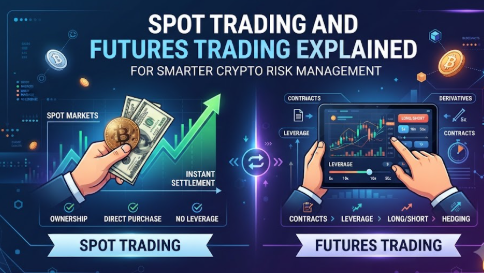
Crypto trading can look simple when someone sees a price chart, a buy button, and stories of traders making fast profits, but the difference between spot trading and futures trading is much more important than many beginners realize. In spot trading, a buyer generally purchases the actual cryptocurrency at the current market price, while futures trading involves a contract linked to an asset’s price and may include leverage, margin requirements, short positions, funding costs, and liquidation risk. A beginner who enters futures without understanding these features can lose money much faster than expected. This guide explains Spot Trading vs Futures Trading Explained in practical language so that crypto learners, investors, salaried people, and new traders can compare both methods, understand their risks, avoid emotional decisions, and select an approach that matches their knowledge, financial capacity, and risk tolerance.
Understanding Spot Trading vs Futures Trading
What Is Spot Trading?
Spot trading means buying or selling a cryptocurrency at or near its current market price. When a person purchases a crypto asset through a standard spot transaction, the purchased quantity is normally credited to the person’s exchange account or wallet.
For example, suppose a crypto asset is trading at ₹1,00,000 per unit. A buyer who spends ₹10,000 through the spot market may receive crypto worth approximately ₹10,000, excluding fees and price movement during order execution.
The buyer can normally:
- Hold the asset.
- Transfer it to a compatible wallet.
- Sell it later.
- Use it where supported.
- Keep it as part of a longer-term portfolio.
Spot trading is commonly used by people who want direct exposure to a crypto asset without using a derivative contract. Coinbase describes crypto spot trading as buying and selling digital assets at their current market prices. utures Trading?
Futures trading involves buying or selling a contract whose value is connected to the price of an underlying asset. The trader may not own the actual cryptocurrency.
A futures trader can generally take:
- A long position when expecting the price to rise.
- A short position when expecting the price to fall.
Traditional futures contracts may have an expiration date, while perpetual futures are designed without a fixed expiry. Perpetual contracts often use funding payments or similar mechanisms to help keep their market price close to the underlying spot price.
Futures trading can also involve leverage. Leverage allows a trader to control a larger position using a smaller amount of capital. However, it increases both potential gains and potential losses. The US Commodity Futures Trading Commission warns that leveraged virtual-currency futures can amplify trading risk because the trader may fund only a fraction of the position’s total value. Beginner Example
Imagine that Bitcoin is trading at ₹50,00,000.
A spot trader spends ₹50,000 and purchases a small portion of Bitcoin. If the price falls by 10%, the holding may lose approximately 10% of its value, excluding fees.
A futures trader deposits ₹50,000 and uses 10× leverage to open a position worth ₹5,00,000. A relatively small adverse price movement can create a much larger percentage loss on the trader’s deposited capital and may trigger liquidation.
Common Misunderstanding
Many beginners believe futures trading is simply a faster version of spot trading. This is incorrect.
Futures introduce additional concepts, including:
- Leverage.
- Margin.
- Liquidation.
- Contract specifications.
- Funding rates.
- Mark price.
- Long and short exposure.
- Position maintenance requirements.
Practical Takeaway
Spot trading is generally easier to understand because the person is buying or selling the asset directly. Futures trading is more complex and requires disciplined risk management, contract knowledge, and close position monitoring.
Why Spot Trading vs Futures Trading Is Important
Understanding the difference between spot and futures trading affects much more than the selection of a trading screen. It influences capital protection, emotional control, investment planning, tax record keeping, security practices, and the amount of risk attached to each decision.
Impact on Savings
A person using long-term savings for spot trading may experience substantial losses if crypto prices fall. However, the asset is not normally liquidated merely because the market price declines, provided there is no borrowing or margin arrangement.
In leveraged futures, an adverse movement may reduce the trader’s margin rapidly. The position may be automatically closed if the available margin becomes insufficient.
Impact on Investing
Spot trading may be used as part of a longer-term investment approach. The investor can research the project, purchase an amount within a planned allocation, and hold it without continuously managing a leveraged contract.
Futures are usually more suitable for experienced participants using a defined trading or hedging strategy. They are not automatically better simply because they provide leverage or allow short positions.
Impact on Trading
Spot traders can attempt to benefit from buying at a lower price and selling at a higher price.
Futures traders may attempt to benefit from both rising and falling markets. However, the ability to trade in both directions does not reduce risk. An incorrect market view can still generate losses.
Impact on Tax and Records
Spot purchases and sales may create taxable events depending on the person’s country and circumstances. Futures profits, losses, fees, and funding payments may be treated differently.
Traders should keep records of:
- Trade dates.
- Purchase and sale values.
- Fees.
- Contract settlements.
- Funding payments.
- Withdrawals.
- Wallet transfers.
- Realized gains and losses.
Impact on Emotional Decisions
Leverage can make small price movements feel financially significant. This may lead to panic closing, revenge trading, excessive position sizes, or repeated entries without analysis.
Practical Scenario
A salaried employee has ₹1,00,000 available after meeting essential expenses. Instead of using the full amount in a leveraged futures trade, the person studies the market, separates emergency savings, limits crypto exposure, and starts with a smaller spot purchase. The better decision does not guarantee profit, but it reduces the risk of one trade damaging the person’s monthly financial stability.
The Real Problem Readers Face With Spot and Futures Trading
The biggest problem is not simply choosing between two trading products. The deeper problem is that many people take positions without understanding what they are buying, what can cause losses, and how much capital is genuinely at risk.
Lack of Awareness
Trading platforms can make complex products appear easy. A user may see leverage options such as 5×, 10×, or higher without fully understanding how quickly losses can increase.
Confusing Online Advice
Social media often presents isolated screenshots of profitable trades while providing little information about losing trades, fees, risk, borrowed exposure, or total account performance.
Emotional Decision-Making
Fear of missing out can make traders enter after a major price increase. Panic can make them sell after a sharp fall. Futures leverage can intensify these emotions because profit and loss values change rapidly.
Weak Comparison
Beginners may compare only profit potential. They may ignore:
- Ownership of the asset.
- Liquidation risk.
- Contract expiry.
- Funding payments.
- Platform restrictions.
- Margin rules.
- Withdrawal options.
- Security responsibilities.
Unrealistic Expectations
A trader may believe that using 10× leverage can convert a small amount into a large amount quickly. The same leverage can also create rapid losses.
Ignoring Terms and Conditions
Every platform may have different rules relating to margin calculation, liquidation, insurance funds, contract settlement, funding, fees, and eligible users.
Depending on Social Media Tips
A trade signal cannot know a reader’s income, savings, debt, tax situation, risk tolerance, or trading knowledge. Acting on anonymous advice transfers decision-making to someone who may face no consequence if the trade fails.
Not Knowing the Next Step
The correct next step for a beginner is usually not to predict the next market move. It is to understand the product, practise order execution, define risk limits, and determine whether trading is financially suitable at all.
How Spot Trading and Futures Trading Work Step by Step
Step 1: Define the Purpose of the Trade
The first step is deciding whether the goal is long-term ownership, short-term trading, portfolio diversification, hedging, or speculation. This matters because spot trading may suit direct ownership, while futures may be used for advanced strategies such as short exposure or hedging. For example, a person wanting to hold a crypto asset for several years may choose spot rather than maintaining a futures contract. A common mistake is selecting futures merely because leverage is available. A better approach is to choose the product only after defining the financial objective.
Step 2: Select the Asset and Trading Market
The trader chooses the cryptocurrency and checks whether it is available in the spot market, futures market, or both. This matters because spot and futures pairs may have different liquidity, fees, price behaviour, and trading rules. For example, a popular asset may have an active spot market but a smaller futures contract on a particular platform. A common mistake is selecting a market based only on a trending token name. A better approach is to review trading volume, spread, contract details, and platform availability.
Step 3: Understand the Order Type
Traders can commonly use market orders, limit orders, and stop-based orders. A market order prioritizes execution but may fill at different prices during volatile conditions. A limit order specifies a preferred price but may not execute. For example, a trader may place a limit buy below the current market price rather than entering immediately. A common mistake is using large market orders in thin markets. A better approach is to understand expected execution, spread, slippage, and order cancellation rules.
Step 4: Determine the Position Size
Position size refers to the amount of capital or exposure placed in a trade. In spot trading, the buyer may decide to invest ₹5,000 from a planned crypto allocation. In futures, the trader must consider both deposited margin and the full notional value of the position. A common mistake is measuring risk only by the margin deposit. A better approach is to calculate how much money could be lost if the stop level is reached and keep that amount within a predefined risk limit.
Step 5: Set the Direction and Risk Level
A spot buyer generally benefits when the asset price rises after purchase. A futures trader can choose a long or short position. The trader should define the entry, invalidation point, stop-loss level, and maximum acceptable loss before opening the position. A common mistake is entering first and planning later. A better approach is to write the trading plan before clicking the order button.
Step 6: Monitor Fees, Margin, and Price Movement
Spot traders should monitor trading fees, spreads, network withdrawal fees, and portfolio concentration. Futures traders must additionally monitor margin usage, maintenance requirements, funding payments, mark price, and liquidation distance. A common mistake is focusing only on the chart while ignoring account-level risk. A better approach is to review the entire position dashboard and avoid using all available margin.
Step 7: Close, Review, and Record the Trade
A spot trade is closed when the asset is sold. A futures position is closed by placing an offsetting order or through settlement, expiry, or liquidation. After closing, the trader should record the reason for entry, result, fees, mistakes, and lessons. A common mistake is reviewing only profitable trades. A better approach is to maintain a journal for both winning and losing decisions so that repeated weaknesses become visible.
Key Factors That Influence Spot and Futures Trading Decisions
Market Volatility
Crypto prices can move rapidly in either direction. Volatility affects spot holdings, but it may have a more immediate effect on leveraged futures positions because losses are calculated on the full position size.
Common mistake: Increasing leverage because the market appears active.
Better approach: Reduce position size when volatility becomes difficult to manage.
Leverage
Leverage increases market exposure relative to deposited capital. It may improve capital efficiency, but it also magnifies losses. CME explains that futures margin represents a deposit supporting the contract rather than the same type of borrowing arrangement commonly associated with buying securities on margin. ake:** Believing leverage increases trading skill.
Better approach: Treat leverage as additional risk that must be justified by a tested strategy.
Liquidation Risk
Liquidation may occur when a leveraged position no longer has enough margin to meet platform requirements.
Common mistake: Treating the displayed liquidation price as a safe exit plan.
Better approach: Use a planned stop well before liquidation and avoid relying on forced closure.
Exchange Reliability
Centralized exchanges hold customer assets or collateral and operate the trading infrastructure. Operational failure, security incidents, withdrawal restrictions, legal changes, or insolvency can create platform risk.
Common mistake: Choosing an exchange only because it offers high leverage.
Better approach: Review regulation, security controls, transparency, fee structure, withdrawal processes, and availability in the user’s country.
Transaction Fees
Spot traders may pay maker or taker fees and withdrawal network fees. Futures traders may pay trading fees, funding payments, settlement costs, and other contract-related charges.
Common mistake: Calculating gross profit while ignoring total costs.
Better approach: Estimate all expected costs before placing the trade.
Liquidity and Spread
Liquidity affects how easily an order can execute near the expected price. A wide bid-ask spread increases the immediate cost of entering and exiting.
Common mistake: Trading a low-liquidity contract with a large position.
Better approach: Check market depth, spread, and typical order execution.
Time Horizon
Spot trading may support both short-term and long-term approaches. Leveraged futures positions often require closer monitoring because of liquidation, margin, funding, and contract conditions.
Common mistake: Holding a high-leverage futures position without a time-based plan.
Better approach: Match the product, position size, and monitoring ability with the expected holding period.
Wallet and Custody Safety
Spot buyers may withdraw assets to a personal wallet, which introduces private-key and seed-phrase responsibility. Futures traders may not hold the underlying asset, but their collateral still depends on platform security.
Common mistake: Assuming one form of custody is completely risk-free.
Better approach: Understand the security responsibilities and failure risks of each custody method.
Emotional Control
Fast profit-and-loss changes can trigger greed, panic, overconfidence, and revenge trading.
Common mistake: Increasing the next position to recover a previous loss.
Better approach: Stop trading when emotional control weakens and review the trading plan.
Detailed Breakdown of Spot Trading vs Futures Trading Explained
Ownership of the Underlying Asset
Spot trading generally gives the buyer ownership or control of the purchased crypto quantity, subject to the exchange’s custody arrangements.
Futures trading gives exposure through a derivative contract. The trader may profit or lose based on price movement without receiving the underlying cryptocurrency.
Ownership matters when the person wants to:
- Transfer crypto to a wallet.
- Use the asset in supported blockchain applications.
- Hold it without a contract expiry.
- Participate in supported network activities.
- Maintain direct long-term exposure.
Buying and Selling in the Spot Market
A spot trader can buy an asset using fiat currency, stablecoins, or another cryptocurrency, depending on the trading pair.
For example:
- BTC/USDT represents Bitcoin priced in USDT.
- ETH/BTC represents Ether priced in Bitcoin.
- A fiat pair may represent crypto priced in a national currency.
After buying, the trader may hold or sell the asset. A decline creates an unrealized loss until the asset is sold, although the economic value of the holding has already fallen.
Long and Short Positions in Futures
A long futures position benefits when the contract price rises, while a short position benefits when the price falls.
Short exposure is one reason experienced traders may use futures. However, short positions can still produce substantial losses if the market rises.
A common beginner mistake is believing that shorting is easier during a falling market. Markets can reverse quickly, and leveraged short positions may be liquidated during sharp upward movements.
Traditional Futures and Perpetual Futures
Traditional futures generally have a defined expiry or settlement date. The contract may be settled in cash or according to the exchange’s contract terms.
Perpetual futures do not have a standard expiry date. They commonly use periodic funding payments between long and short participants to help align the contract with the spot market.
Funding can affect profitability. A position that appears profitable from price movement may produce a smaller net result after repeated funding charges and fees.
Margin in Futures Trading
Margin is collateral used to open and maintain a leveraged position.
Two important concepts are:
- Initial margin: The amount required to open a position.
- Maintenance margin: The minimum amount required to keep the position open.
If account equity falls below required levels, the trader may need to add funds, reduce exposure, or face liquidation.
Isolated Margin and Cross Margin
With isolated margin, only the collateral allocated to a specific position is generally exposed to that position’s liquidation process.
With cross margin, available account collateral may support multiple positions. This can delay liquidation in one position but may expose more of the account balance.
A beginner may assume cross margin is safer because liquidation appears farther away. However, it can place a larger portion of the account at risk.
Mark Price and Last Traded Price
Some futures platforms use a mark price for unrealized profit, loss, and liquidation calculations. The mark price may differ from the last traded price.
This mechanism is intended to reduce liquidation caused by brief or unusual contract-price movements, but traders must understand the exact platform rules.
Spot Price and Futures Price
The spot price is the current market price for immediate purchase or sale.
A futures contract may trade above or below the spot price because of market expectations, demand, time to expiry, funding conditions, interest rates, and trading pressure.
The two prices are related but are not always identical.
Hedging With Futures
An experienced holder may use a short futures position to reduce some exposure to a temporary decline in a spot portfolio.
For example, a person holding Bitcoin may open a smaller short futures position. If Bitcoin falls, the loss in the spot holding may be partly offset by gains in the short contract.
However, hedging introduces:
- Basis risk.
- Fees.
- Funding payments.
- Position-sizing challenges.
- Liquidation risk.
- Tax and record-keeping complexity.
A poorly designed hedge can create additional losses instead of reducing risk.
Research and Analysis
Both spot and futures traders may use:
- Fundamental research.
- Technical analysis.
- Market structure.
- Volume.
- Liquidity.
- Risk-reward analysis.
- News verification.
- On-chain information.
- Broader economic context.
Analysis does not remove uncertainty. It helps traders organize decisions and define conditions under which an idea may be wrong.
Patience and Discipline
Spot investors may need patience during long periods of volatility.
Futures traders need discipline to follow stops, control leverage, limit frequency, and avoid increasing risk after losses.
Random tips are dangerous because they rarely include a complete plan covering entry, invalidation, position size, costs, and exit conditions.
Common Mistakes Beginners Make With Spot and Futures Trading
Using Emergency Money
This happens when a person sees trading as a solution to immediate financial pressure.
It is risky because crypto prices can fall, and futures losses can occur rapidly. Losing rent, medical, education, or emergency funds can create problems beyond the trading account.
Better action: Trade only with money that is not required for essential short-term expenses.
Selecting High Leverage
Beginners may select high leverage because it increases the displayed position size.
It is risky because a smaller adverse movement can consume margin and trigger liquidation.
Better action: Learn position sizing without leverage first and understand the full notional exposure.
Following Random Signals
Signals are attractive because they reduce the effort of personal research.
They are risky because the signal provider may enter earlier, exit without notice, use different leverage, or have a different financial capacity.
Better action: Take responsibility for the complete trading plan.
Entering Without a Stop or Exit Plan
This often happens when the trader believes the market will eventually reverse.
A small planned loss can become a much larger loss. In futures, the exchange may close the position before the trader’s expected recovery.
Better action: Define the invalidation point and maximum loss before entry.
Ignoring Fees and Funding
Frequent trading can create meaningful cumulative costs.
A strategy may look profitable before fees but perform poorly after trading charges, spreads, slippage, and funding payments.
Better action: Track net results rather than chart movement alone.
Confusing Margin With Maximum Loss
A trader may believe that the amount initially allocated is the only amount at risk.
Cross-margin systems or additional collateral can expose more capital. Platform rules also vary.
Better action: Understand the margin mode, liquidation method, and total account exposure.
Moving the Stop-Loss
A trader may move the stop farther away because accepting a loss feels uncomfortable.
This increases the loss without improving the original trade analysis.
Better action: Close the position when the original reason for the trade is invalidated.
Overtrading
Overtrading may result from boredom, profit excitement, loss recovery, or fear of missing out.
More trades create more opportunities for mistakes and additional fees.
Better action: Trade only when predefined conditions are present.
Ignoring Security
Beginners may reuse passwords, disable authentication controls, share screens, or store seed phrases online.
A profitable trade has little value if the account or wallet is compromised.
Better action: Use unique passwords, strong authentication, withdrawal controls, and offline seed-phrase storage.
Ignoring Legal and Tax Responsibilities
Crypto trading rules differ by jurisdiction and can change. Futures products may also be restricted in certain locations.
Better action: Verify local rules and consult qualified professionals when the legal or tax treatment is unclear.
“Don’t Do This” Checklist
- Do not borrow money to fund speculative crypto trades.
- Do not use rent, medical, education, tax, or emergency funds.
- Do not choose leverage because of profit screenshots.
- Do not share passwords, private keys, seed phrases, or verification codes.
- Do not enter a trade without calculating potential loss.
- Do not rely entirely on anonymous social media tips.
- Do not continue trading while angry, panicked, or desperate.
- Do not keep adding margin without reviewing the original idea.
- Do not assume a popular exchange is free from operational risk.
- Do not treat previous profits as proof that future trades will succeed.
- Do not ignore funding payments, spreads, slippage, and fees.
- Do not trade products that are unavailable or restricted in your jurisdiction.
Practical Real-Life Examples of Spot and Futures Trading
Example 1: Salaried Employee Starting With Spot Trading
A salaried employee wants crypto exposure but has limited experience. The initial mistake is considering a leveraged position after seeing a profitable trade online. A better action is to protect emergency savings, allocate a small planned amount to spot, and study price behaviour. The learning is that beginning with a simpler product can reduce complexity while market knowledge develops.
Example 2: Beginner Using Excessive Futures Leverage
A beginner deposits ₹20,000 and opens a position with high leverage. A small adverse price movement creates a large loss and the position approaches liquidation. A better action would have been using a smaller position, lower or no leverage, and a predetermined stop. The learning is that account size does not equal safe position size.
Example 3: Long-Term Holder Considering a Hedge
An investor holds crypto for the long term but expects temporary volatility. The challenge is deciding whether to sell the spot holding or hedge part of it. A carefully sized short futures position may reduce some downside exposure, but only after understanding funding, liquidation, and basis risk. The learning is that hedging is a risk-management process, not a guaranteed profit strategy.
Example 4: Trader Ignoring Funding Costs
A trader keeps a perpetual futures position open for several weeks. The market moves slightly in the expected direction, but repeated funding payments and trading fees reduce the net result. A better action is to estimate holding costs before entry and review whether spot exposure would be more efficient. The learning is that correct direction does not always produce a good net outcome.
Example 5: Crypto Learner Avoiding a Fake Scheme
A crypto learner receives a message promising guaranteed daily returns through automated futures trading. The challenge is pressure to deposit quickly. The better action is to reject guaranteed-profit claims, verify the platform independently, and protect personal information. The learning is that legitimate trading always involves uncertainty and risk.
Two Useful Tables for Better Understanding
Table 1: Spot Trading and Futures Trading Comparison
| Comparison Point | Spot Trading | Futures Trading |
|---|---|---|
| Basic structure | Direct purchase or sale of cryptocurrency | Trading a derivative contract linked to cryptocurrency |
| Asset ownership | Buyer generally receives the purchased asset | Trader generally receives contract exposure, not the asset |
| Market direction | Commonly benefits from buying before a price increase | Can take long or short positions |
| Leverage | Usually absent in standard spot trading | Commonly available, depending on platform and product |
| Liquidation risk | Normally no liquidation without margin or borrowing | Leveraged positions may be liquidated |
| Holding period | Can be held without contract expiry | Depends on traditional expiry or perpetual contract rules |
| Main costs | Trading fee, spread, withdrawal or network fee | Trading fee, spread, funding, settlement and related costs |
| Complexity | Comparatively easier for beginners | Requires margin, contract and liquidation knowledge |
| Typical use | Direct ownership, investing or unleveraged trading | Speculation, hedging and advanced trading |
| Primary concern | Asset volatility and custody risk | Volatility, leverage, margin and liquidation risk |
Table 2: Beginner Mistake and Better Approach
| Beginner Mistake | Why It Is Risky | Better Approach |
|---|---|---|
| Choosing the highest leverage | Small price changes can create major losses | Use the smallest practical exposure and calculate risk first |
| Using emergency savings | Losses can affect essential expenses | Keep trading capital separate from essential money |
| Following anonymous signals | The complete strategy and risk may be hidden | Make decisions from personal research and a written plan |
| Ignoring contract terms | Funding, expiry and margin rules may be misunderstood | Read the product specification before trading |
| Trading without a stop | Losses may grow beyond the planned amount | Define an invalidation point before entry |
| Using the full account as margin | One position may threaten the entire balance | Keep unused capital and set account-level limits |
| Chasing a fast price move | Entry may occur after much of the move is complete | Wait for predefined conditions rather than emotional urgency |
| Reviewing only profits | Weak decisions may remain hidden | Journal every trade, including fees and mistakes |
| Leaving accounts unsecured | Funds and personal data may be stolen | Use strong authentication and withdrawal protections |
| Assuming profit is guaranteed | Markets remain uncertain | Focus on risk control and realistic expectations |
Tools, Methods, and Frameworks Readers Can Use
Trading Journal
A trading journal records the entry reason, position size, market conditions, stop level, exit, fees, emotional state, and result.
It helps beginners identify repeated patterns, such as:
- Entering because of fear of missing out.
- Using larger positions after losses.
- Closing profitable trades too early.
- Ignoring fees.
- Moving stops.
The journal should measure decision quality, not only profit.
Position-Size Calculator
A position-size calculator estimates how large a position can be based on:
- Account balance.
- Maximum acceptable loss.
- Entry price.
- Stop-loss price.
- Contract size.
- Leverage.
It helps prevent the mistake of selecting position size based on available margin alone.
Spot and Futures Comparison Checklist
Before choosing a market, compare:
- Asset ownership.
- Expected holding period.
- Leverage.
- Liquidation risk.
- Fees.
- Funding.
- Expiry.
- Security.
- Tax records.
- Monitoring requirements.
This method encourages product selection based on suitability rather than excitement.
Exchange Review Framework
A basic exchange review should examine:
- Availability in the user’s jurisdiction.
- Security controls.
- Regulatory status where applicable.
- Fee transparency.
- Withdrawal rules.
- Margin and liquidation documentation.
- Customer support.
- Operational history.
- Proof or disclosure practices.
- Contract specifications.
No single feature should be treated as proof of safety.
Risk-Reward Framework
The trader identifies the amount that may be lost if the idea fails and compares it with the potential gain at the planned target.
A favourable numerical ratio does not make a poor trade safe. The trader must also consider the probability of success, volatility, fees, slippage, and whether the stop is logically placed.
Pre-Trade Checklist
Before each trade, ask:
- What is the reason for entry?
- What would prove the idea wrong?
- How much can be lost?
- Is leverage necessary?
- Are major announcements expected?
- What fees apply?
- Is the position liquid enough?
- Is the decision emotional?
- Is the trade permitted locally?
- Is the account secure?
This framework helps prevent impulsive entries.
Demo or Paper-Trading Method
A simulator allows a learner to practise order placement and strategy rules without risking real money.
However, simulated results may differ from live trading because they may not reproduce stress, slippage, liquidity, technical delays, or real financial consequences.
The tool is useful for learning mechanics, not proving future profitability.
Monthly Crypto Risk Review
Once a month, review:
- Total crypto exposure.
- Spot and futures allocation.
- Realized and unrealized results.
- Fees and funding costs.
- Security settings.
- Exchange balances.
- Wallet backups.
- Tax records.
- Repeated mistakes.
- Changes in personal finances.
This prevents trading activity from becoming disconnected from broader financial planning.
Expert Tips to Make Better Trading Decisions
1. Learn the Product Before Predicting the Price
Understanding order types, margin, liquidation, and fees is more important than immediately predicting whether the market will rise or fall. A correct price prediction can still produce a loss if the position is oversized or poorly executed.
2. Begin With the Simplest Suitable Market
A beginner who wants direct crypto exposure may find standard spot trading easier to understand than leveraged futures. Complexity should be added only when there is a clear purpose and sufficient knowledge.
3. Measure Risk Using the Full Position
A futures trader should examine the full notional exposure, not only the margin deposited. This provides a clearer view of how price movement affects profit and loss.
4. Keep Emergency Funds Separate
Trading capital should not include money needed for rent, food, medical care, taxes, education, debt payments, or near-term obligations. Separation reduces emotional pressure and financial damage.
5. Use a Written Entry and Exit Plan
Write the entry condition, stop, target, position size, time horizon, and maximum loss before placing the order. A written plan makes it easier to identify when emotions are replacing analysis.
6. Avoid High Leverage During Early Learning
High leverage reduces the distance between entry and potential liquidation. Beginners should focus on execution, risk calculation, and discipline rather than maximizing exposure.
7. Review Net Results After All Costs
Include trading fees, spread, slippage, funding, network fees, and tax-related record keeping. Gross profit can give a misleading view of performance.
8. Protect Accounts and Wallets
Use unique passwords, strong multifactor authentication, withdrawal address controls, and secure seed-phrase storage. Never provide private keys or verification codes to support agents, traders, or investment groups.
9. Limit Exposure to One Trade
One idea should not be capable of damaging the entire account. Account-level position limits help protect capital when analysis is wrong or unexpected volatility occurs.
10. Do Not Trade to Recover a Loss
Revenge trading often leads to larger positions and weaker decisions. After a significant loss, pause, record what happened, and return only when the next decision meets the original rules.
11. Compare Multiple Platforms Carefully
Compare security, contract rules, costs, liquidity, withdrawal processes, and jurisdictional availability. High leverage, bonuses, or a large list of tokens should not be the main selection criteria.
12. Treat Social Media as a Research Lead
A social media post may provide an idea to investigate, but it should not replace independent analysis. Verify the source, incentives, timing, risks, and missing information.
13. Use Stop-Loss Orders Carefully
A stop can limit planned risk, but execution may differ during fast markets or low liquidity. Position size should remain conservative even when a stop order is used.
14. Track Emotional Patterns
Record whether the trade was influenced by greed, panic, boredom, pressure, or overconfidence. Emotional awareness can reveal why a technically reasonable strategy is being applied inconsistently.
15. Seek Qualified Advice When Needed
Tax, legal, investment, and accounting treatment can depend on personal circumstances and location. Professional guidance is important when trading activity becomes financially significant or complex.
Case Studies: How Better Understanding Changes Decisions
Case Study 1: The New Salaried Crypto Buyer
Profile: Rohan is a salaried employee with limited market experience.
Situation: He wants to invest part of his monthly surplus in cryptocurrency after seeing a strong market rally.
Problem: He believes futures are better because a smaller deposit can control a larger position.
Wrong approach: Rohan plans to use high leverage without understanding liquidation, funding, or position sizing. He is also considering using money reserved for an insurance payment.
Better approach: He first separates essential expenses and emergency savings. He studies spot orders, begins with a small planned allocation, and records the reason for every purchase. He avoids futures until he understands margin and can demonstrate disciplined risk control through simulation.
Result or learning: Rohan does not eliminate market risk, but he prevents one leveraged trade from threatening an essential financial obligation.
Key takeaway: Product simplicity and capital protection matter more than the size of possible short-term profits.
Case Study 2: The Active Trader Who Ignored Position Size
Profile: Meera has traded spot crypto for several months and decides to try perpetual futures.
Situation: She correctly expects short-term weakness in a crypto asset.
Problem: She chooses a position that is too large relative to her account and places the stop extremely close to the entry.
Wrong approach: Meera assumes that a correct directional view guarantees a profitable result. Normal volatility triggers her stop before the market later moves in the expected direction.
Better approach: She studies the asset’s typical volatility, reduces position size, places the invalidation level based on market structure, and calculates the maximum account loss before entry.
Result or learning: Meera learns that direction, timing, position size, and stop placement must work together. Correct analysis alone is not enough.
Key takeaway: A trading idea can be reasonable while its execution and risk design remain poor.
Case Study 3: The Long-Term Holder Considering a Hedge
Profile: Arjun owns a long-term spot portfolio and runs a small business.
Situation: He expects temporary crypto volatility but does not want to sell the entire portfolio.
Problem: He considers opening a large short futures position to offset possible losses.
Wrong approach: The proposed hedge is almost equal to the total spot holding and uses leverage. This could create funding costs, liquidation risk, and excessive complexity.
Better approach: Arjun calculates the exact amount of exposure he wants to reduce, uses a smaller hedge, sets a clear duration, monitors funding, and consults a qualified tax professional about record keeping.
Result or learning: The hedge may reduce part of the temporary price exposure, but it is treated as a controlled risk-management tool rather than a profit guarantee.
Key takeaway: Hedging requires accurate sizing, defined objectives, cost awareness, and continuous monitoring.
Risk Awareness: What Readers Must Check First
Market Risk
Market risk means the price may move against the position.
Spot holdings can lose substantial value. Futures positions may lose value faster when leverage is used.
Risk reduction: Limit exposure, diversify carefully, use a written plan, and avoid assuming that past price movement will continue.
Volatility Risk
Crypto markets can experience rapid price changes.
Fast movement may create slippage, trigger stops, or move a futures position toward liquidation.
Risk reduction: Use smaller positions, avoid excessive leverage, and be cautious during major announcements or unstable market conditions.
Leverage Risk
Leverage increases exposure beyond the deposited margin.
The CFTC notes that leveraged futures can amplify both gains and losses, making market changes more significant for the trader’s account. ion:** Use little or no leverage, calculate notional exposure, and define the maximum loss before entry.
Liquidation Risk
Liquidation is the forced closure of a leveraged position when margin becomes insufficient.
The actual process depends on the platform, contract, mark price, maintenance margin, and account mode.
Risk reduction: Keep a wide margin buffer, use a planned stop, and never depend on liquidation as an exit strategy.
Platform Risk
An exchange may experience security breaches, outages, insolvency, withdrawal restrictions, or regulatory action.
Risk reduction: Research the platform, avoid keeping unnecessary balances online, enable security controls, and maintain records.
Liquidity Risk
Low liquidity can prevent execution near the expected price.
This may increase slippage during entry, exit, stop execution, or liquidation.
Risk reduction: Prefer liquid markets, examine spreads, and reduce order size.
Funding and Fee Risk
Trading fees and perpetual funding payments can reduce returns or increase losses.
Risk reduction: Estimate the total holding cost and review whether the chosen product fits the intended duration.
Counterparty Risk
Users depend on exchanges, clearing arrangements, custody providers, and other service providers to meet their obligations.
Risk reduction: Use reputable services, understand custody arrangements, and avoid concentrating all assets with one provider.
Cybersecurity Risk
Phishing, malware, account takeover, fake applications, and seed-phrase theft can result in permanent loss.
Risk reduction: Verify website addresses, use strong authentication, store recovery information securely, and never share sensitive credentials.
Fraud and Misinformation Risk
Scammers often use guaranteed-profit claims, fake endorsements, urgency, or fabricated account balances.
Risk reduction: Reject guaranteed returns, verify identities independently, and avoid sending funds to unknown managers.
Emotional Risk
Greed, panic, overconfidence, and desperation can override risk rules.
Risk reduction: Use written limits, pause after major wins or losses, and avoid trading under financial pressure.
Legal, Tax, and Compliance Risk
Availability and treatment of crypto products can differ across countries and may change.
Risk reduction: Verify current local requirements, maintain complete records, and consult qualified legal, tax, or financial professionals when necessary.
Checklist Before Taking Action
- I understand whether I am buying the crypto asset or trading a derivative contract.
- I know whether the product has an expiry date or perpetual structure.
- I understand the role of leverage, margin, and liquidation.
- I have calculated the full position size and maximum planned loss.
- I have compared spot and futures based on my actual objective.
- I have reviewed trading fees, spreads, funding, withdrawal charges, and settlement costs.
- I have checked the exchange’s security and withdrawal controls.
- I have confirmed that the product is available in my jurisdiction.
- I have kept emergency and essential-expense money separate.
- I have written an entry, stop, target, and exit plan.
- I am not acting because of panic, greed, pressure, or fear of missing out.
- I have avoided guaranteed-return and quick-profit claims.
- I understand the difference between isolated and cross margin.
- I know which price is used for liquidation calculations.
- I have checked liquidity and expected slippage.
- I have considered custody and wallet-security responsibilities.
- I am maintaining records for tax and accounting purposes.
- I know what would prove my trading idea wrong.
- I am prepared to accept the planned loss without increasing risk.
- I have considered qualified professional advice where needed.
Readers should complete this checklist before depositing funds or opening a position. Any unclear point is a reason to pause and study the product further rather than guessing.
Strategic Insights for Better Decision-Making
Position Sizing Matters More Than Leverage Selection
A beginner may ask whether 5× or 10× leverage is better. The more important question is how much account value will be lost if the trade reaches its invalidation level.
A trader can select low leverage and still take excessive risk by using a large position. Position sizing should begin with the maximum acceptable loss.
Spot Holdings Still Require Risk Management
Spot trading avoids standard futures liquidation, but it is not risk-free.
A spot investor may still face:
- Major price declines.
- Project failure.
- Exchange risk.
- Wallet loss.
- Fraud.
- Concentration risk.
- Tax obligations.
- Difficulty selling in low-liquidity markets.
The absence of leverage does not remove the need for research and allocation limits.
Futures Should Have a Defined Purpose
Futures may be used for:
- Short-term directional trading.
- Hedging.
- Arbitrage.
- Market-neutral strategies.
- Managing specific portfolio exposure.
Using futures merely because leverage is available is not a strategy.
Funding Rates Provide Information but Not Certainty
Funding rates can reflect positioning pressure in perpetual futures markets.
High positive funding may indicate strong demand for long positions, while negative funding may indicate stronger short positioning. However, funding alone cannot predict the next price move.
It should be treated as one data point within broader analysis.
Open Interest Requires Context
Open interest refers to outstanding futures contracts that have not been closed or settled. CME explains that traders often use open interest alongside other information when evaluating participation and possible market trends. nterest does not automatically mean prices will rise. It may reflect new long and short positions entering simultaneously.
Wallet Custody Changes Responsibility
With self-custody, the user controls the private keys but also bears responsibility for backup, recovery, and secure transaction verification.
With exchange custody, the platform manages operational security, but the user faces counterparty and withdrawal risk.
The appropriate choice depends on knowledge, amount, use case, and ability to protect recovery information.
Transaction Confirmation Prevents Avoidable Losses
Before transferring spot assets, users should verify:
- Blockchain network.
- Destination address.
- Memo or tag requirements.
- Minimum deposit amount.
- Network compatibility.
- Withdrawal fee.
- Test-transfer option.
Crypto transactions may be difficult or impossible to reverse.
Scam Patterns Often Use Emotional Pressure
Common warning signs include:
- Guaranteed daily profit.
- Limited-time deposits.
- Secret trading algorithms.
- Requests for seed phrases.
- Remote access to devices.
- Additional fees required to unlock withdrawals.
- Unverified celebrity endorsements.
- Pressure to recruit others.
A credible trading product does not eliminate market uncertainty.
Network Fees Affect Small Transactions
Spot users transferring assets between wallets may pay blockchain network fees.
For small transactions, the fee can represent a meaningful percentage of the total value. Users should compare the transfer cost with the reason for moving the asset.
Portfolio Allocation Should Reflect Financial Capacity
Crypto allocation should be considered alongside:
- Income stability.
- Emergency savings.
- Debt.
- Insurance.
- Tax obligations.
- Business cash flow.
- Short-term goals.
- Dependants.
- Risk tolerance.
A percentage suitable for one person may be unsuitable for another.
Key Terms Explained for Beginners
- Spot Market: A market where cryptocurrency is bought or sold at the current market price for direct settlement.
- Futures Contract: A derivative contract whose value is connected to an underlying asset and governed by specific contract terms.
- Long Position: A position that generally benefits when the market price rises.
- Short Position: A position that generally benefits when the market price falls.
- Leverage: A method of controlling a larger position with a smaller amount of deposited capital. It increases both potential gains and losses.
- Margin: Collateral placed with a platform to open and maintain a leveraged position.
- Initial Margin: The collateral required to open a futures position.
- Maintenance Margin: The minimum collateral that must remain available to keep a leveraged position open.
- Liquidation: Forced closure of a leveraged position when margin becomes insufficient under the platform’s rules.
- Perpetual Futures: Futures-style contracts without a standard expiry date. They commonly use funding payments to help track the spot market.
- Funding Rate: A periodic payment exchanged between long and short perpetual-futures participants according to the contract mechanism.
- Mark Price: A reference price that some platforms use for unrealized profit, loss, and liquidation calculations.
- Notional Value: The full market value represented by a futures position, which may be much larger than the deposited margin.
- Slippage: The difference between the expected order price and the actual execution price.
- Hedging: Taking a position intended to reduce the financial effect of an adverse move in another holding or exposure.
Who Should Read This Blog
Beginners
Beginners can use this guide to understand ownership, leverage, margin, liquidation, fees, and basic risk control before selecting a trading market.
Students and Crypto Learners
Students can learn the vocabulary and mechanics of spot and futures markets without relying only on promotional trading material.
Salaried Employees
Salaried people can understand why emergency funds, monthly expenses, and financial stability should be separated from speculative trading capital.
Small Business Owners
Business owners can learn why operating cash, tax funds, payroll money, and supplier payments should not be placed in volatile or leveraged positions.
New Investors
New investors can compare direct crypto ownership with derivative exposure and consider which approach fits a longer-term plan.
Active Traders
Traders can review position sizing, funding, order execution, liquidation, emotional discipline, and account-level risk.
Loan Seekers and Borrowers
People with loans can understand why borrowed money and repayment funds should not be used for speculative crypto trading.
Finance Bloggers and Content Creators
Writers can use the distinctions in this guide to produce clearer, more responsible, and risk-aware educational content.
Casino Content Creators
Casino-content professionals can learn from the responsible-language principles used here, including avoiding guaranteed outcomes, misleading claims, and pressure-based messaging.
People Improving Financial Awareness
Anyone trying to make better money decisions can use the checklists and frameworks to compare risk before focusing on possible returns.
Frequently Asked Questions
1. What is the main difference between spot and futures trading?
Spot trading generally involves buying or selling the actual cryptocurrency at the current market price. Futures trading involves a derivative contract connected to the asset’s price. Futures may include leverage, short positions, margin requirements, funding payments, and liquidation risk.
2. Is spot trading safer than futures trading?
Spot trading is usually simpler and does not normally include liquidation when no margin or borrowing is used. However, spot assets can still lose substantial value, and users face custody, exchange, fraud, and security risks. “Safer” depends on position size, knowledge, and financial circumstances.
3. Can beginners start with crypto futures trading?
A beginner can study futures mechanics, but real-money leveraged trading requires strong knowledge of margin, liquidation, order execution, and position sizing. Practising through simulation and learning spot-market basics first may reduce avoidable mistakes. Futures should not be treated as a shortcut to profit.
4. What does Spot Trading vs Futures Trading Explained mean?
Spot Trading vs Futures Trading Explained refers to comparing direct crypto buying and selling with derivative-contract trading. The comparison covers ownership, leverage, long and short positions, fees, margin, liquidation, holding periods, and risk-management requirements.
5. Can a spot trader lose all invested money?
Yes. A cryptocurrency can lose most or all of its market value because of project failure, fraud, security issues, regulatory problems, loss of confidence, or market decline. Spot trading avoids standard leveraged liquidation but does not protect against asset-value loss.
6. Can futures losses exceed the initial margin?
The result depends on the contract, account mode, platform rules, and market conditions. Cross margin or additional collateral may expose more account funds. Traders must review the exchange’s loss, liquidation, and negative-balance policies before opening a position.
7. What is liquidation in crypto futures?
Liquidation is the forced closure of a leveraged position when available margin falls below the required level. It can occur after an adverse price movement. Traders should use conservative position sizes and planned exits rather than relying on the liquidation price.
8. Are perpetual futures the same as normal futures?
No. Traditional futures generally have a defined expiry or settlement date. Perpetual futures do not have a standard expiry and commonly use funding payments to keep their price close to the underlying spot market. Both remain derivative products with significant risk.
9. Is leverage necessary for futures trading?
Futures are often associated with leverage, but traders should not use more exposure simply because it is available. Leverage increases the sensitivity of account profit and loss. Beginners should prioritize risk limits, position size, and product understanding.
10. Which is better for long-term holding?
Spot trading is generally more direct for people who want to own and hold cryptocurrency without maintaining a derivative contract. Futures may introduce funding, expiry, margin, and liquidation concerns. The appropriate decision still depends on research, custody planning, and risk tolerance.
11. How can beginners compare spot and futures properly?
Beginners should compare ownership, leverage, maximum loss, liquidation, fees, funding, expiry, custody, tax records, security, and monitoring requirements. The Spot Trading vs Futures Trading Explained framework should be used before comparing possible profits.
12. What is the best next step after reading this guide?
Review the checklist, study the chosen platform’s documentation, calculate sample position sizes, and practise order execution without risking essential money. Anyone uncertain about tax, legal, or investment implications should seek advice from an appropriately qualified professional.
Conclusion
Spot trading and futures trading offer different ways to participate in the crypto market. Spot trading involves buying and holding the actual cryptocurrency, making it easier for beginners to understand and manage. Futures trading uses derivative contracts and may include leverage, short positions, funding costs, margin requirements, and liquidation risk. Because of this added complexity, futures trading requires stronger market knowledge, disciplined position sizing, and careful risk control. Beginners should compare both methods based on their goals, experience, financial capacity, and ability to handle losses. Emergency funds and essential expenses should always remain separate from trading capital. Taking time to understand the product, platform rules, fees, and risks can support safer and more responsible crypto decisions.